
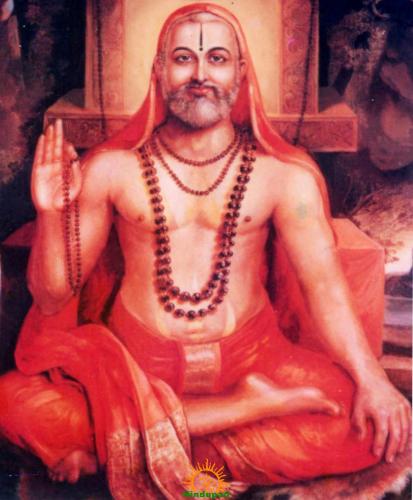
At Mantralayam, a small quantity of earth carries a field of meaning far greater than its physical size. Raghavendra Mrittika, the sacred sand or soil associated with Sri Raghavendra Swamy, is treasured by devotees as a material connection to the guru, his Brindavana and the sacred geography surrounding the Tungabhadra River. Its significance does not arise from mineral composition alone. It arises from provenance, ritual association, collective memory and the conviction that Sri Rayaru’s compassionate presence remains accessible to sincere seekers.
An accurate study of Raghavendra Mrittika must distinguish several kinds of knowledge. Dates, locations, institutions and surviving literary works belong to the historical record. Accounts maintained by the Sri Raghavendra Swamy Matha represent an authoritative institutional tradition. Stories of supernatural protection belong to hagiography, the sacred biography through which a religious community remembers a saint. Personal testimonies belong to lived faith. These categories can be examined together without presenting devotional claims as laboratory findings or dismissing the deep meaning they hold for devotees.
Sri Raghavendra Swamy: saint, scholar and spiritual guide
Sri Raghavendra Swamy was born as Venkatanatha in 1595, according to the official life history maintained by Sri Raghavendra Swamy Matha. He received a rigorous education in grammar, scripture, music and Vedanta, lived through severe material hardship as a householder and accepted sannyasa in 1621 under the name Sri Raghavendra Teertha. Following the passing of Sri Sudheendra Teertha, he became the head of the Matha in 1623.
Popular devotion often remembers him primarily as a compassionate guru, but his intellectual legacy is equally important. His writings include Vedic and Upanishadic expositions, works on the Bhagavad Gita, interpretations of the Brahma Sutras and commentaries on Sri Madhvacharya, Sri Jayateertha and Sri Vyasa Teertha. The Matha’s catalogue of his literary works includes Geeta-Vivrutti, Nyaya Muktavali, Tattva Manjaree and Nyaya-Sudha-Parimala. The last of these is associated with his honorific Parimalacharya. This scholarly background prevents Raghavendra Mrittika from being reduced to an isolated miracle object; it belongs to a tradition shaped by theology, disciplined learning, worship and service.
Sri Raghavendra stood within the Dvaita Vedanta lineage of Sri Madhvacharya. Dvaita affirms the reality of the Supreme Lord, individual souls and the material world while maintaining their enduring distinctions and the dependence of all beings upon Sri Hari. Its technical framework includes pañca-bheda, the five real distinctions involving God, souls and matter. Within this theology, the guru does not replace the Supreme. The guru teaches correct knowledge, models devotion, removes confusion and directs the disciple toward Sri Hari.
This context clarifies the devotional interpretation of mrittika. The sacred earth is not understood as an autonomous power competing with divine grace. It functions as a guru-prasada and a reminder of relationship: Sri Hari is supreme, the guru is a compassionate guide and the devotee responds through faith, ethical conduct, study and service. Treating the soil as a mechanical charm detached from this framework would miss its theological center.
Why Mantralayam is central to the tradition
Mantralayam lies in present-day Kurnool district of Andhra Pradesh, on the banks of the Tungabhadra. The official Matha describes the site as a center of Dvaita Vedanta, bhakti, Vedantic learning and Guru Seva. The Andhra Pradesh State Road Transport Corporation’s pilgrimage information likewise identifies it as an important South Indian pilgrimage center housing Sri Raghavendra Swamy’s Jeeva Samadhi.
The settlement was traditionally known as Manchale. The Matha’s sacred history relates that Sri Raghavendra selected this place after receiving the village through the administration of the Nawab of Adoni. It also records that he first sought the blessing of Manchalamma, the local guardian deity, and chose the site for its inherited sanctity. This narrative situates Mantralayam within a layered sacred landscape rather than portraying the guru’s shrine as disconnected from its earlier religious memory.
According to the Matha’s account, Sri Raghavendra entered Brindavana in 1671 on Shravana Krishna Paksha Dwitiya. He completed worship, taught his disciples, blessed the assembled community and entered meditation while seated in padmasana. Stone slabs were arranged around him, and a copper container holding 1,200 Lakshminarayana shaligramas was placed according to his instructions before the structure was closed and covered with earth. This event is remembered as Brindavana Pravesha or Jeeva Samadhi.
More than 350 years later, devotees continue to approach the Moola Brindavana as a living spiritual center. The assertion that Sri Rayaru remains present and responsive is a confessional belief of the tradition, not a proposition that historical method can independently verify. Its enduring force is nevertheless observable in pilgrimage, recitation, service, family practice, temple networks and the emotional vocabulary through which devotees interpret protection, guidance and hope.
What the word mrittika means
Mṛttikā is a Sanskrit term for earth, soil or clay. English-language devotional sources render it in several ways, including mrittika, mruttika, mrithika and mritika; the source narrative also uses Mritigai. The spellings vary because sounds from Sanskrit and South Indian languages are represented differently in Roman script. In this context, however, the term does not mean every handful of soil found in Mantralayam. It denotes earth connected to an authorized ritual setting and received with reverence.
The distinction between ordinary soil and sacred mrittika is relational rather than merely chemical. In the study of material religion, an object can acquire special status through its origin, contact, consecration, ritual use and connection to an authoritative lineage. Two visually identical samples of earth may therefore have very different meanings: one is common soil, while the other has a recognized ritual provenance linking it to the guru’s sacred center.
The living ritual dimension is visible in the Matha’s record of Mruttika Sangrahana Mahotsava. On Ashada Pournima, observed as Guru Pournima, the pontiff visits the Tulasi garden, performs special worship connected with the mrittika, places it in a Suvarna pallaki and brings it ceremonially to Sri Rayaru’s Sannidhana. The procession shows that collection is not treated as casual removal of dirt. Ritual sequence, authorized agency and public offering establish its sacred context.
Mrittika also links Mantralayam with distant devotional communities. The official Matha refers to numerous Mrittika Vrindavanas established in different parts of India, and its contemporary records document the reconsecration of such shrines. A Mrittika Vrindavana may therefore be understood as portable sacred geography: earth associated with Mantralayam helps a local shrine maintain a material and institutional connection to the Moola Brindavana.
The original account compares Raghavendra Mrittika with the sacred ash associated with Lord Shiva. The comparison is useful at the level of sacred materiality. Both mrittika and vibhuti are outwardly modest substances that can become dense signs of remembrance, blessing and spiritual discipline. Their simplicity teaches that sacred meaning need not depend upon luxury.
The comparison should not erase their differences. Vibhuti has its own Shaiva histories, ritual methods and theological meanings, including associations with purification, impermanence and Shiva. Raghavendra Mrittika belongs to the devotional world of Sri Rayaru, the Mantralayam Brindavana and the Madhva lineage. Respectful unity among Hindu traditions is strengthened when analogies are recognized without treating distinct practices as interchangeable.
The traditional story of the disciple and the sacred sand
The best-known narrative about this mrittika begins during Sri Raghavendra Swamy’s lifetime. A disciple approached the guru and sought his blessing for marriage. Sri Raghavendra blessed him, gave him sacred mrittika and directed him to continue his search for a suitable bride. The gift accompanied the disciple into uncertainty, functioning as both a sign of the guru’s goodwill and a responsibility to act with discernment.
While travelling, the disciple reached a village after nightfall and rested outside a house. There he encountered a giant or hostile supernatural being. The being asked him to move the vessel containing the sacred earth because its presence prevented an intended attack on a newborn child inside the house. In the narrative’s sacred imagination, the mrittika shone like gold and produced an unbearable heat for the being.
The being then offered the disciple a pot filled with gold coins if he would remove the mrittika. The disciple refused the bargain. Rather than protecting only himself or accepting wealth at the cost of another family’s safety, he mixed the sacred earth with water and sprinkled it upon the threatening figure. The story says that the being was released from its afflicted condition and attained liberation from the cycle of birth and death.
The householder learned what had occurred, welcomed the disciple and heard his account. In the version preserved by the source article, the disciple later married the householder’s daughter and lived a contented life. The narrative thus returns to the blessing with which it began: the search for marriage is fulfilled, but only after the disciple demonstrates courage, compassion and freedom from greed.
How an academic reading approaches the miracle account
This episode is most responsibly described as a devotional legend or hagiographic account. No surviving evidence presented with the story allows its supernatural details to be tested as a modern historical report. Calling it hagiography does not mean calling it meaningless. Hagiographic narratives communicate a community’s understanding of holiness by showing how a saint’s grace becomes visible through protection, moral transformation and unexpected resolution.
The mrittika is the narrative’s focal object, but the disciple’s character is indispensable. He does not surrender to fear, accept a bribe or ignore danger to a vulnerable infant. He acts for another household and seeks the release of the hostile being rather than its annihilation. The sacred sand consequently signifies protection joined with compassion, not violence driven by revenge.
The pot of gold sharpens the story’s ethical test. Material gain is offered in exchange for complicity with harm. The disciple’s refusal dramatizes a foundational principle of dharmic conduct: a blessing cannot be separated from responsibility. A person who invokes the guru while exploiting another person would contradict the very grace being invoked.
The marriage at the end is also more than a reward delivered by an enchanted object. It completes a moral arc. The disciple begins by asking for help with a personal need; he finds fulfilment after protecting life, rejecting greed and showing compassion. The legend therefore presents grace and human action as cooperative rather than opposed. Blessing does not eliminate the need for character.
The hostile being’s liberation adds another layer. The story does not end merely with an enemy’s defeat. Even the threatening figure is released from a destructive state. This movement from danger to liberation reflects a wider dharmic preference for transformation: wrongdoing must be stopped, yet the deepest resolution restores order rather than perpetuating hatred.
Mrittika as material theology
From within the devotional tradition, mrittika carries Sri Rayaru’s anugraha, or grace. From an academic, descriptive perspective, it is a ritual medium that joins person, place, lineage and memory. These interpretations answer different questions. The first explains what the sacred earth means to a believer; the second explains how a modest material object sustains religious identity across distance and time.
The mrittika can also be described as an indexical sacred object. An index derives meaning from a real connection rather than resemblance alone: smoke points to fire, while a footprint points to someone’s presence. In a comparable ritual sense, authenticated mrittika points back to Mantralayam because its meaning depends upon origin and authorized association. It allows a devotee far from Andhra Pradesh to remember the Moola Brindavana through a tangible connection.
This framework explains why random soil should not be passed off as Raghavendra Mrittika. Sacred provenance is not a marketing label. It depends upon trust, recognized custodianship and ritual context. Commercial exaggeration, fabricated authenticity or unauthorized extraction would weaken the very relationship the object is meant to embody.
The source account says that Sri Raghavendra continues to fulfil the reasonable needs of devotees and help them through difficulties. The word reasonable is ethically significant. Devotion is not a license for greed, domination or harm. A prayer for health, clarity, livelihood, education, family stability or courage can be integrated with dharmic responsibility; a demand built upon injustice cannot be sanctified merely by placing a sacred object beside it.
For a family waiting through illness, debt, an examination, uncertainty about marriage or a season of grief, a small container of mrittika may create a disciplined pause. Hands become still, a mantra is remembered, anxiety is named and the next responsible action becomes easier to see. The emotional value of such a moment can be genuine even when no supernatural mechanism is asserted. Ritual can organize attention, preserve hope and connect private distress with an inherited community of care.
This is one reason sacred objects endure in technologically advanced societies. They address dimensions of experience that technical systems do not exhaust: belonging, moral purpose, grief, gratitude and the need to place personal struggle within a larger story. Raghavendra Mrittika does not need to compete with reason in order to perform this religious and emotional role.
Respectful handling and home practice
Devotees seeking authentic mrittika should obtain guidance from Sri Raghavendra Swamy Matha or a recognized branch rather than collecting soil independently or relying upon an unverified seller. Not every shrine follows an identical procedure, and local archakas may distinguish between mrittika intended for a Brindavana, a sealed devotional keepsake or another ritual purpose. Verification protects both the devotee and the integrity of the tradition.
When mrittika is received for personal devotional keeping, it may be placed in a clean, dry and clearly identified container in the home’s prayer area. It should be protected from moisture, contamination, careless handling and access by small children or pets. It should not be scattered as decoration, treated as a curiosity, mixed indiscriminately with household products or discarded with ordinary waste.
A restrained home observance may consist of washing the hands, sitting quietly before the prayer space, remembering Sri Hari and Sri Rayaru, reciting an established prayer and reflecting upon one concrete duty that requires attention. The mrittika may remain sealed throughout. This approach honors its symbolic presence without inventing a compulsory ritual or making claims that the tradition itself has not universally prescribed.
The mantra preserved in the source may be recited exactly as written:
OM SRI GURU RAGHAVENDRAYA NAMAHA
No single number of repetitions should be presented as universally mandatory without reference to a recognized lineage or qualified guide. In devotional practice, steadiness, humility and ethical follow-through matter more than competitive counting. A brief daily recitation performed with attention can be more meaningful than a large number repeated mechanically.
The traditional legend describes mrittika mixed with water and used for sprinkling. Such narrative detail should not automatically be converted into a universal domestic instruction. Ritual use varies, and water can also damage stored material or create microbial contamination. Any prescribed ceremonial application should therefore follow current guidance from an authorized Matha representative.
An essential health and safety distinction
The source article goes beyond the legend and claims that consuming the sand in water can remove health problems. That statement is a devotional health claim, not an evidence-based medical conclusion. No credible clinical evidence cited by the source establishes that soil cures disease, and no sacred substance should be described as a guaranteed treatment for every medical condition.
Soil can contain bacteria, parasites, fungi, animal or human waste, pesticides, fertilizers and toxic substances. MedlinePlus guidance on swallowing dirt notes risks including contamination, abdominal symptoms, constipation and intestinal blockage. The World Health Organization also explains that contaminated soil can transmit parasitic infections when infective eggs are ingested.
For that reason, Raghavendra Mrittika should not be swallowed, added to drinking water or used as medicine. Particular care is appropriate for children, pregnant people, older adults and anyone with a weakened immune system. Its religious dignity does not establish food safety, sterility, dosage or therapeutic efficacy.
If soil has been swallowed accidentally and there is concern about the amount, source or possible contamination, advice should be obtained from a local poison-information service or qualified clinician. Severe abdominal pain, persistent vomiting, breathing difficulty, altered consciousness or other serious symptoms require urgent medical assessment. Devotional practice must never delay emergency care.
Faith and medicine need not be framed as enemies. A devotee may pray for courage, family support and clarity while also consulting clinicians, following treatment, obtaining diagnostic tests and observing public-health guidance. In the same way, prayers concerning debt, legal trouble or psychological distress should accompany competent financial, legal or mental-health assistance when those forms of help are needed.
The pilgrimage experience and sacred geography
For many pilgrims, the emotional force of mrittika becomes clearer at Mantralayam. The journey, the Tungabhadra landscape, collective recitation, waiting for darshana and the sight of the Brindavana place the individual within a centuries-old pattern of devotion. A person may arrive carrying a private burden and discover that countless others have also come with illness, gratitude, uncertainty, bereavement or hope. Shared vulnerability is part of the shrine’s social power.
The Matha’s account that Sri Raghavendra first honored Manchalamma offers an important model of sacred etiquette. A major institution can acknowledge the local guardian and the inherited sanctity of place rather than erasing what preceded it. This layered memory encourages humility toward regional traditions and reminds pilgrims that a sacred center is sustained by communities, landscapes and histories as well as monumental structures.
Reverence for sacred earth also carries an ecological implication. If soil is capable of bearing spiritual meaning, it should not be treated as an inexhaustible souvenir. Unauthorized digging, littering and careless extraction contradict respect for the kshetra. Cleanliness, water conservation, care for the Tulasi garden and protection of the Tungabhadra environment are practical extensions of devotion to Mantralayam’s sacred geography.
Unity among Dharmic traditions without erasing difference
Hindu, Buddhist, Jain and Sikh traditions possess distinct scriptures, metaphysical teachings, institutions and ritual vocabularies. Yet communities within all four traditions recognize that disciplined remembrance, ethical conduct, sacred places, teachers and material practices can shape human character. Raghavendra Mrittika can therefore invite respectful comparative reflection without being detached from its specifically Madhva and Hindu setting.
Genuine unity does not require every sacred object to mean the same thing. It requires the ability to honor another community’s practice without ridicule, appropriation or forced equivalence. The distinctive meaning of Raghavendra Mrittika remains intact when devotees also recognize the dignity of Buddhist, Jain, Sikh, Shaiva, Shakta and other Vaishnava paths. Diversity becomes a discipline of mutual respect rather than a reason for rivalry.
The disciple legend supports this wider ethic. Its movement is from fear toward courage, from temptation toward integrity, from danger toward protection and from hostility toward liberation. These moral directions can be appreciated across Dharmic communities even when interpretations of guru, grace, soul and liberation differ.
Frequently asked questions about Raghavendra Mrittika
Is every handful of soil from Mantralayam sacred mrittika? No. Within ritual practice, authorized provenance and context matter. Visitors should not dig at the site or assume that ordinary roadside soil has the status of Matha-associated mrittika.
Is Raghavendra Mrittika the same as Shiva vibhuti? No. The two can be compared as sacred materials, but their preparation, lineage, symbolism and ritual use are different. Each should be handled according to its own tradition.
Does possession of mrittika guarantee a miracle? No outcome can be guaranteed. Reports of miracles belong to devotional testimony and hagiography. Faith may provide hope and moral strength, but it does not create a contractual entitlement to a particular result.
Must mrittika be consumed to receive Sri Rayaru’s blessing? No. It should not be consumed. Prayer, remembrance, study, darshana, seva, ethical living and responsible action do not require swallowing soil.
Can mrittika replace medical, legal or financial help? No. It is a devotional object, not a diagnostic instrument, medicine, legal remedy or financial plan. Religious practice can accompany professional assistance but should not delay it.
Can devotees outside India maintain a connection to Mantralayam? Yes. Recognized Mrittika Vrindavanas, local Raghavendra Matha branches, established prayers, study of Sri Rayaru’s works and service to others can sustain the connection. Authenticity should be confirmed through official or recognized institutional channels.
Key terms in the Raghavendra tradition
Mrittika: Earth, clay or soil; here it means sacred earth associated through recognized ritual provenance with Sri Raghavendra Swamy and Mantralayam.
Brindavana: In this context, the sacred enclosure associated with a Madhva ascetic. The Moola Brindavana at Mantralayam is the central shrine of Sri Raghavendra Swamy.
Jeeva Samadhi: The tradition’s description of a realized saint entering profound meditative absorption while living. Sri Raghavendra’s Brindavana Pravesha in 1671 is understood by devotees in this framework.
Dvaita Vedanta: The Vedantic school systematized by Sri Madhvacharya, affirming the reality of Sri Hari, individual souls and the world, together with their enduring distinctions and dependence upon the Supreme.
Hagiography: Sacred biography written or transmitted to reveal exemplary holiness. It may preserve historical memory, theological interpretation and miracle narratives, but its claims must be identified according to genre rather than treated automatically as modern documentary evidence.
Research basis: The disciple narrative and comparison with sacred ash derive from the detailed Raghavendra Mrittika source article. Biographical dates, Brindavana tradition, literary works, the Mruttika Sangrahana ceremony and Mrittika Vrindavanas were checked against materials published by Sri Raghavendra Swamy Matha, Mantralayam. Medical cautions were checked against public-health information from MedlinePlus and the World Health Organization. Promotional, donation and commercial material has been omitted.
Raghavendra Mrittika is most fully understood neither as ordinary dirt nor as a guaranteed instrument of supernatural control. It is sacred earth embedded in a theological, ritual and ethical relationship. Its deepest message is carried by the disciple who refuses wealth obtained through harm, protects vulnerable life and becomes an agent of liberation. When handled with reverence, factual clarity and responsible judgment, the mrittika can remain what devotees cherish it as: a humble material reminder of Sri Rayaru’s grace, Mantralayam’s sacred presence and the obligation to transform faith into compassionate action.
Inspired by this post on Hindu Pad.









Leave a Reply
You must be logged in to post a comment.