
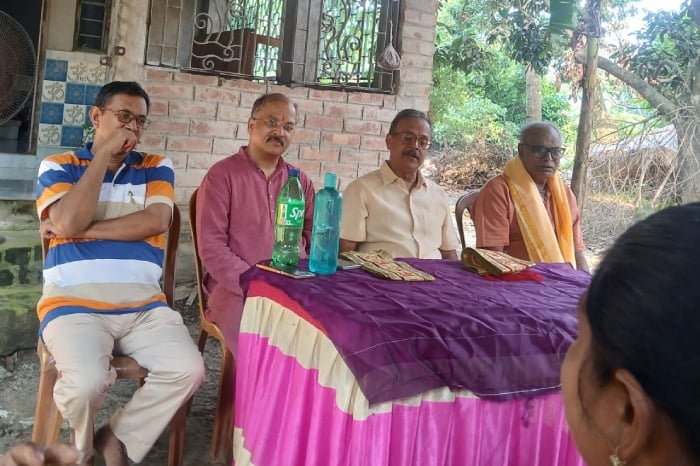
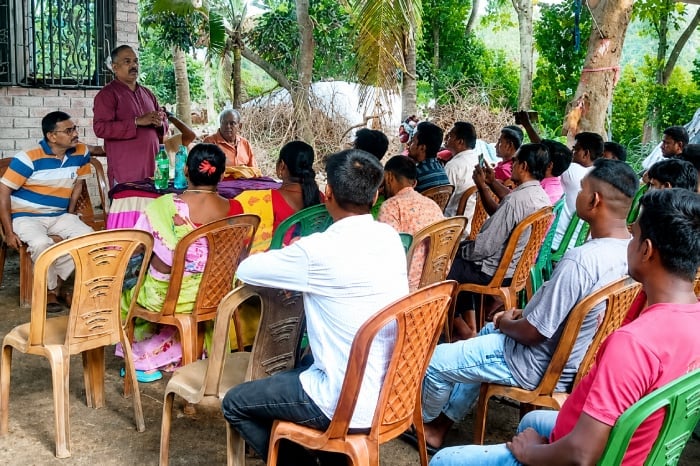
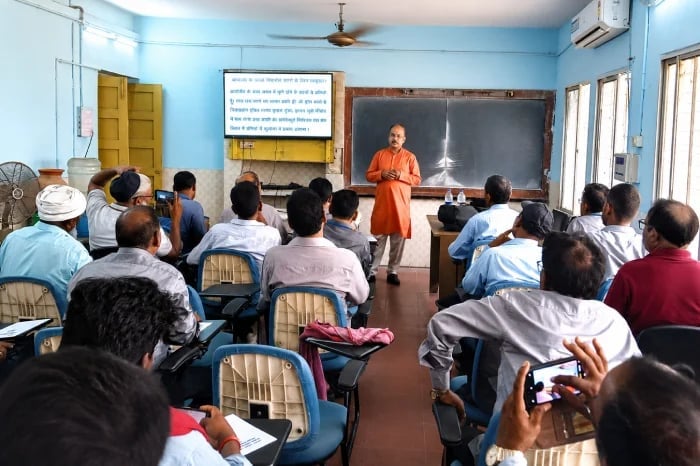
North 24 Parganas, West Bengal, hosted a ‘Hindu Rashtra-Jagruti Meeting’ convened by the Hindu Rashtra Samanvay Samiti. According to the supplied report, the central purpose was to clarify the committee’s objectives and outline a path forward for a Hindu Rashtra. Even in brief form, this emphasis is significant: it moves the discussion from a general civilizational aspiration toward questions of organization, responsibility, public education, and sustained community work.
The available source summary does not identify the meeting’s date, precise venue, attendance, speakers, adopted resolutions, or implementation timetable. Academic accuracy therefore requires a clear boundary between reported facts and analytical interpretation. The confirmed core is that the meeting took place in North 24 Parganas, was organized under the Hindu Rashtra Samanvay Samiti, and addressed both objectives and future direction. The wider analysis below explains how such objectives can be translated into a coherent, peaceful, measurable, and constitutionally responsible program without inventing details absent from the source.
Why the North 24 Parganas setting matters
North 24 Parganas is not a socially or geographically uniform district. Its official district profile identifies five subdivisions, while the district administration describes a landscape that includes densely urbanized and industrial areas, agricultural plains, and riverine zones. It also adjoins Kolkata and shares an international boundary with Bangladesh. A cultural-awareness movement operating in such a district therefore encounters varied languages of public life, livelihoods, infrastructure, local institutions, and community concerns. A single standardized program would be less effective than locally adapted initiatives built around the conditions of each subdivision.
The meeting can also be understood within Bengal’s long culture of public associations, religious assemblies, literary circles, reform initiatives, neighborhood committees, and voluntary organizations. A samiti or sabha often does more than host speeches. At its best, it creates a forum in which inherited values are interpreted, collective concerns are organized, and individuals discover practical roles. The importance of the Hindu Rashtra-Jagruti Meeting therefore lies not only in what may have been said on the day, but in whether the gathering can generate disciplined work after the event.
The subject also carries an emotional dimension. For a family trying to pass a festival tradition to younger generations, a volunteer preserving a neglected shrine, a teacher explaining the philosophical diversity of Hindu Dharma, or a young person seeking a meaningful connection with civilizational heritage, cultural continuity is not an abstract policy category. It is experienced through memory, language, worship, music, food, service, and relationships. Yet emotional energy becomes socially constructive only when it is joined to factual knowledge, ethical restraint, competent organization, and respect for the dignity of others.
Defining Hindu Rashtra with intellectual precision
Hindu Rashtra is not a self-explanatory term. In contemporary discussion, it may refer to civilizational identity, the public recognition of Hindu heritage, governance informed by Dharma, institutional reform, constitutional change, or a more explicitly religious conception of the state. These meanings are not identical. A serious movement must therefore define the term affirmatively: what institutions it proposes, which rights it guarantees, how authority would be restrained, how diversity would be protected, and how every citizen’s dignity would be secured. Ambiguity allows supporters and critics to project incompatible meanings onto the same phrase.
A constructive Dharmic interpretation would treat Hindu Rashtra as an ethical and civilizational framework rather than a license for exclusion. Such a framework would emphasize satya, seva, self-discipline, justice, accountable power, protection of cultural inheritance, freedom of conscience, care for vulnerable people, and responsible stewardship of nature. It would also recognize that Hindu civilization has historically contained multiple sampradayas, philosophical schools, ritual systems, languages, regional customs, and modes of worship. Unity in this setting cannot require uniformity.
Broader organizational context supports the emphasis on coordination. In its coverage of the 2024 Vaishvik Hindu Rashtra Mahotsav, Hindu Janajagruti Samiti reported that participating organizations intended to work through the Hindu Rashtra Samanvay Samiti throughout the year and develop a coordinated Hindu ecosystem. That earlier report does not establish the specific resolutions of the North 24 Parganas meeting, but it helps explain why samanvay—coordination—appears central to the committee’s institutional identity.
A technical reading of the committee’s possible objectives
The first necessary objective is cultural literacy. Awareness cannot be reduced to slogans, forwarded messages, or selective historical anecdotes. A credible Dharma-education program would distinguish scripture from later commentary, history from collective memory, law from political opinion, and verifiable evidence from speculation. It could introduce the Vedas, Upanishads, Itihasas, Puranas, darshanas, bhakti traditions, temple culture, regional literature, and modern reform movements through age-appropriate and multilingual materials. Bengali-language resources would be essential in Bengal, while translations could widen access without weakening local cultural expression.
A second objective is institutional coordination. Hindu society includes temples, ashrams, educational trusts, cultural organizations, service groups, professional associations, neighborhood committees, and informal volunteer networks. These bodies frequently work in isolation, duplicate efforts, or depend heavily on a few individuals. The Hindu Rashtra Samanvay Samiti can add value by mapping capabilities, connecting complementary institutions, maintaining reliable contact channels, and establishing procedures for joint action. Coordination should preserve organizational autonomy while enabling cooperation on shared priorities.
A third objective is civic and legal literacy. Participants need an accurate understanding of constitutional rights, administrative procedures, lawful assembly, public representations, heritage regulations, trust governance, police complaints, information requests, and judicial remedies. Legal awareness reduces two opposite risks: passive resignation when legitimate rights are affected and reckless action based on incorrect assumptions. A legally competent movement documents facts, preserves evidence, uses established institutions, and distinguishes an allegation from a verified finding.
A fourth objective is seva-centered social credibility. Cultural advocacy becomes more persuasive when communities experience it through tutoring, medical assistance, disaster preparedness, heritage conservation, support for elderly residents, environmental work, food relief, or help for families in distress. Seva should not be conditional on ideological agreement or religious identity. Unconditional service demonstrates that Dharma is not merely defended in speech; it is embodied through compassion, competence, and responsibility.
A fifth objective is principled Dharmic unity. The blog’s larger purpose—strengthening bonds among Hinduism, Buddhism, Jainism, and Sikhism—requires respectful cooperation without absorbing distinct traditions into a single institutional identity. Common projects may include manuscript preservation, heritage documentation, youth ethics programs, non-violence initiatives, environmental stewardship, protection of places of worship, and scholarship on historical interaction. Cooperation is strongest when every tradition speaks in its own voice and enters partnership as an equal.
A sixth objective is leadership development across generations and social backgrounds. Durable community work requires meaningful participation by women, young adults, scholars, priests, artisans, professionals, rural volunteers, and people with organizational experience. Youth engagement should offer genuine responsibility rather than symbolic visibility. Mentoring, documented procedures, rotating roles, and succession planning prevent a movement from becoming dependent on a single personality or age group.
Turning a meeting into a durable institution
A practical path forward begins with a theory of change. In technical terms, the committee should distinguish inputs, activities, outputs, outcomes, and long-term impact. Inputs include volunteers, knowledge, venues, partnerships, and modest financial resources. Activities may include study circles, legal-awareness sessions, heritage projects, and seva. Outputs are directly countable, such as sessions conducted or records digitized. Outcomes concern changes in knowledge, participation, institutional cooperation, and public trust. The desired impact is a more informed, ethical, cohesive, and culturally confident society.
Governance must be designed before expansion. A written charter should define the committee’s mission, decision-making process, membership expectations, financial controls, conflict-of-interest rules, safeguarding standards, dispute-resolution mechanism, and prohibition on violence or discriminatory conduct. A responsibility matrix can identify who approves, implements, reviews, and reports each activity. Meeting minutes and periodic summaries should record decisions without exposing sensitive personal information. Transparency is not an administrative burden; it is the infrastructure of trust.
Local planning should begin with a stakeholder and needs map. Urban and industrial areas may require programs suited to working professionals, students, apartment communities, and digital audiences. Agricultural and riverine areas may benefit from mobile sessions, partnerships with local institutions, disaster-readiness training, and programs scheduled around livelihood patterns. Each local unit should conduct listening meetings before selecting priorities. This approach prevents a central committee from mistaking its assumptions for community needs.
A balanced program portfolio could contain five connected streams: Dharma and heritage education; temple and cultural-institution capacity building; civic and legal literacy; seva and community resilience; and research, documentation, and communication. Each stream should have a trained coordinator, a defined audience, a written curriculum or operating procedure, and an evaluation method. Pilot programs should be tested on a small scale before district-wide replication.
Communication requires particular discipline. Every public claim should be traceable to a primary document, official record, named eyewitness, or clearly identified secondary source. Images and videos should be checked for date, location, edits, and missing context before circulation. Correcting an error publicly should be treated as evidence of integrity, not weakness. Communications should distinguish the committee’s formal position from a volunteer’s personal opinion and should be available in clear Bengali as well as other locally useful languages.
Data governance is equally important. Volunteer databases, photographs, phone numbers, attendance lists, and reports may contain personal information. The committee should collect only what is necessary, obtain informed consent, restrict access by role, secure digital records, establish retention periods, and provide a process for correction or deletion. Children’s information requires especially strong safeguards. A cultural movement loses moral authority if it treats the privacy of its own participants casually.
Measurement should focus on quality as well as volume. Attendance counts and social-media reach are useful but insufficient. Better indicators include knowledge gained before and after a course, volunteer retention, representation across age and gender, the number of institutions collaborating, response time during community service, participant satisfaction, documented corrections of misinformation, and the percentage of projects completed within agreed budgets and schedules. Independent review can make the findings more credible.
Constitutional and ethical guardrails
Any contemporary discussion of Hindu Rashtra must engage India’s constitutional order directly. The official Constitution of India describes India in the Preamble as a sovereign socialist secular democratic republic. Article 14 guarantees equality before the law. Article 19 protects specified freedoms, including speech, peaceful assembly, and association, subject to constitutionally permitted restrictions. Articles 25 and 26 protect freedom of conscience, religious practice, and the management of religious affairs within stated limits. Article 29 protects cultural interests, while Article 51A calls upon citizens to promote harmony and preserve India’s composite cultural heritage.
These provisions create both civic space and civic responsibility. Citizens and organizations may advocate ideas, form associations, hold peaceful meetings, preserve traditions, and seek lawful policy change. At the same time, freedom does not erase duties concerning public order, the rights of others, or equal protection. A meeting devoted to Hindu interests is fully capable of framing those interests through constitutional participation, factual advocacy, and peaceful organization.
If Hindu Rashtra is intended as a proposal for formal constitutional change, its advocates must explain the institutional route with precision. Public mobilization can influence democratic debate, but it cannot substitute for constitutional procedure, elected institutions, judicial scrutiny, or the equal application of law. If the phrase instead denotes cultural renewal and ethical governance within the current framework, that distinction should be stated clearly. Precision reduces unnecessary polarization and permits substantive evaluation.
Equal citizenship is a decisive test. Any credible Dharmic public ethic should protect an individual’s life, property, conscience, worship, speech, and access to public institutions regardless of religious identity. Collective pride need not depend on collective hostility. Hindu civilizational confidence is strengthened—not diminished—when it rejects dehumanization, collective blame, coercion, and vigilante action. Dharma-oriented advocacy should therefore combine firmness about lawful rights with restraint, proportionality, and compassion.
Constructive disagreement should also be treated as a resource. Scholars may question historical claims, citizens may challenge policy proposals, and members of Dharmic traditions may interpret Hindu Rashtra differently. A mature committee responds with evidence and reasoned argument rather than personal attacks. Structured debates, published questions and answers, external peer review, and correction protocols can transform criticism into institutional learning.
Dharmic unity without erasing difference
Hinduism, Buddhism, Jainism, and Sikhism have interacted across centuries, but they are not interchangeable. They possess distinct scriptures, doctrines, sacred histories, institutions, authorities, and community identities. Even apparently shared terms such as Dharma, karma, liberation, meditation, and non-violence may carry different technical meanings. Respectful unity begins by learning those differences rather than treating them as inconvenient details.
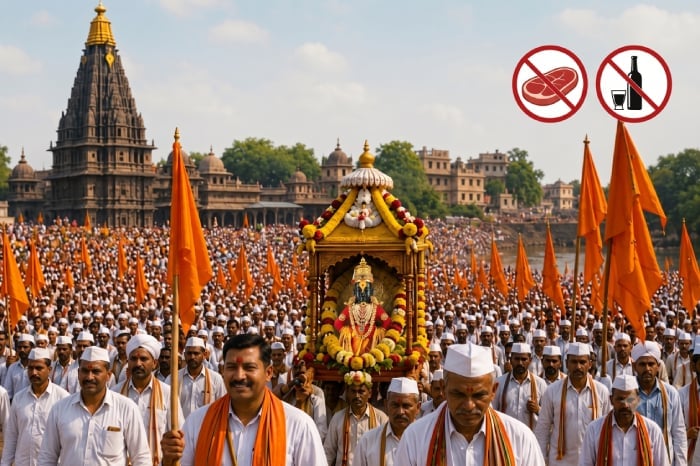
Practical cooperation can nevertheless be substantial. Joint heritage inventories can document temples, monasteries, Jain sites, gurdwaras, manuscripts, oral histories, music, and local art. Youth programs can compare ethical teachings without declaring them identical. Service networks can collaborate during floods, cyclones, health emergencies, and periods of economic hardship. Academic forums can explore shared history while inviting scholars from each tradition to review how their communities are represented.
This approach gives Hindu unity a generous civilizational horizon. It allows Hindu organizations to preserve their own traditions confidently while recognizing the dignity and autonomy of neighboring Dharmic paths. The result is neither a diluted identity nor an artificial merger, but a federation of respect built through scholarship, service, and reciprocal protection.
Risks that any serious movement must manage
Several organizational risks deserve explicit attention: mission drift, partisan capture, personality-centered leadership, unverified claims, opaque finances, exclusionary rhetoric, volunteer burnout, weak safeguarding, careless handling of personal data, and competition among partner organizations. A living risk register should identify each threat, estimate its likelihood and impact, assign an accountable person, and specify preventive and corrective measures. Periodic review is essential because risks change as a network grows.
Polarization presents a distinct challenge. Cultural concerns often involve grief, fear, anger, or memories of historical injury. Those emotions deserve serious attention, but they can also make communities vulnerable to rumors and sweeping generalizations. Facilitators should therefore be trained in conflict de-escalation, evidence assessment, and responsible public speech. Where a possible offence or threat is reported, the appropriate response is documentation and referral to lawful authorities—not retaliation or collective accusation.
Institutional independence must also be protected. Members may hold political preferences, but a coordination body should disclose formal affiliations and avoid allowing short-term electoral goals to replace its stated cultural and social mission. Clear rules on endorsements, campaign activity, use of organizational resources, and conflicts of interest help preserve credibility across changing political conditions.
A phased roadmap for North 24 Parganas
During an initial ninety-day foundation phase, the committee could adopt its charter and code of conduct, map participating institutions, document community needs, establish legal and financial review, create a consent-based communications directory, and define baseline indicators. Listening sessions across different subdivisions would reveal whether residents prioritize education, heritage preservation, temple governance, youth engagement, legal literacy, social service, or another locally grounded concern.
During a three-to-twelve-month pilot phase, a small number of carefully designed programs could be tested. These might include a Bengali Dharma-literacy course, a heritage-documentation project, a lawful civic-participation workshop, a youth seva initiative, and an inter-Dharmic scholarly dialogue. Every pilot should have written learning goals, trained facilitators, participant safeguards, an operating budget, and a post-program review. Programs that do not achieve their goals should be revised rather than defended for symbolic reasons.
During a twelve-to-twenty-four-month consolidation phase, effective pilots could be adapted for additional localities. Expansion should depend on evidence of quality, not merely demand for visibility. The committee could publish an annual public report covering activities, audited finances, outcomes, lessons, complaints received, corrections issued, and priorities for the following year. An external advisory group drawn from law, education, history, social service, technology, and Dharmic institutions could review standards without controlling the committee’s mission.
A concise public dashboard would make progress legible. It could track trained volunteers, active partnerships, educational completion rates, heritage records created, service beneficiaries, response times, participant diversity, verified corrections, grievances resolved, and program costs. Metrics should never turn people into mere numbers, but they can expose the distance between aspiration and performance. What is measured thoughtfully is more likely to improve.
What meaningful success would look like
The success of the Hindu Rashtra-Jagruti Meeting should not be judged by applause, slogans, photographs, or social-media impressions alone. Meaningful success would appear in better-informed families, ethically trained volunteers, stronger cultural institutions, preserved records, more capable youth, transparent governance, lawful defense of rights, reliable seva, and respectful cooperation among Dharmic traditions. It would also be visible in the committee’s willingness to correct errors, hear criticism, protect dissent, and apply its ethical standards consistently.
The meeting in North 24 Parganas therefore represents a potentially important starting point rather than a completed achievement. Its reported focus on objectives and a path forward raises the right organizational question: how can cultural conviction become durable public responsibility? The strongest answer lies in knowledge rather than rumor, coordination rather than fragmentation, service rather than spectacle, and constitutional participation rather than coercion.
Understood in this way, Hindu Rashtra becomes a demanding ethical proposition. It asks institutions to embody the Dharma they invoke, leaders to accept accountability, communities to protect cultural memory without denying equal dignity, and Dharmic traditions to cooperate without surrendering their distinctiveness. If the Hindu Rashtra Samanvay Samiti grounds its future work in these principles, the Bengal meeting can contribute to a form of Hindu unity that is confident, disciplined, compassionate, and socially constructive.
Inspired by this post on Hindu Jagruti Samiti.





Leave a Reply
You must be logged in to post a comment.