
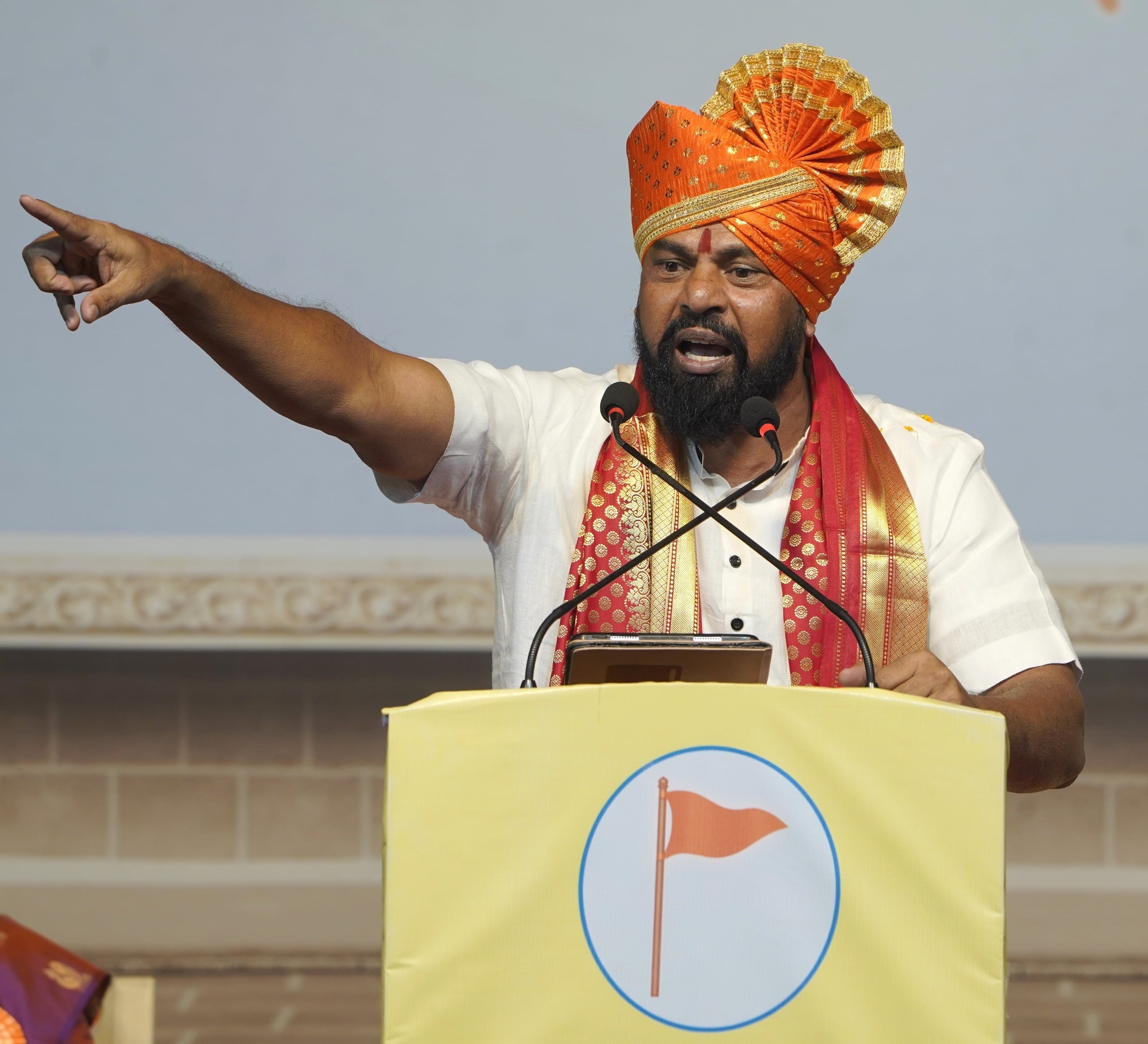
The acquittal of MLA T. Raja Singh by a special court in Telangana in a 2022 case concerning alleged remarks about Prophet Mohammad is more than a short courtroom update. It is a reminder that criminal law, especially in cases involving religious sentiment, public speech, and political controversy, depends on evidence rather than public pressure, media noise, or ideological expectation.
According to the available report, the court acquitted Raja Singh after finding that the prosecution had failed to substantiate the charges. In plain legal terms, the case did not meet the evidentiary threshold required for conviction. The verdict therefore turned not on a broad political endorsement of any speech, but on the narrower and more technical question that every criminal court must answer: whether the allegations were proved through legally acceptable evidence.
Raja Singh welcomed the ruling and described it as a victory for truth, justice, and the rule of law. Such a response was expected from a public figure who had faced prosecution in a highly sensitive matter. Yet the larger significance of the judgment lies in the institutional principle it reflects: courts are not meant to decide cases by public emotion; they are meant to decide them by law, procedure, and proof.

In India, cases involving alleged religiously offensive speech often sit at the intersection of constitutional freedom, public order, and community dignity. Article 19(1)(a) of the Constitution protects freedom of speech and expression, while Article 19(2) permits reasonable restrictions in the interests of public order, decency, morality, and other constitutionally recognized concerns. This balance is delicate because democratic society must protect open expression while also preventing speech that can deliberately inflame social tensions.
The Telangana court’s ruling, as reported, reinforces a basic criminal-law safeguard: allegation is not proof. A prosecution must establish the ingredients of the alleged offence through admissible material, credible testimony, procedural compliance, and a coherent chain of evidence. Where that burden is not discharged, acquittal is not an exception to justice; it is part of justice itself.
This distinction matters because public controversies frequently move faster than the judicial process. A video clip, a public statement, a political reaction, or a social media campaign can create immediate conclusions in the public mind. A court, however, must move differently. It must ask what was said, in what context it was said, whether the accused can legally be connected to the alleged act, whether the statutory requirements are satisfied, and whether the prosecution’s evidence survives scrutiny.
For citizens observing such cases, the emotional pull can be intense. Religious identity is not an abstract category for millions of people; it is tied to memory, belonging, family life, worship, and inherited dignity. When allegations involve remarks about revered figures, reactions can become deeply personal. At the same time, a society governed by law cannot allow hurt, anger, or political mobilization to replace the discipline of evidence.

The verdict therefore should be understood with precision. An acquittal means that the prosecution failed to prove the case to the required legal standard. It does not automatically settle every ethical, social, or political debate surrounding public speech. Courts decide legal culpability; society still carries the responsibility of encouraging restraint, mutual respect, and peaceful disagreement.
That responsibility is especially important in a civilizational setting as diverse as India. Hinduism, Buddhism, Jainism, and Sikhism have long preserved different paths of inquiry, discipline, devotion, renunciation, service, and wisdom. Their shared dharmic spirit does not require uniformity; it asks for self-restraint, responsibility, and respect for the dignity of others. In a plural society, these values become essential not only in temples, monasteries, gurudwaras, and homes, but also in political speech and public conduct.

Telangana, and particularly Hyderabad’s public sphere, has a long history of cultural, religious, and political complexity. Legal disputes involving speech can therefore carry consequences beyond the individual accused. They can affect community relations, policing priorities, political narratives, and public trust in institutions. This is why courts must remain methodical, and why political actors must recognize the weight of their words.
The case also highlights the importance of due process in Indian politics. Public representatives are not above the law, but neither are they outside its protections. When an MLA, activist, journalist, religious leader, or ordinary citizen faces criminal prosecution, the same principles must apply: proper investigation, fair trial, credible evidence, and judicial independence. Selective outrage cannot be the measure of justice.

From a technical legal perspective, prosecutions in speech-related matters often face difficulties around intent, context, authenticity, circulation, and causation. A court may need to consider whether a statement was accurately reproduced, whether it was made by the accused, whether it was edited or circulated by others, whether it met the legal threshold for an offence, and whether witnesses and records support the prosecution’s theory. These questions are not procedural formalities; they are safeguards against wrongful conviction.
The acquittal of T. Raja Singh therefore belongs within a broader debate about the rule of law in India. A mature legal culture must be able to hold two ideas together: speech that wounds religious harmony should be treated with seriousness, and criminal punishment should follow only when the law is clearly proved. Weak evidence cannot be strengthened by public anger, just as serious allegations cannot be dismissed merely because an accused person is politically influential.

There is also a lesson here for public discourse. Democratic debate becomes healthier when legal outcomes are discussed without exaggeration. Supporters of Raja Singh may view the verdict as vindication, while critics may continue to raise concerns about political rhetoric and communal sensitivity. Both responses exist in democratic society, but the court’s finding must be described accurately: the prosecution did not substantiate the charges in this case.
For ordinary readers, the case offers a practical reminder about patience. In moments of controversy, immediate judgment can feel satisfying, but legal truth often emerges through slower examination. Documents, witnesses, procedural records, and judicial reasoning matter. A society that values justice must learn to respect this slower rhythm, even when the subject is emotionally charged.

The judgment also underlines why India’s courts remain central to managing conflicts in a diverse democracy. When disputes involve religious sentiment and political speech, street-level escalation can damage social trust. Judicial resolution provides a constitutional path, allowing grievances to be tested by law rather than by force, intimidation, or retaliatory mobilization.
At its best, the rule of law protects everyone: the complainant who seeks accountability, the accused who demands fairness, and the wider public that depends on peaceful order. This is why acquittals and convictions must both be read within the same constitutional ethic. Justice is not measured by whether a judgment satisfies one side’s emotion; it is measured by whether the process remains fair, reasoned, and faithful to law.

The Telangana court’s decision in the Raja Singh case will likely continue to be discussed in political and legal circles. Its most durable message, however, is straightforward. In a democratic republic, even the most controversial allegations must be proved. Where the prosecution fails to substantiate its case, acquittal is not a weakness of the system. It is evidence that the system still recognizes the difference between accusation and conviction.
That distinction is vital for India’s future. A society rooted in dharma, constitutionalism, and civilizational diversity must protect religious dignity while refusing to abandon legal discipline. The path forward is not reckless speech, selective prosecution, or communal suspicion. It is a stronger commitment to truth, restraint, justice, and peaceful coexistence under the rule of law.
Inspired by this post on Hindu Jagruti Samiti.









Leave a Reply
You must be logged in to post a comment.