

The Ram Temple donation theft row has become one of the most sensitive public controversies surrounding the Shri Ram Janmabhoomi Mandir in Ayodhya because it touches a question deeper than bookkeeping: how should sacred public trust be protected when millions of devotees contribute with faith, memory, sacrifice, and emotion?
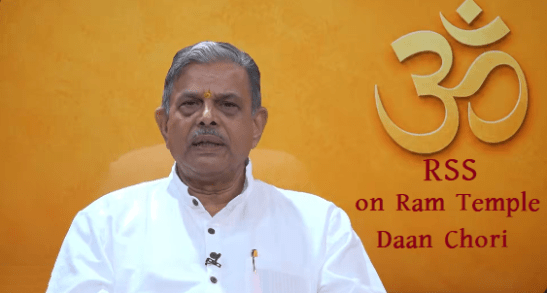
Reports published in early July 2026 said that the RSS responded to the controversy by describing the alleged theft as deeply painful for Ram devotees and by calling for strict action against those found guilty. The same reports noted that RSS general secretary Dattatreya Hosabale urged patience, restraint, and Hindu unity, while also asking that weaknesses in temple management be corrected. That combination of accountability and social calm is important because the issue is not only legal; it is institutional, ethical, and civilisational.
The public question being asked about RSS veteran Champat Rai must therefore be framed with care. In any democratic and dharmic understanding of justice, punishment cannot be based on anger, political pressure, or social media verdicts. It must be based on evidence, due process, defined responsibility, and the findings of the competent investigating authorities. If wrongdoing is proved, strict legal punishment should follow. If negligence or administrative failure is proved, institutional consequences should follow. If neither is proved, reputational punishment should not be substituted for justice.
Champat Rai’s name has appeared in public discussion because of his senior role in the Shri Ram Janmabhoomi Teerth Kshetra Trust and because reports stated that police recorded his statement after he offered to resign on moral grounds. This is a significant development, but it does not by itself establish criminal guilt. Resignation on moral responsibility can indicate acceptance of institutional accountability, yet criminal liability requires proof of direct involvement, knowledge, conspiracy, facilitation, or legally defined negligence. A serious public debate must preserve this distinction.
The most responsible position is that the Special Investigation Team and the police should examine every layer of the alleged embezzlement: donation-box handling, counting protocols, staff access, cash movement, gold and silver inventory, CCTV coverage, digital records, bank deposits, audit trails, and supervisory approvals. If reports of an organized theft network are correct, then the investigation should not stop at low-level employees. It should identify the full chain of command, the gaps that allowed the alleged theft, and any person who knowingly benefited from or enabled the misconduct.
At the same time, the language of public accusation must remain disciplined. A temple trust manages offerings that are spiritually charged, but it still operates in the world of administration, law, and public finance. The phrase “Ram Temple Daan Chori” captures public anguish, yet the corrective path must be more precise: independent audit, transparent disclosure, prosecution where evidence exists, governance reform where systems failed, and protection of the sanctity of the temple from political exploitation.
The deeper lesson is that Hindu temple governance cannot depend only on personal reputation, ideological affiliation, or devotional language. A sacred institution requires stronger systems precisely because devotees give without suspicion. Many families donate small amounts after years of waiting, many elderly devotees contribute from savings, and many diaspora Hindus treat such offerings as a living connection to Bharat, dharma, and the Ram Janmabhoomi movement. Their trust deserves more than emotional speeches; it deserves verifiable accountability.
Strict punishment, therefore, should mean proportionate punishment. For any person directly involved in theft, fraud, conspiracy, or destruction of evidence, the law should apply fully. For any official who ignored warnings, failed to maintain controls, or allowed avoidable administrative collapse, removal from position, public disclosure of findings, and disqualification from future financial authority may be appropriate if established by inquiry. For trustees or senior office-bearers, moral responsibility should not be symbolic only; it should lead to reforms that make repetition difficult.
The issue also raises the question of how Hindu institutions can be made resilient without turning internal accountability into internal division. The RSS appeal for Hindu unity should not be read as a request to suppress legitimate questions. Unity is not silence. Unity means that devotees, trustees, religious leaders, auditors, administrators, and investigators work toward the same aim: protecting the temple, recovering any misappropriated property, punishing proven offenders, and restoring confidence in the sacred institution.
This approach is consistent with the wider dharmic tradition. Hinduism, Buddhism, Jainism, and Sikhism all place moral weight on integrity, restraint, truthfulness, stewardship, and responsibility toward the community. In Hindu thought, dana is not an ordinary transaction; it is a sacred act linked to dharma. In Jain ethics, asteya rejects taking what is not rightfully given. In Buddhist ethics, right conduct requires freedom from greed and deceit. In Sikh tradition, honest living and seva are inseparable. A donation scandal at a sacred site must therefore be answered through a shared dharmic ethic of truth and accountability.
The public demand for action against Champat Rai should be understood within that ethical framework rather than as a demand for predetermined punishment. If investigation establishes personal culpability, he should face the same legal process and consequences as any other accused person, without privilege. If the evidence shows administrative failure but not criminal conduct, then the consequence should be institutional accountability, including resignation, exclusion from fiduciary roles, and public governance reform. If evidence clears him, that conclusion should also be accepted with the same seriousness demanded from others.
For the Shri Ram Janmabhoomi Teerth Kshetra Trust, the path forward should include a public audit summary, strengthened internal controls, separation of collection and accounting functions, biometric or digital access logs for donation handling, independent oversight of high-value offerings, periodic third-party audits, and a transparent grievance mechanism for whistleblowers. These are not signs of distrust toward the temple. They are signs of respect for the devotees whose offerings built and sustained the institution.
The political dimension cannot be ignored. Opposition parties have demanded wider probes, lawyers’ groups have sought action, and public commentary has targeted the BJP, RSS, and temple trust. In such an atmosphere, every side has an incentive to use the controversy for narrative advantage. Yet the Ram Mandir is larger than party politics. The temple belongs to the civilisational memory of millions, and its governance must rise above partisan defensiveness as well as partisan attack.

A mature response should reject both extremes: shielding influential figures from scrutiny and convicting them in public before evidence is tested. The first destroys trust; the second destroys justice. The right standard is impartial inquiry, transparent institutional repair, and firm punishment for proven guilt. This standard protects the dignity of the temple, the rights of the accused, and the devotion of the public at the same time.
The emotional wound caused by the alleged donation theft is real because devotees see the Ram Temple not merely as stone, architecture, or administration, but as a symbol of historical endurance and sacred restoration. When offerings are suspected to have been stolen, people feel that their devotion itself has been mishandled. That feeling should be acknowledged, but it should be channeled into constructive reform rather than anger that fractures Hindu society or divides dharmic communities.
The proper answer to the question of punishment is therefore clear in principle: punish the guilty, hold the negligent accountable, protect the innocent from mob judgment, recover misappropriated assets, and rebuild the trust system with public transparency. For Champat Rai specifically, the consequence should match the evidence. No seniority, ideological stature, or past service should provide immunity; equally, no allegation should become punishment without proof.
The Ram Temple donation theft row can become either a moment of bitterness or a turning point in temple governance. If handled with truth, restraint, and courage, it can lead to stronger systems for Hindu temples across India: better audits, cleaner administration, independent oversight, and renewed trust among devotees. That would be the most meaningful response to a controversy that has hurt religious sentiment and raised urgent questions about accountability.
The larger dharmic lesson is simple but demanding: sacred institutions must be governed in a way that is worthy of sacred faith. Hindu unity cannot be built by hiding failure; it is built by correcting failure without hatred. Justice for the Ram Mandir donations means not only finding who stole, if theft is proved, but also ensuring that no future system allows such a wound to be repeated.
Inspired by this post on Struggle for Hindu Existence.










Leave a Reply
You must be logged in to post a comment.