


Tamal Krishna Goswami occupies a distinctive place in the modern history of ISKCON, Krishna consciousness, and the global expansion of Gaudiya Vaishnava devotional culture. Remembered on the occasion of his 80th Vyasa-puja anniversary in China, his life continues to evoke gratitude, philosophical reflection, and the intimate pain of separation felt when a major spiritual leader departs from visible association. His legacy is not confined to institutional achievements, administrative service, or public preaching; it also lives in the private memories of friendship, guidance, sacrifice, and spiritual affection that shaped the lives of many devotees.
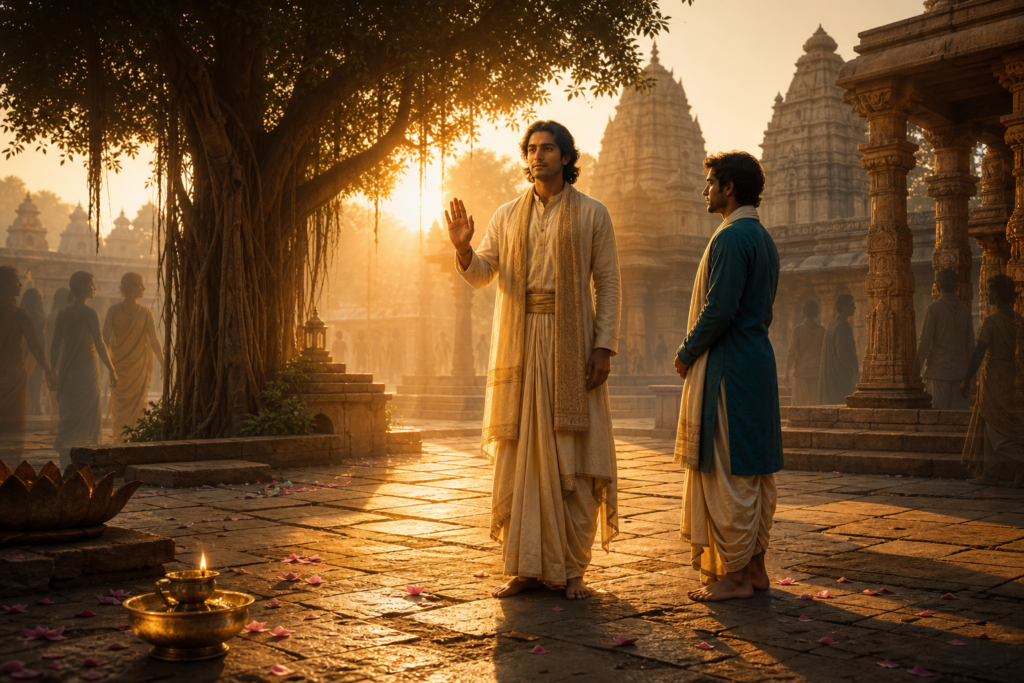
The remembrance of Tamal Krishna Goswami begins not with abstraction, but with association. In the mid-1970s, during the formative decades of the Hare Krishna Movement, a small circle of godbrothers would periodically withdraw from the intense demands of preaching and management to visit Rishikesh, the sacred town in the Himalayan foothills. Those retreats were marked by simplicity: reading Srila Prabhupada’s books, chanting the holy name, bathing in the waters of Mother Ganges, and holding intimate kirtans in a spiritually charged environment. Such moments reveal an important dimension of devotional life: intense service requires equally meaningful spiritual friendship.
Rishikesh became more than a geographical setting. It became a place where the external demands of leadership temporarily softened, allowing godbrothers to relate beyond titles, responsibilities, and organizational expectations. The setting also illustrates a recurring principle in dharmic traditions: pilgrimage is not only movement through sacred geography, but also movement inward, toward renewed clarity, humility, and shared purpose. In those few days away from public obligations, the essence of sadhu-sanga, or saintly association, became tangible.
Tamal Krishna Goswami’s missionary spirit left a profound impression on those who served with him. He spoke repeatedly and with conviction about the glories of the holy name, the urgency of book distribution, and the need to bring sincere souls into contact with Krishna consciousness. His words carried the force of lived realization. They were not theoretical reflections offered from a distance, but conclusions forged through austerity, travel, organizational responsibility, and direct service to Srila Prabhupada.
For newer devotees, his presence could be formidable. He was often perceived as a commander in Lord Caitanya’s army, disciplined, focused, and uncompromising in standards. His leadership could awaken in others the desire to work harder, surrender more deeply, and avoid spiritual mediocrity. In the historical development of ISKCON, such leaders played a crucial role. They helped translate Srila Prabhupada’s vision into practical institutions, temples, book distribution networks, festivals, training systems, and international preaching initiatives.
Yet the public image of a powerful preacher did not exhaust his personality. Those who came close to him discovered a gentle and affectionate heart beneath the commanding exterior. He valued the association of his godbrothers and genuinely loved devotees. As his life matured, his longing for Vrindavan and the devotional mood of the residents of Vraja became increasingly apparent. This gradual softening did not weaken his preaching spirit; rather, it deepened it, connecting public service with the inner cultivation of remembrance of Radha and Krishna.
A revealing episode occurred in 1978 during the Gaura-purnima festival in Mayapur, when a young preacher approached him about accepting sannyasa. The expectation was that Tamal Krishna Goswami would conduct a severe examination, probing motives, qualifications, and future plans. Instead, he invited the devotee to sit beside him and asked only a few careful questions about determination to preach. He then explained the responsibilities of the renounced order with practical clarity, compassion, and encouragement.
This incident demonstrates one of the more subtle aspects of spiritual leadership. True discipline need not express itself as intimidation. In the guru-shishya tradition and in the wider culture of dharmic mentorship, firmness and tenderness are not opposites. A teacher may preserve high standards while also ensuring that a disciple, junior colleague, or godbrother feels protected, understood, and guided. Tamal Krishna Goswami’s counsel on sannyasa remained influential for decades because it was practical, personal, and rooted in genuine concern.
Another formative memory took place at the Los Angeles Ratha-yatra in 1980. During that festival, Tamal Krishna Goswami proposed a preaching partnership: “Indra, let’s form a team: you and me. We’ll travel all over America, all over the world, just like I did with Visnujana Maharaja. You’ll lead the kirtan, I’ll speak and together we’ll make devotees everywhere.” The proposal reflected his characteristic combination of vision and immediacy. He did not merely imagine service; he saw it as an actionable reality waiting to be embraced.
That invitation became, in later reflection, one of the great missed opportunities of devotional life. Practical commitments seemed pressing at the time, and the chance passed. Similar invitations later arose in Dallas, Vrindavan, Cambridge, and Oxford, but preaching schedules and other responsibilities often took precedence. Only afterward did the full value of those invitations become clear. The lesson is not simply sentimental. It is a serious spiritual observation: association with advanced devotees is not an accessory to service; it is one of the means by which service becomes purified and sustained.
Among his godbrothers, Tamal Krishna Goswami seemed to understand the value of association with unusual depth. Devotees do not merely cooperate on projects. They nourish one another through honest conversation, shared sacrifice, philosophical inquiry, friendship, kirtan, prasadam, and remembrance of Srila Prabhupada. Many of the deepest exchanges in spiritual communities occur not in formal meetings, but during walks, meals, quiet discussions, and unplanned moments between responsibilities.
This insight has broad relevance for contemporary spiritual communities. Modern religious life is often evaluated through visible outputs: attendance, publications, construction, festivals, fundraising, organizational growth, and institutional recognition. These are not unimportant. Yet dharmic traditions repeatedly emphasize that inner culture sustains outer achievement. Without meaningful association, service can become mechanical. With association, even difficult service becomes a vehicle for humility, friendship, and remembrance of the Divine.
Tamal Krishna Goswami was also remembered as an exceptional speaker on Srimad Bhagavatam. His classes were clear, logical, philosophical, practical, and spiritually compelling. He had the rare ability to make profound truths understandable without reducing their depth. This quality is essential in any living scriptural tradition. A teacher must not merely repeat sacred texts; he must illuminate their relevance, preserve their integrity, and guide listeners toward transformation.
His Bhagavatam presentations reflected both scholarship and realization. They were not complicated for the sake of intellectual display, yet they were never superficial. Listeners came away with renewed commitment to become better devotees and more faithful servants of Srila Prabhupada. This balance between philosophical rigor and practical application is one reason his legacy continues to matter within ISKCON and beyond it.
The question of why Kṛishna called him away so soon naturally arose among those who loved him. He possessed extraordinary experience in Srila Prabhupada’s service, profound insight into his mood and mission, exceptional organizational ability, and a bold vision for expanding Krishna consciousness globally. His departure therefore felt not only personal but historical. A leader who still seemed to have much to contribute was suddenly no longer present in visible form.
Within Vaishnava theology, such separation is approached with both grief and trust. Kṛishna has His own purposes, and the devotee’s service does not end with the body’s departure. It is possible to understand Tamal Krishna Goswami’s passing as a transfer of service, perhaps to another field beyond ordinary perception, where Srila Prabhupada’s mission continues in ways unseen by those left behind. Such reflection does not erase grief, but it situates grief within a larger spiritual framework.
Tamal Krishna Goswami belonged to a remarkable generation of devotees who served Srila Prabhupada intimately. They did not merely hear his lectures or read his books from a distance. They traveled with him, cared for him, shared responsibilities, observed his decisions, carried his concerns, and witnessed the establishment of Lord Caitanya’s movement across continents. That kind of association leaves an imprint that cannot be replicated by institutional training alone.
Because of this intimate service, he absorbed not only what Srila Prabhupada wanted accomplished, but also something of how Srila Prabhupada wanted it accomplished. He understood the importance of determination, compassion, practical intelligence, scriptural fidelity, and dependence upon Krishna. His leadership was therefore not merely managerial; it was an attempt to carry forward a received mood of service.
His life, however, was not free from trials. During his years in Cambridge, he spoke openly about concerns regarding certain developments within the movement. He carried substantial responsibilities, and with them came disappointment, misunderstanding, criticism, and the hidden burdens of leadership. Health challenges also became an increasing reality. These details matter because spiritual history becomes more honest when it acknowledges the complexity of service rather than presenting saints and leaders as untouched by difficulty.
Through these challenges, his faith in Srila Prabhupada did not diminish, nor did his loyalty to ISKCON weaken. His conviction remained steady: Srila Prabhupada’s movement was a vital hope for the world, and every available strength should be offered to fulfill that vision. Such steadiness is one of the defining marks of spiritual leadership. It does not mean the absence of struggle; it means fidelity through struggle.
To his disciples, he was an affectionate spiritual father. To his godbrothers, he was a trusted friend. To countless devotees, he was a source of inspiration. To those unfamiliar with the holy name, he accepted extraordinary austerities so that they might encounter Krishna’s mercy. This missionary impulse linked his early service with his later work, including his dedication to opening preaching in China.
The China mission reveals the depth of his sacrifice. Few devotees can fully know the obstacles he accepted there. He moved into difficult fields of service with the conviction that even one sincere soul coming closer to Krishna made every hardship worthwhile. Again and again, he accepted responsibilities that others hesitated to accept and entered spaces where preaching required patience, intelligence, courage, and discretion.
Despite his many accomplishments, there was no sense that he considered himself extraordinary. Beneath the visible force of leadership was the heart of a servant. Whatever service Srila Prabhupada placed before him, he accepted it wholeheartedly. This servant identity is central to the Vaishnava understanding of greatness. Real greatness is not self-display, but the willingness to be used in service to guru, Krishna, and the welfare of others.
By Kṛishna’s arrangement, Tamal Krishna Goswami became the first of Srila Prabhupada’s initiating spiritual masters to be placed in samadhi in Mayapur. His departure sent shock through the society. When a devotee leaves this world, separation is naturally painful; when a devotee of such stature departs, the loss extends beyond disciples, family, and close friends. The entire Vaishnava community feels the absence.
In the age of Kali, saintly devotees are among humanity’s rarest treasures. Their presence brings moral clarity, spiritual courage, and a living reminder that human life can be dedicated to Divine service. When such a person returns to the Lord’s eternal service, the world feels quieter. The mission continues, but those who remain recognize that something precious has become inaccessible in its former form.
Sankirtana has always been a collective effort. Srila Prabhupada built the Hare Krishna Movement by bringing devotees together, each offering distinct capacities in a spirit of cooperation. When one of the principal members of that team departs, the loss is felt structurally as well as emotionally. New devotees join, new leaders emerge, and preaching continues because the mission belongs to Sri Caitanya Mahaprabhu. Yet the community never stops missing those who once inspired greater courage, conviction, and faith.
The circumstances of Tamal Krishna Goswami’s departure were also remembered as spiritually auspicious. He left this world in the sacred land of Mayapur, near Phuliya, the place associated with Srila Haridasa Thakura’s extraordinary bhajana and his daily chanting of three hundred thousand holy names. His departure occurred on the disappearance day of Jagannatha dasa Babaji Maharaja and Rasikananda Prabhu. In Vaishnava memory, such details are not incidental; they are read as signs of Divine arrangement.
His samadhi ceremony brought together the leadership of ISKCON, including members of the GBC, sannyasis, temple presidents, disciples, godbrothers, friends, and devotees from many parts of the world. It was a farewell worthy of one of Srila Prabhupada’s great generals, but it was more than an institutional honor. It was an expression of affection and respect earned through sincere service, sacrifice, and commitment to the mission of Krishna consciousness.
One remembered statement offers a final theological lens for understanding his continued influence. In 1997, when Vraja-lila dasi departed in Vrindavan, Tamal Krishna Goswami consoled those grieving by explaining that after departure she would occupy a transcendental position from which she could continue to bless those left behind. The same reflection can be applied to him. Wherever he is now, whether serving Radha and Krishna in Their eternal pastimes or assisting Srila Prabhupada in expanding Lord Caitanya’s mission beyond ordinary vision, his service continues.
The enduring prayer associated with his memory is a prayer for courage, determination, loyalty, and missionary spirit. These were among his gifts to the devotees who knew him. They remain relevant not only to ISKCON, but to every dharmic community seeking to combine devotion, discipline, unity, and compassionate outreach. His example shows that spiritual leadership requires intellectual clarity, emotional depth, personal sacrifice, and an unwavering commitment to service.
The memory of the Los Angeles Ratha-yatra continues to stand as a symbol of what his life represented. “Indra, let’s form a team” was more than an invitation to travel and preach. It expressed his understanding that devotional service flourishes through partnership, shared purpose, kirtan, teaching, and mutual trust. The regret of not accepting such an invitation becomes, in retrospect, a lesson for all seekers: when saintly association is offered, it should be valued while it is present.
His life encouraged acceptance of the renounced order, love for preaching, and deeper loyalty to Srila Prabhupada’s mission. His friendship helped shape the devotional identity of those who served near him. His example continues to instruct later generations that devotion is not merely belief, nor merely institution, nor merely ritual. It is a disciplined life of service animated by affection for guru, reverence for scripture, compassion for souls, and longing for Radha and Krishna.
The anonymous lines once offered in grief still capture the emotional weight of separation: “If tears could build a stairway / And memories a lane / I’d walk right up to heaven / And bring you back again.” Such poetry expresses what academic language alone cannot: the ache of losing a friend, guide, and spiritual companion. Yet Vaishnava remembrance does not end in loss. It matures into gratitude, prayer, and renewed service.
Tamal Krishna Goswami’s legacy therefore remains both historical and living. Historically, he helped shape the global expansion of ISKCON and Krishna consciousness. Personally, he transformed lives through counsel, friendship, and example. Spiritually, he demonstrated how bold preaching and tender devotion can coexist in one life. His memory continues to ask a demanding and necessary question: whether those who inherit such a legacy will serve with the same seriousness, humility, courage, and love.
Inspired by this post on Dandavats.








Leave a Reply
You must be logged in to post a comment.