
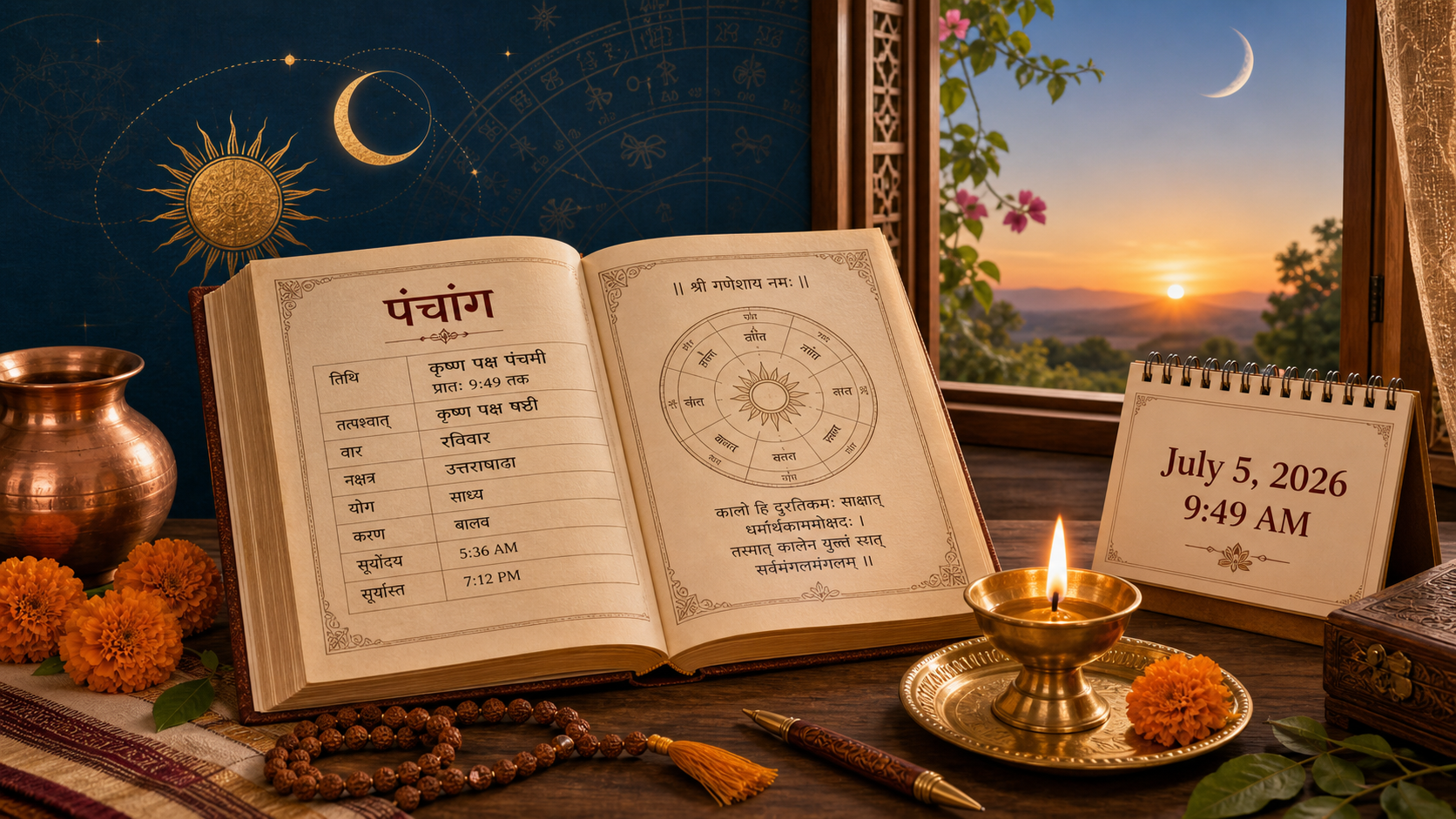
Sunday, July 5, 2026, is observed in the Hindu calendar and Panchang as a day governed primarily by Krishna Paksha Panchami, the fifth tithi of the waning or dark fortnight of the lunar month. According to the available Panchang details, Krishna Paksha Panchami continues until 9:49 AM on July 5. After this transition, Krishna Paksha Sashti, the sixth tithi of the waning phase, begins and shapes the remainder of the day.
This daily Panchang note is significant because Hindu timekeeping is not merely a civil date system. It is a lunar, solar, and ritual framework through which many practitioners organize worship, fasting, travel, study, family duties, and important decisions. A date such as July 5, 2026, therefore carries meaning not only because it falls on a Sunday, but because the tithi changes within the morning, creating two distinct ritual segments within the same civil day.
Krishna Paksha refers to the waning fortnight, the period after Purnima when the visible Moon gradually decreases until Amavasya. In traditional Hindu practice, this phase is often associated with introspection, restraint, completion, ancestral remembrance, and inward discipline. While Shukla Paksha is commonly linked with expansion and visible growth, Krishna Paksha is valued for review, purification, humility, and the quiet strengthening of spiritual resolve.
Panchami is the fifth lunar day of a fortnight. Technically, a tithi is calculated from the angular distance between the Sun and the Moon, with each tithi measuring 12 degrees of separation. Krishna Paksha Panchami corresponds to the fifth tithi after the full Moon phase, and its completion marks the movement into Krishna Paksha Sashti. This astronomical foundation is one reason the Hindu calendar remains deeply connected to observed celestial motion rather than only fixed clock time.
For July 5, 2026, the key tithi detail is clear: Krishna Paksha Panchami is present until 9:49 AM, and Krishna Paksha Sashti follows thereafter. This distinction matters because rituals and observances tied specifically to Panchami should generally be completed before the tithi ends, especially when a family tradition or temple custom gives priority to the prevailing tithi at sunrise or to a particular tithi window.
In practical terms, the early part of the day carries the Panchami influence, while the rest of the day is governed by Sashti. Panchami is traditionally connected with reverence, learning, healing, disciplined worship, and the honoring of subtle natural forces. Sashti, in many Hindu traditions, is associated with protection, strength, continuity, and the grace of deities such as Skanda or Subramanya in regions where Sashti observances are prominent.
The phrase “good time” in Panchang usage should be understood carefully. A good time, or shubh muhurat, is not decided by tithi alone. It depends on the combined reading of tithi, nakshatra, yoga, karana, weekday, sunrise, sunset, lunar month, local geography, and the purpose of the activity. A time suitable for daily puja may not be suitable for marriage, housewarming, business registration, or travel. This is why traditional Panchang reading is contextual rather than mechanical.
For ordinary devotional activity on July 5, 2026, the day can be approached with steadiness and mindfulness. Morning worship before 9:49 AM aligns with the continuing Panchami tithi, while later worship falls under Sashti. Daily japa, lighting a lamp, offering water, reading from Hindu scriptures, meditation, and quiet acts of seva are appropriate ways to honor the day without overstating its ritual obligations.
Nakshatra and Rashi are also important parts of the daily Panchang, but they are not preserved in the supplied source excerpt. Nakshatra refers to the lunar mansion occupied by the Moon, one of twenty-seven divisions of the zodiac, each spanning 13 degrees and 20 minutes. Rashi refers to the zodiac sign, one of twelve 30-degree divisions. Together, Nakshatra and Rashi help refine the interpretation of the day, especially for personal astrology, tarabalam, chandrabalam, vrata timing, and temple observances.
Because Panchang values can vary by location, the same civil date may be read differently in India, North America, Europe, Southeast Asia, or other regions of the Hindu diaspora. Sunrise time, lunar position, and local time zone affect the practical application of tithi and muhurat. Therefore, anyone using July 5, 2026, for a major samskara, vrata, travel decision, or formal ceremony should consult a location-specific Panchang rather than relying only on a general national listing.
The academic value of a daily Hindu calendar entry lies in its ability to show how dharmic traditions preserve a sophisticated relationship between cosmic order and lived time. The Panchang is not superstition when properly understood; it is a traditional system of calendrical astronomy, ritual culture, and social memory. It reminds communities that time can be measured not only by productivity, but also by rhythm, restraint, gratitude, and sacred attention.
There is also an emotional dimension to such a calendar. In many households, the daily Panchang is read before beginning the day, calling a parent, planning a puja, preparing for a vrata, or deciding whether to postpone a task. For families living away from ancestral towns and temple networks, a date like July 5, 2026, becomes a small but meaningful bridge to inherited practice. It helps preserve continuity across generations without demanding uniformity.
This spirit of continuity is important for all dharmic traditions. Hindu, Buddhist, Jain, and Sikh communities have distinct calendars, observances, teachers, and ritual vocabularies, yet they share a civilizational respect for disciplined time, ethical living, remembrance, and self-cultivation. A Panchang entry should therefore be read not as a narrow sectarian claim, but as one expression of the broader dharmic effort to align daily life with awareness, responsibility, and reverence.
For July 5, 2026, the most important takeaway is simple and useful: Krishna Paksha Panchami prevails until 9:49 AM, after which Krishna Paksha Sashti begins. Those who observe Panchami-related practices should give attention to the morning period. Those following general daily worship may continue with devotion throughout the day, while remembering that exact auspicious timings, Rahu Kaal, Nakshatra, Rashi, and regional observances should be checked in a local Panchang.
Inspired by this post on Hindu Blog.


Leave a Reply
You must be logged in to post a comment.