
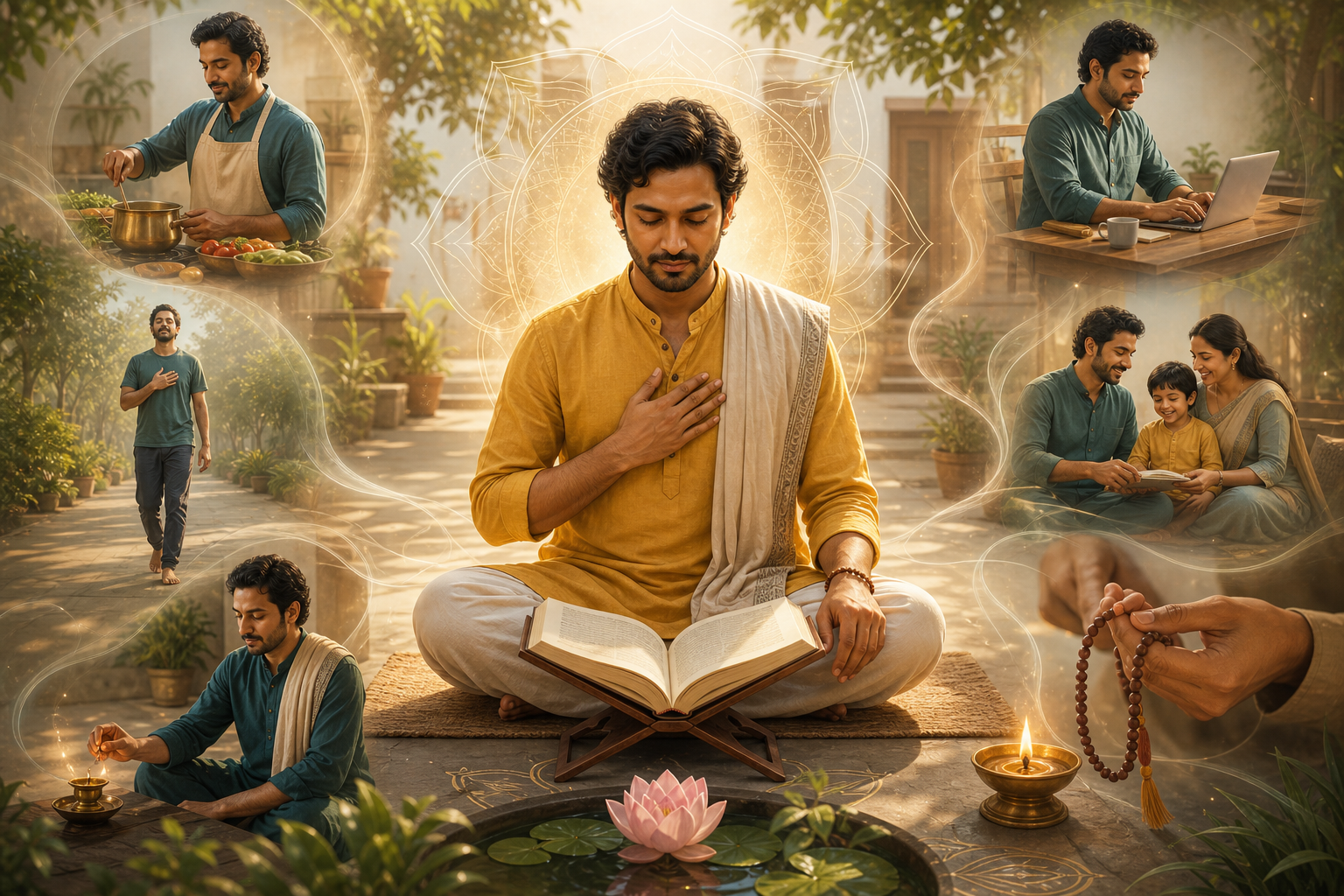
Mindfulness in Hindu thought is not limited to a meditation cushion, a temple visit, or a formal spiritual retreat. It is presented as a disciplined way of living in which awareness, ethical intention, and self-mastery enter ordinary actions such as eating, speaking, working, walking, studying, serving, and resting. This insight is especially important because daily life is where the mind most often becomes distracted, reactive, anxious, or mechanical. Hindu spirituality therefore treats everyday activity as a field of practice, where the restless mind can be gently redirected toward clarity, dharma, and inner steadiness.
The Bhagavad Gita offers one of the most influential formulations of this discipline in Chapter VI, verse 26: yato yato niścarati manaś cañcalam asthiram, tatas tato niyamyaitad ātmany eva vaśaṁ nayet. The verse teaches that wherever the restless and unsteady mind wanders, it should be restrained and brought back under the governance of the Self. This is not a command to suppress thought violently. It is a technical instruction in attention training: notice the movement of the mind, recognize its wandering, and return it again and again to a deeper center of awareness.
This teaching makes Hindu mindfulness both practical and psychologically precise. The mind is described as cañcala, restless, and asthira, unstable. These terms remain strikingly relevant in modern life, where attention is repeatedly pulled by digital notifications, social pressure, professional demands, emotional memory, and constant sensory stimulation. The Gita does not deny this difficulty. Instead, it begins from an honest diagnosis: the untrained mind moves outward by habit, and spiritual maturity requires patient, repeated redirection.
In this framework, mindfulness is not merely passive awareness. It is active recollection, ethical alignment, and disciplined return. A person notices irritation before speech turns harsh, observes desire before consumption becomes compulsive, and recognizes fear before decision-making becomes distorted. This refined awareness allows dharma to become practical rather than abstract. The teaching moves from scripture into lived conduct when the individual pauses, remembers, and chooses with steadiness.
Hindu tradition uses several interconnected concepts to explain this process. Manas refers to the mind as the coordinator of sensory impressions and ordinary thought. Buddhi refers to discernment, the faculty that judges, distinguishes, and guides. Atman points to the deeper Self, the witnessing consciousness that is not identical with passing thoughts. Mindfulness matures when manas is gradually steadied by buddhi and oriented toward the recognition of Atman. This layered psychology gives the practice a technical depth beyond simple relaxation.
Daily activities become spiritually meaningful when they are performed with this layered awareness. Washing hands can become a moment of purification and gratitude. Preparing food can become an act of care rather than hurried utility. Walking can become a practice of breath awareness and bodily presence. Conversation can become a test of truthfulness, restraint, and compassion. Work can become Karma Yoga when action is performed with sincerity, skill, and reduced attachment to egoic reward.
Karma Yoga is central to this discussion because it prevents mindfulness from becoming self-absorbed. The Bhagavad Gita does not teach escape from action as the highest practical path for most people. It teaches purified action. When ordinary duties are performed with attention, humility, and dedication, they become instruments of inner transformation. The household, workplace, classroom, road, marketplace, and public square can all become arenas for spiritual practice.
This approach also protects spiritual life from compartmentalization. A person may meditate in the morning but remain impatient, careless, or ego-driven throughout the day. Hindu mindfulness challenges that division. It asks whether attention remains present while responding to criticism, handling money, caring for elders, raising children, eating food, using technology, or dealing with disappointment. The true measure of practice is not only the stillness achieved in solitude, but the quality of awareness carried into relationship and responsibility.
The discipline begins with observation. In everyday experience, the mind usually runs in patterns: attraction, aversion, comparison, memory, fantasy, anxiety, and judgment. Hindu philosophy often connects these patterns with the play of the gunas: sattva, rajas, and tamas. Sattva brings clarity, harmony, and luminosity. Rajas produces agitation, craving, and restless activity. Tamas produces inertia, confusion, and dullness. Mindfulness allows these movements to be seen without immediately becoming enslaved by them.
When sattva is cultivated, daily life becomes more transparent to wisdom. Food, sleep, speech, study, companionship, and work habits all influence the quality of attention. This is why Hindu spirituality often connects mindfulness with lifestyle rather than isolating it as a mental exercise. The body, senses, breath, emotions, and moral choices are not separate from consciousness. They form the conditions in which awareness either becomes clouded or refined.
Breath awareness is one of the most accessible bridges between formal practice and ordinary life. In yogic traditions, the breath is connected with prana, vital energy, and with the regulation of the nervous system. A conscious breath before speaking can prevent needless conflict. A few steady breaths before beginning work can reduce scattered attention. Breath awareness during walking, cooking, or waiting can return the mind to the present moment without requiring withdrawal from duty.
Pranayama, when properly learned and practiced with moderation, gives this process a more structured form. Yet the essential principle can be applied simply: breath reveals the state of the mind, and the mind can be gently influenced through the breath. Rapid, shallow breathing often accompanies agitation. Slow, steady breathing supports steadiness. The Bhagavad Gita’s instruction to bring the mind back to the Self can therefore be supported by embodied practices that make attention more stable.
Mantra practice offers another important method. Repetition of a sacred sound, divine name, or scriptural phrase gives the mind a wholesome point of return. In daily life, mantra may function as an interior anchor during travel, household work, or moments of emotional strain. This does not require public display or external performance. Its power lies in recollection. The mind, instead of wandering through resentment or worry, is repeatedly brought back to sacred remembrance.
Japa, the repetition of mantra, illustrates the broader principle of Hindu mindfulness: repetition is not mechanical when it is joined with awareness. The same is true of ritual. Lighting a lamp, offering water, bowing before a deity, or reciting a verse can become either a habit performed without attention or a meaningful act of presence. Mindfulness does not reject ritual; it restores depth to ritual by aligning gesture, intention, and consciousness.
This is why Hindu spiritual practice often emphasizes bhava, the inner feeling or devotional attitude. A simple act performed with sincerity can carry more spiritual weight than an elaborate act performed distractedly. In Bhakti traditions, mindfulness is not cold observation. It is loving remembrance. The mind is trained not only to become quiet, but to remain connected with the chosen form of the Divine, the guru’s teaching, or the sacred presence that gives meaning to life.
At the same time, Hindu mindfulness is broad enough to include non-theistic and contemplative dimensions shared across dharmic traditions. Buddhist mindfulness emphasizes careful observation of body, feeling, mind, and phenomena. Jain practice gives deep attention to non-violence, restraint, and purification of intention. Sikh spirituality emphasizes remembrance of the Divine Name, honest work, and selfless service. These traditions differ in metaphysical language, yet they meet in the practical effort to refine awareness, reduce egoism, and live with compassion.
This shared dharmic horizon is important for contemporary spiritual discourse. Mindfulness should not be reduced to a commercial wellness technique detached from ethical responsibility. In Hinduism, Buddhism, Jainism, and Sikhism, awareness is inseparable from conduct. It is linked with non-harm, truthfulness, self-discipline, compassion, service, humility, and liberation from destructive habits. The goal is not merely to feel calmer, but to become more awake, responsible, and aligned with a higher order of life.
The ethical dimension is visible in the yamas and niyamas of Yoga philosophy. Ahimsa, satya, asteya, brahmacharya, and aparigraha guide behavior through non-violence, truthfulness, non-stealing, disciplined energy, and non-possessiveness. Saucha, santosha, tapas, svadhyaya, and Ishvara pranidhana guide inner cultivation through purity, contentment, disciplined effort, self-study, and surrender to the Divine. These principles convert mindfulness into a complete way of life rather than a temporary mental state.
Modern discussions of mindfulness often focus on stress reduction, and that benefit is real. A disciplined attention practice can reduce reactivity, improve emotional regulation, and support mental clarity. Yet Hindu spirituality places stress reduction within a larger aim. Calmness is valuable because it allows discernment. Discernment is valuable because it supports dharma. Dharma is valuable because it harmonizes personal life with truth, responsibility, and spiritual progress.
In practical terms, mindfulness in daily activities may begin with small pauses. Before eating, there can be a moment of gratitude for the food, the earth, the farmer, the cook, and the unseen networks of support that make nourishment possible. Before speaking, there can be a moment of examination: is the speech true, necessary, kind, and timely? Before beginning work, there can be a dedication of action to a purpose larger than ego. Before sleep, there can be reflection on the day without harsh self-condemnation.
This kind of practice is realistic because it does not demand withdrawal from life. Parents, workers, students, caregivers, business owners, teachers, and public servants can all practice mindfulness within their existing responsibilities. Hindu tradition recognizes that spiritual growth is not reserved for those who renounce household life. The inner orientation of action matters. When duty is performed with awareness and dedication, the ordinary rhythm of life becomes a path of refinement.
Emotional life is also transformed through this discipline. Anger, grief, jealousy, fear, and longing are not denied; they are observed and understood. The practitioner learns that an emotion is a movement within consciousness, not the whole of identity. This distinction creates freedom. A person can feel anger without becoming cruel, feel sadness without losing all perspective, and feel uncertainty without abandoning dharma. Such maturity is one of the strongest fruits of mindfulness.
The Gita’s teaching on returning the mind to the Self is therefore not abstract metaphysics alone. It is a practical method for handling criticism, conflict, failure, and desire. When criticized, the mind may rush toward defensiveness. Mindfulness asks for a pause. Is there truth in the criticism? Is the reaction driven by ego? What response would be consistent with dharma? This pause does not make a person passive. It makes response more intelligent.
Similarly, in moments of success, mindfulness prevents inflation of ego. Praise, recognition, and achievement can easily strengthen attachment. Karma Yoga teaches that action should be skillful and sincere, but its fruits should not become the basis of identity. This does not weaken excellence. It purifies it. Work done without obsessive self-importance often becomes more careful, more stable, and more beneficial to others.
The senses play a major role in this discipline. Hindu texts frequently note that the mind is drawn outward through sight, sound, taste, touch, and smell. Modern life intensifies this outward movement through screens, advertising, entertainment, and constant stimulation. Mindfulness does not require hatred of the senses. It requires intelligent relationship with them. A person learns what nourishes clarity and what produces agitation, dullness, or dependency.
This is where mindful consumption becomes a spiritual issue. Food, media, conversation, and social environments all leave impressions on the mind. In Sanskritic thought, such impressions are often discussed as samskaras. Repeated exposure creates tendencies, and tendencies shape future perception and action. Daily mindfulness therefore includes attention to what is consumed mentally and emotionally, not only what is consumed physically.
Self-study, or svadhyaya, deepens the process. It includes study of sacred texts, but also honest observation of one’s own motives and patterns. Why does a particular insult hurt so deeply? Why does a specific desire return repeatedly? Why is silence uncomfortable? Why does comparison create suffering? Such questions turn ordinary discomfort into material for insight. The restless mind becomes a teacher when observed carefully.
Hindu mindfulness also has a communal dimension. Awareness is not only a private inward state; it affects family life, social trust, and cultural continuity. A mindful household speaks with greater patience, eats with more gratitude, preserves rituals with more understanding, and handles disagreement with less contempt. A mindful community becomes less vulnerable to impulsive anger, divisive rhetoric, and shallow imitation. Spiritual awareness therefore contributes to social harmony.
This social dimension supports unity among dharmic traditions. Hinduism, Buddhism, Jainism, and Sikhism each offer sophisticated methods for disciplining attention and purifying conduct. Their vocabularies are distinct, but their practical wisdom often converges around compassion, restraint, service, remembrance, and liberation from ego-centered living. A mature approach honors these differences without forcing artificial sameness. Unity is strengthened through respectful understanding, not erasure of diversity.
The academic study of Hindu spirituality must therefore avoid two extremes. One extreme reduces mindfulness to a modern therapeutic technique and strips away its philosophical and ethical roots. The other treats spirituality as remote from practical life. The Hindu view challenges both assumptions. It presents mindfulness as a disciplined, embodied, ethical, and metaphysical practice that belongs in the middle of daily activity.
The instruction from Bhagavad Gita VI.26 can be read as a complete method in miniature. First, there is recognition: the mind has wandered. Second, there is non-dramatic correction: the wandering is noticed without despair. Third, there is restraint: attention is not allowed to follow every impulse. Fourth, there is return: the mind is guided back to the Self. Fifth, there is repetition: the process continues as often as necessary. This cycle is the heart of meditation and the foundation of mindful living.
Such repetition requires patience. Many people abandon practice because the mind continues to wander. The Gita’s realism is helpful here: wandering is expected. The spiritual task is not to become instantly free of distraction, but to develop the strength to return. Each return builds capacity. Each return weakens automatic identification with thought. Each return makes awareness more available in ordinary life.
There is also emotional comfort in this teaching. The restless mind is not a personal failure; it is a common human condition. The discipline of mindfulness begins where life actually is, not where one imagines a perfect spiritual life should be. This makes the path accessible. A distracted student, a tired parent, an anxious professional, or an elder facing uncertainty can all begin with the same practice: notice, pause, return, and act with greater awareness.
The phrase ātmany eva vaśaṁ nayet, bringing the mind under the influence of the Self, carries a profound implication. Human beings are not condemned to be ruled by every impulse. There is a deeper center from which life can be governed. Hindu spirituality calls attention back to that center through meditation, devotion, knowledge, service, mantra, breath discipline, ethical restraint, and self-inquiry. These are not competing paths so much as complementary tools suited to different temperaments and stages of growth.
Mindfulness in daily activities therefore becomes a bridge between philosophy and practice. Vedanta offers insight into the Self. Yoga offers disciplined methods for stabilizing body, breath, and mind. Bhakti offers loving remembrance. Karma Yoga offers sanctification of action. Dharma offers ethical direction. Together, these streams show that spiritual life is not an escape from the world, but a transformation of how the world is perceived and served.
In a contemporary setting, this teaching has special urgency. Many people live with fragmented attention, chronic comparison, emotional exhaustion, and a sense of separation from meaning. Hindu mindfulness answers this condition by returning attention to presence, responsibility, and sacred orientation. It does not promise that life will become free of difficulty. It teaches that difficulty can be met with a steadier mind, a cleaner intention, and a deeper awareness of the Self.
The practical conclusion is clear: spirituality becomes real when mindfulness enters daily conduct. A mindful meal, a mindful word, a mindful breath, a mindful decision, and a mindful act of service are not small matters. They are the building blocks of inner transformation. The Bhagavad Gita’s teaching remains powerful because it does not ask for theatrical spirituality. It asks for repeated, honest return. Wherever the mind wanders, bring it back. Wherever action occurs, let awareness enter. Wherever life places responsibility, let dharma guide it.
This is the enduring insight of Hindu tradition: the sacred is not absent from ordinary life. It is often hidden by distraction. Through mindfulness, breath awareness, Karma Yoga, devotion, self-study, and disciplined attention, daily activities become occasions for awakening. The path begins not in a distant place, but in the next thought, the next breath, the next word, and the next action performed with awareness.
Inspired by this post on Hindu Blog.









Leave a Reply
You must be logged in to post a comment.