
Panihati Chida Dahi, also known as Chida-dadhi Mahotsava or the Chipped Rice Festival of Panihati, occupies a distinctive place in the devotional memory of the Gaudiya Vaishnava tradition. Celebrated on the bank of the Ganges at Panihati, north of Kolkata, the festival recalls the meeting of Srila Raghunatha dasa Goswami with Lord Nityananda Prabhu and the extraordinary public feast that followed. The event is not merely a charming sacred story about yogurt and chipped rice; it is a theological narrative about mercy, humility, service, community, and the transformation of personal longing into shared prasada.
The principal narrative is preserved in the Caitanya Caritamrita, Antya-lila, Chapter 6, where the life of Raghunatha dasa Goswami is presented as a movement from material privilege toward complete devotional surrender. Raghunatha dasa belonged to a wealthy family, yet his heart remained drawn toward the shelter of Sri Caitanya Mahaprabhu. His repeated attempts to leave home were restrained by family arrangements, social responsibilities, and practical obstacles. The Panihati episode therefore becomes a decisive turning point: before attaining the direct shelter of Sri Caitanya Mahaprabhu, he receives the mercy of Lord Nityananda Prabhu through seva.
Panihati itself becomes more than a geographical location in this tradition. The bank of the Ganges functions as a sacred social space where pilgrimage, kirtana, food distribution, and divine remembrance converge. In the Indic religious imagination, rivers often carry both ritual and emotional meaning: they gather communities, purify intention, and become witnesses to acts of devotion. In this account, the Ganges bank becomes comparable in mood to the bank of the Yamuna, because the devotees remember the intimate pastoral meals of Krsna and Balarama with the cowherd boys.
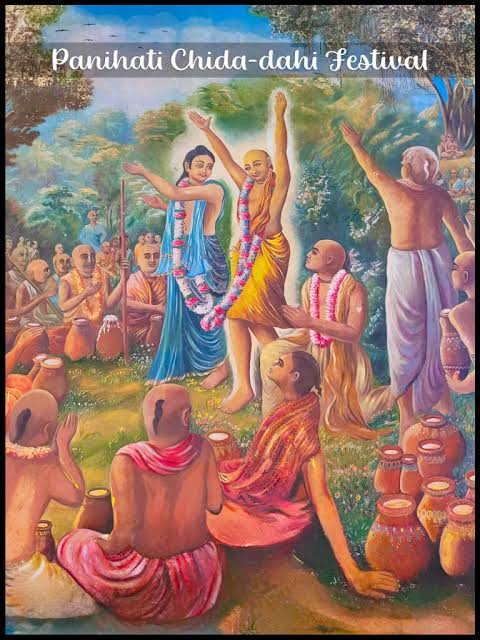
The festival begins with Raghunatha dasa approaching Lord Nityananda Prabhu from a distance. Nityananda Prabhu is seated beneath a tree on a rock by the Ganges, surrounded by kirtana performers, servants, and devotees. The source tradition describes His brilliance through the language of devotional awe, comparing His presence to countless rising suns. The image is significant: Raghunatha dasa does not encounter a distant religious authority, but a living center of spiritual warmth, joy, and communal energy.
Raghunatha dasa offers obeisances from afar. This distance is psychologically important. He longs for divine shelter, yet remains hesitant, cautious, and perhaps conscious of his own unworthiness. When a servant points him out, Lord Nityananda Prabhu playfully calls him a thief and summons him closer. In devotional interpretation, this affectionate rebuke does not condemn Raghunatha dasa; rather, it exposes the subtle tendency to seek the highest spiritual treasure while still standing at a distance from active service.
The so-called punishment given by Lord Nityananda Prabhu is central to the meaning of the Chida-dadhi Mahotsava. He places His lotus feet on Raghunatha dasa’s head and instructs him to organize a feast of yogurt and chipped rice for all His associates. The punishment is therefore an act of grace. It redirects Raghunatha dasa from private longing into public service, from inward aspiration into practical generosity, and from spiritual anxiety into joyful participation in the community of devotees.
This principle has enduring relevance in dharmic life. Spiritual aspiration does not become mature merely by intensity of feeling; it becomes refined through service, discipline, humility, and care for others. In the Panihati festival, the path forward for Raghunatha dasa is not dramatic self-display, but the simple, demanding, and inclusive act of feeding everyone. The story presents seva as a bridge between personal devotion and social harmony.
Raghunatha dasa responds immediately and happily. He arranges chipped rice, yogurt, milk, sweetmeats, sugar, bananas, and other ingredients. As the news spreads, brahmanas, respected villagers, devotees, and visitors begin to gather in large numbers. The practical scale of the event increases rapidly, requiring additional supplies from nearby villages and hundreds of large earthen pots. The narrative shows that devotion is not opposed to organization; sincere bhakti often requires logistics, foresight, procurement, distribution, and responsibility.
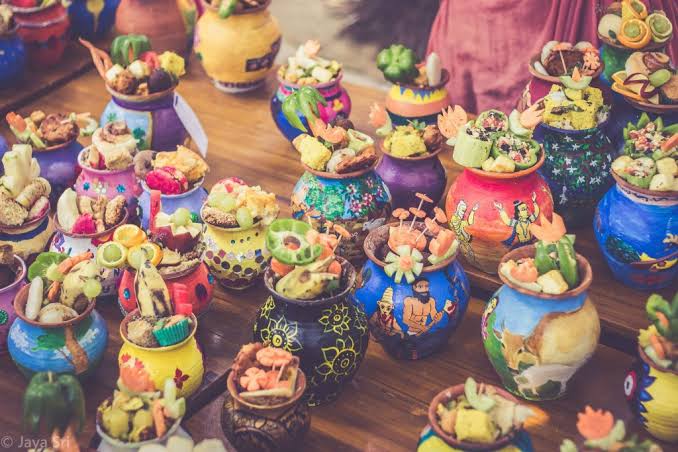
The preparation of the prasada is described with notable detail. One variety of chipped rice is mixed with yogurt, sugar, and bananas. Another is prepared with condensed milk, sugar, clarified butter, and fragrant ingredients. The use of simple grains, milk products, and fruit reflects the agrarian and pastoral symbolism of the tradition. Chipped rice is humble food, yet when offered in devotion and distributed as prasada, it becomes a medium of theological meaning and communal joy.
The earthen pots also deserve attention. They are not merely containers; they help situate the festival in the material culture of Bengal and traditional village hospitality. Clay vessels, riverbank assembly, milk preparations, bananas, kirtana, and shared eating together create a complete ritual ecology. The sacred is not presented as abstract or remote. It is embodied through food, sound, place, touch, fragrance, and collective participation.
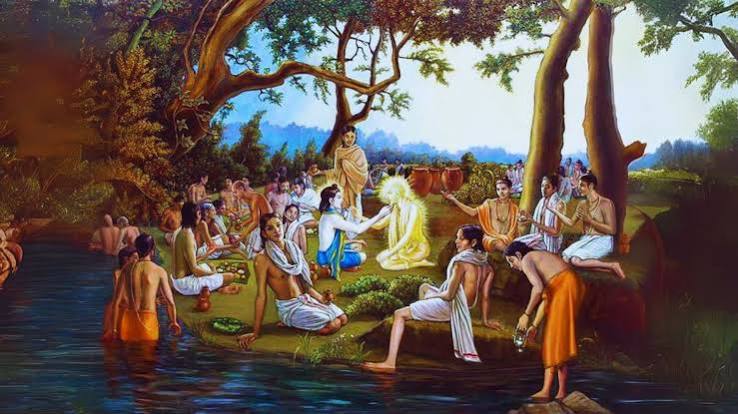
As the crowd grows, the distribution expands beyond the initial circle of close associates. People sit on the raised platform, around the platform, on the riverbank, and even in the shallow water when space becomes limited. Each person receives two pots: one preparation with yogurt and another with condensed milk. The visual power of the scene lies in its inclusiveness. The festival does not narrow devotion into a private elite experience; it broadens it into a public act of nourishment.
Raghava Pandita’s arrival deepens the narrative. Seeing the abundance of the festival, he laughs in astonishment and brings food cooked in ghee to offer to Lord Nityananda Prabhu. He respectfully notes that he had already offered food for the Lord at his home, but the Lord is now absorbed in this riverside celebration. Lord Nityananda Prabhu replies in the mood of a cowherd companion, expressing happiness in eating with His associates in a picnic-like gathering by the river.
This reply is theologically rich. The cowherd mood recalls the intimate world of Vraja, where Krsna and Balarama eat with their companions in freedom, affection, and simplicity. The Panihati festival therefore becomes a reenactment of sacred companionship. The public distribution of chipped rice and yogurt is simultaneously social service, devotional offering, and remembrance of divine play.
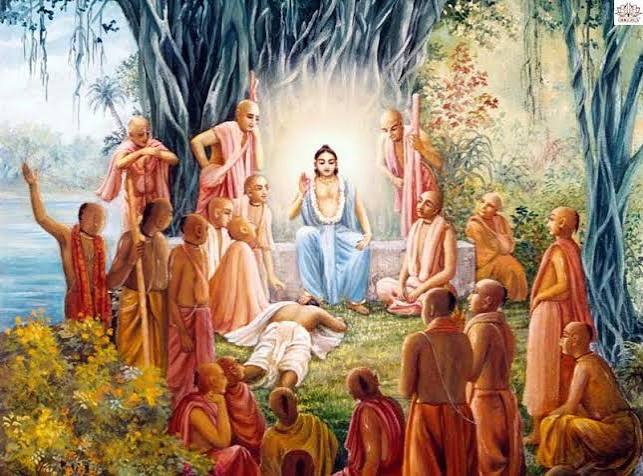
The Caitanya Caritamrita then presents a profound moment: Lord Nityananda Prabhu, in meditation, brings Sri Caitanya Mahaprabhu to the gathering. While the devotees enjoy the preparations, Lord Nityananda Prabhu walks among them and playfully offers morsels to Sri Caitanya Mahaprabhu. The text indicates that not everyone can perceive this mystery, but fortunate devotees witness the presence of Sri Caitanya Mahaprabhu. The festival thus becomes a meeting point between visible community action and subtle devotional realization.
The exchange between Lord Nityananda Prabhu and Sri Caitanya Mahaprabhu is marked by affection and humor. The scene resists a dry or overly formal understanding of religious life. It presents divine mercy as intimate, playful, and relational. In many dharmic traditions, the highest truths are not only expressed through doctrine but also through rasa, the lived taste of relationship, service, remembrance, and joy.
The chanting of “Hari Hari” gives the event its sonic center. Food distribution is not separated from nama-sankirtana; the holy name fills the environment while devotees eat prasada. This union of sound and nourishment is a key feature of Gaudiya Vaishnava practice. The body is fed, the mind is steadied, the community is gathered, and the heart is directed toward remembrance of Krsna.
The Panihati Chida Dahi festival also illustrates a broader dharmic principle shared across Hindu, Buddhist, Jain, and Sikh traditions: food offered or distributed with reverence can become a profound instrument of unity. Whether expressed as prasada, dana, langar, ahimsa-oriented hospitality, or compassionate feeding, the act of nourishing others has long served as a practical theology of equality and care. Panihati belongs specifically to the Gaudiya Vaishnava tradition, yet its ethical resonance is widely intelligible across dharmic communities.
The narrative is especially powerful because Raghunatha dasa is not asked first to teach, debate, or renounce publicly. He is asked to feed. This detail challenges any tendency to reduce spirituality to intellectual identity or ritual status alone. The festival teaches that sacred knowledge must become generosity, and devotion must become service that others can tangibly receive.
There is also a subtle lesson in humility. Raghunatha dasa comes from wealth, but in Panihati his wealth is sanctified through distribution. Resources that might otherwise reinforce status become instruments of seva. The transformation is not the rejection of capacity, but its redirection. In this sense, the festival offers a practical model for householders, community leaders, and institutions: material resources become spiritually meaningful when used for the welfare and upliftment of others.
The emotional force of the episode lies in this redirection. Many seekers understand the tension between inward longing and outward obligation. Raghunatha dasa’s life dramatizes that tension in a heightened form. He desires the shelter of Sri Caitanya Mahaprabhu, yet must move through patience, instruction, and service. Panihati shows that spiritual progress is not always achieved by forceful escape from circumstance; sometimes it unfolds through obedience to grace in the very place where one stands.
After the feast, Lord Nityananda Prabhu blesses Raghunatha dasa. The blessing is not vague encouragement; it directly assures him that the obstacles binding him will be removed and that he will attain the shelter of Sri Caitanya Mahaprabhu. This sequence is central to Gaudiya Vaishnava theology: the mercy of Lord Nityananda Prabhu opens the way to the mercy of Sri Caitanya Mahaprabhu. Service to devotees becomes the pathway to deeper divine association.
Historically, the event is situated in the devotional culture of sixteenth-century Bengal, a period in which kirtana, pilgrimage, community feasting, and vernacular religious expression played major roles in shaping collective identity. The Caitanya movement emphasized congregational chanting and accessible devotion, drawing people into shared practices rather than limiting spiritual life to scholastic or hereditary frameworks. Panihati reflects that democratizing devotional energy through its open feeding of all who arrived.
The festival’s culinary simplicity is part of its durability. Chipped rice, yogurt, milk, sugar, and bananas are ordinary ingredients, but their combination carries memory. Communities continue to prepare Chida Dahi because it connects present practice to the original lila. Repetition here is not mechanical. Each year, the preparation becomes a form of remembrance, and remembrance becomes a way of entering the moral and devotional world of the story.
From a ritual studies perspective, Chida-dadhi Mahotsava integrates several layers of meaning. It is commemorative because it recalls a specific sacred event. It is performative because devotees reenact the feeding through preparation and distribution. It is pedagogical because it teaches humility, service, and reliance on grace. It is communal because it gathers people across social roles into shared prasada. It is aesthetic because it uses taste, fragrance, music, and festive abundance to make theology experiential.
The episode also demonstrates how sacred narratives preserve ethical memory. The story does not simply say that Lord Nityananda Prabhu is merciful; it shows mercy operating through a concrete instruction. It does not merely praise Raghunatha dasa; it shows him accepting service with joy. It does not simply assert community; it depicts people sitting together, receiving food, chanting, laughing, and remembering Krsna and Balarama.
For contemporary readers, Panihati Chida Dahi offers a needed corrective to fragmented religious life. In many settings, identity can become separated from compassion, ritual from service, and scholarship from lived practice. This festival reunites them. It affirms that theological depth and public generosity can coexist, that devotion can be both disciplined and joyful, and that a sacred community is strengthened when nourishment is shared without narrowness.
The final mood of the narrative is wonder. The source tradition asks who can understand the influence and mercy of Lord Nityananda Prabhu. This is not a rhetorical flourish alone. It recognizes that grace often appears in unexpected forms: a playful rebuke, a simple food preparation, a crowd by a river, a service opportunity, or a blessing received after obedience. Panihati Chida Dahi endures because it makes mercy visible through the most human of gestures: feeding others with love.
Inspired by this post on Dandavats.









Leave a Reply
You must be logged in to post a comment.