
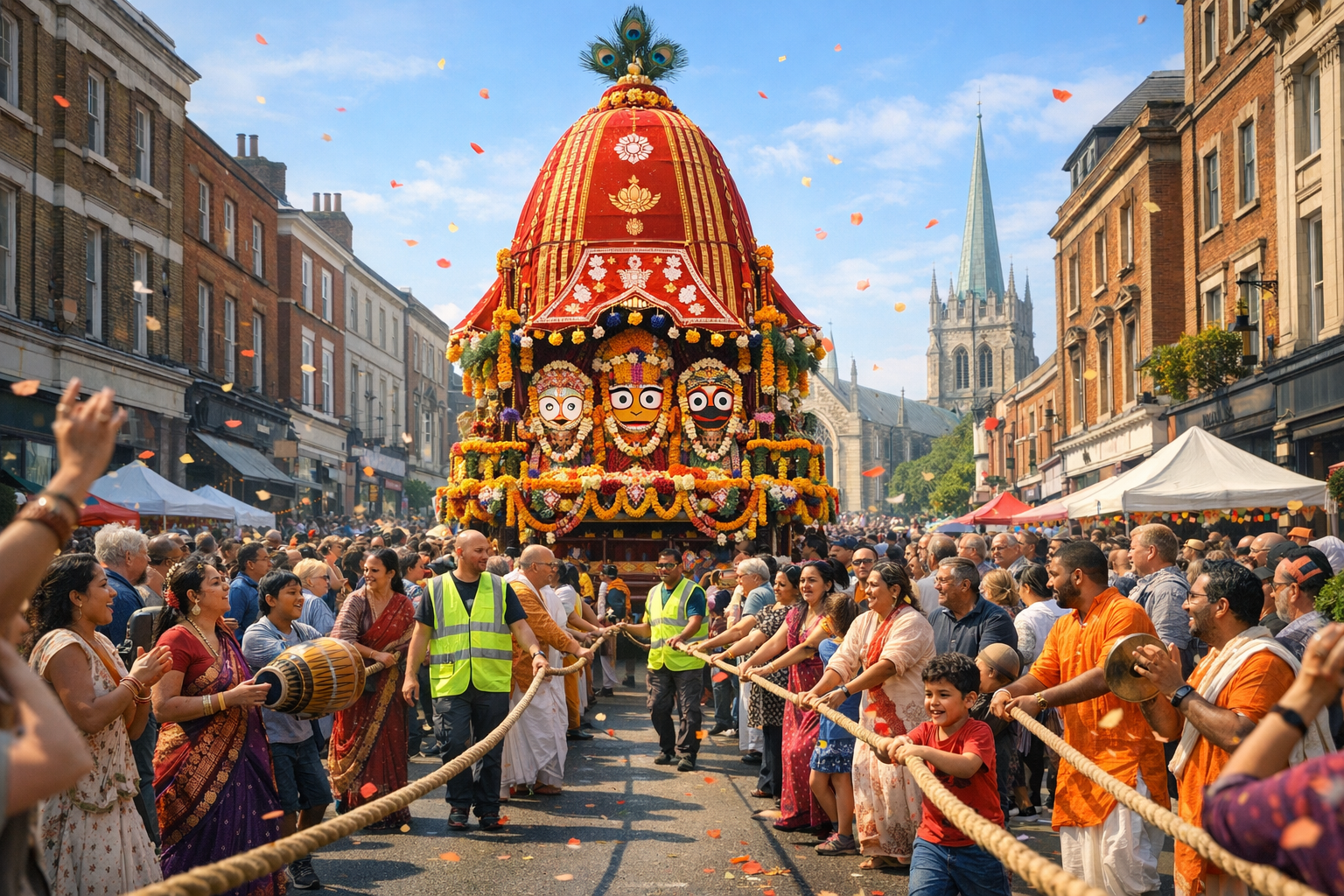
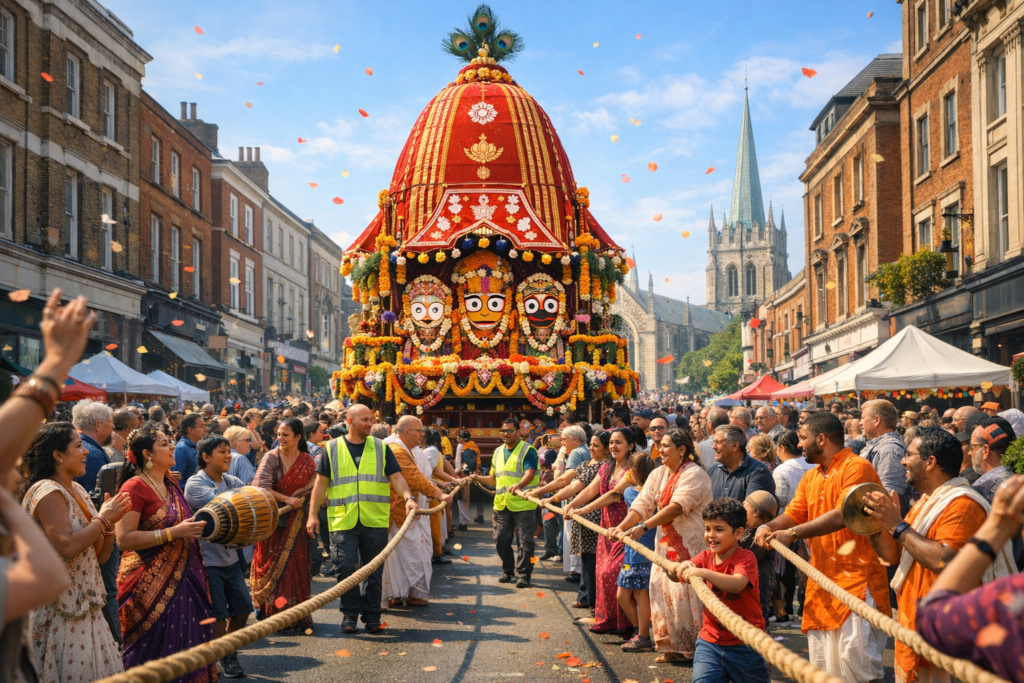
On Sunday, 14 June 2026, Chelmsford staged the second annual Rathayatra—widely known as the Festival of Chariots—with a scale and warmth that transformed the city centre. For the first time, the chariot procession advanced along Chelmsford High Street, drawing an estimated 1,200 participants and onlookers. The milestone set a new civic precedent and affirmed the event’s place in the city’s cultural calendar.
Rathayatra is rooted in the Jagannath tradition of Puri, Odisha, where the deities Jagannath, Balabhadra, and Subhadra are ceremonially drawn on towering chariots. In the modern era, the festival has travelled globally through the Hare Krishna movement (ISKCON), which has adapted the procession to urban contexts across London and many other cities worldwide. In the United Kingdom, such events highlight Hindu cultural heritage while welcoming broad public participation regardless of background, making them exemplary Hindu Festival occasions in the UK’s multicultural landscape.
Formal recognition by civic leaders framed the day’s proceedings. The Mayor of Chelmsford and her husband, together with Chelmsford MP Marie Goldman and her husband, Simon Goldman, inaugurated the festival by breaking a coconut—a customary Vedic gesture invoking auspiciousness and safe passage. In ritual terms, the coconut (śrīphala) symbolises purification and the surrender of ego; in civic terms, the act signalled partnership between faith communities and local government and set a tone of shared responsibility.
Procession dynamics were anchored in congregational kirtan—call-and-response singing of sacred names—accompanied by hand cymbals, drums, and melodic instruments. Lively dancing and rhythmic clapping created a soundscape that was both devotional and accessible, enabling children, youth, and elders to participate together. The inclusive form of bhakti-yoga embedded in Hare Krishna kirtan encouraged spontaneous engagement from passers-by, many of whom joined or followed along for segments of the route.
Bringing a religious procession onto the High Street required careful coordination of stewards, signage, and timed traffic management. Organisers utilised staggered movement, clear marshalling points, and visible volunteer teams to maintain safety while preserving flow. The measured pace accommodated families with prams, elders, and persons with limited mobility, reinforcing the festival’s ethos of hospitality and inclusion.
Attendance reflected Chelmsford’s rich diversity, with participants from varied cultural backgrounds, faiths, and age groups. The event’s open, street-based format lowered barriers to entry and modelled interfaith harmony in practice. Shared dharmic values—seva (service), ahimsa (non-harm), and sangati/sangat (community)—resonated across Hindu, Buddhist, Jain, and Sikh sensibilities, while universal themes of gratitude and celebration welcomed neighbours of all beliefs.
Beyond the procession, a curated stage hosted traditional dances, cultural presentations, and dramatic performances that linked aesthetics to meaning. Brief explanations between items helped new audiences connect rhythm and gesture to narratives from the Puranas and to living practices of devotion and ethical conduct. This pedagogy-through-performance supported cultural literacy while keeping the programme engaging for families.
Hospitality stood out as a defining experience. More than 1,200 visitors received free vegetarian food (prasadam), a Vaishnava practice in which a meal becomes sanctified hospitality that extends the circle of community. Attendees also enjoyed Nannari juice, a refreshing drink traditionally prepared from Hemidesmus indicus (Indian sarsaparilla) syrup and prized in South Indian culinary heritage for its cooling properties—an apt complement to a summer festival.
Complementary community tents amplified engagement through henna art and face painting, snacks, mantra meditation sessions, and the distribution of Vedic literature and books. These spaces functioned as living classrooms, where newcomers encountered foundational ideas—such as karma, yoga, and devotion—through conversation and practice rather than abstraction. The format encouraged questions, reflection, and respectful dialogue suitable for all ages.
Feedback from attendees was consistently positive, citing the festival’s warmth, colour, and accessibility. Chelmsford City Council acknowledged the significance of hosting the first Rathayatra procession on the High Street, noting its contribution to cultural cohesion and placemaking. The visible participation of civic leaders validated the event as a shared asset for the whole city.
While exact footfall on an open route is inherently approximate, meal distribution records and steward counts provide a pragmatic proxy for attendance. On-site observations of dwell-time—how long visitors remained in the procession, at the stage, or within activity tents—suggest sustained engagement rather than cursory viewing. Such metrics are useful for future planning around capacity, facilities, and programming depth.
The procession’s rhythmic cadence, collective singing, and steady walking align with established insights into communal music-making and wellbeing. Kirtan’s repetitive, melodic structure supports attentional focus and calm, while group dance fosters social synchrony—both associated with elevated mood and a stronger sense of belonging. Families and first-time visitors reported that the day felt both energising and restorative.
Ethical and environmental dimensions were also notable. Vegetarian catering is widely recognised as having a lower environmental footprint than comparable meat-based offerings, aligning hospitality with sustainability goals. Public-realm festivals naturally encourage walkability and public transport use in city centres, adding an additional layer of environmental benefit to the celebration.
For diaspora communities, Rathayatra functions as both devotion and documentation—an enactment that preserves intangible cultural heritage in public memory. The chariot becomes a mobile classroom; songs become archives; and collective service becomes an ethics lesson rendered at city scale. The success of Chelmsford’s Festival of Chariots underscores how heritage practices adapt to contemporary urban life without losing theological depth or cultural integrity.
Behind the scenes, multidisciplinary teams handled permits, safeguarding, route stewarding, stage logistics, and kitchen operations that met food hygiene standards. This volunteer infrastructure is a hallmark of dharmic festivals, where seva is expressed through time, skill, and attention to detail. Transparent coordination with municipal authorities strengthened trust and set replicable standards for future years.
Education through encounter emerged as a theme. Many visitors described their first hands-on experience with mantra meditation, noting that guided practice demystified techniques often perceived as esoteric. The accessible framing—simple breathing, attentive listening, and call-and-response singing—introduced the principles of bhakti-yoga alongside broader yogic concepts familiar across Hinduism, Buddhism, Jainism, and Sikh contemplative traditions.
City-centre festivals typically boost nearby businesses through increased footfall and extended dwell-time. Informal conversations with shopfront staff and café patrons indicated uplift during and after the procession, suggesting a positive economic externality that complements the event’s social and spiritual dividends. Such outcomes highlight how cultural heritage and local commerce can be mutually reinforcing.
Documentation and memory-making were integral to the day. Photographs and video contributed to a shared archive for community reflection, education, and outreach. A public video overview is available at https://www.youtube.com/watch?v=9CVsNhDoK4w, offering a visual summary for those who could not attend and a resource for future cultural education initiatives.
The 2026 edition demonstrated not only the growing popularity of Chelmsford Rathayatra but also the festival’s capacity to deepen friendship, harmony, and joy across the city. Organisers and attendees expressed a clear intention to build on this foundation—refining logistics, expanding educational offerings, and continuing to model unity in diversity at the heart of the High Street. By centring shared dharmic values and open civic collaboration, Chelmsford’s Festival of Chariots offered a compelling template for inclusive cultural celebration in the UK.
Inspired by this post on Dandavats.







Leave a Reply
You must be logged in to post a comment.