
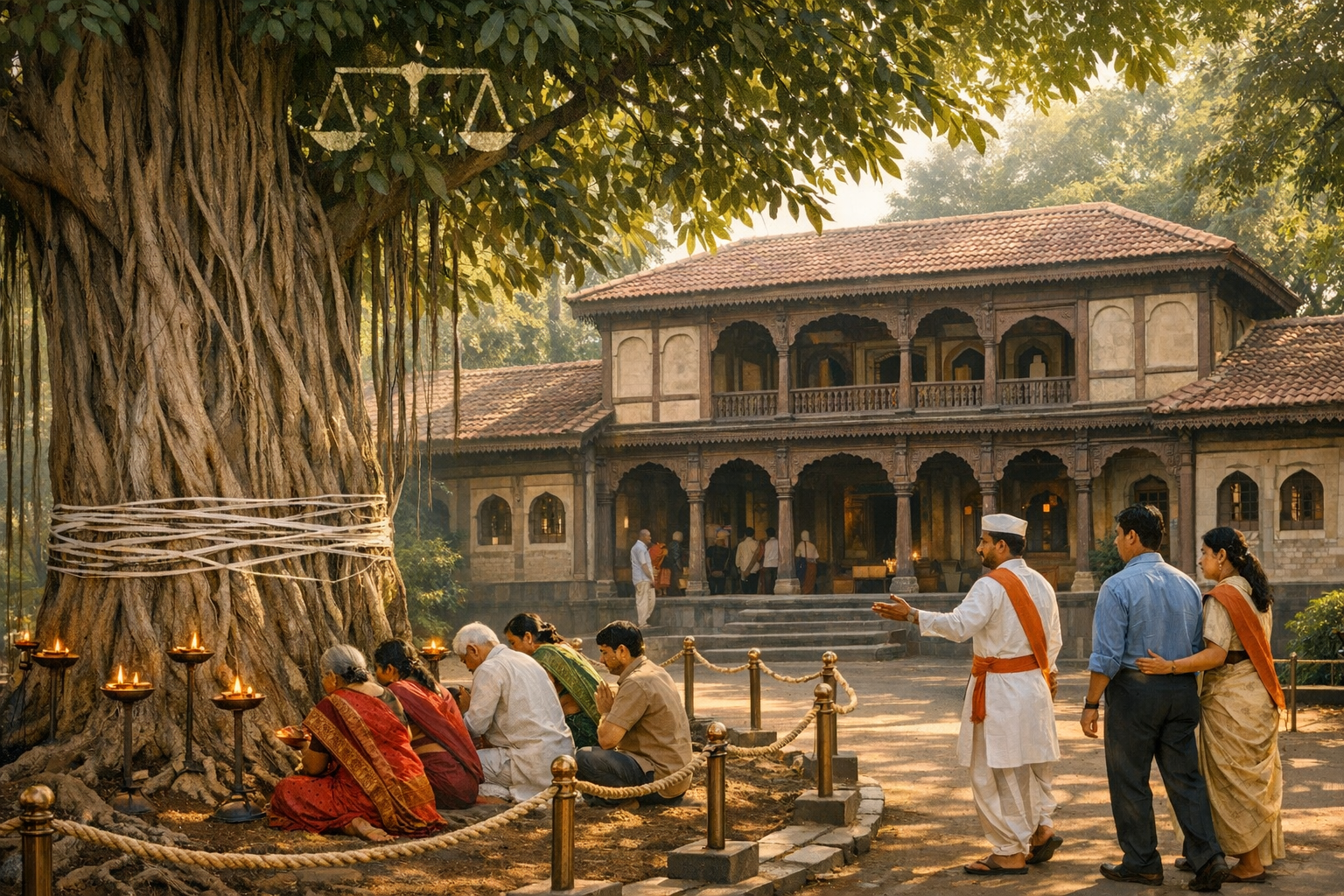
In Pune, the decision to prohibit or restrict Vatavriksha Pujan outside Mahatma Phule Wada has drawn immediate and emphatic opposition from Hindu Janajagruti Samiti (HJS) and other Hindu organisations, which have demanded that the ban be withdrawn without delay. The issue is not solely administrative; it lies at the confluence of constitutional freedoms, heritage conservation, urban governance, environmental stewardship, and social harmony. A measured resolution must preserve the sanctity of Mahatma Phule Wada as a heritage site while safeguarding citizens’ rights to perform time-honoured rituals such as Vatavriksha Pujan.
Mahatma Phule Wada, associated with the reformist legacy of Jyotirao Phule, is a seminal landmark in Pune’s civic and intellectual memory. The surrounding public space functions as a living interface where heritage, community, and urban circulation intersect. Rituals observed in such spaces carry layered meanings: they encode cultural continuity, reflect local identity, and often express values—such as social duty and environmental reverence—that are deeply rooted in everyday civic life.
Vatavriksha Pujan, widely associated in Maharashtra with Vat Savitri Vrat and observances around Vat Purnima, is an intangible cultural practice centred on the banyan tree (Ficus benghalensis). Typically, it involves circumambulation of the tree, the tying of cotton threads, modest offerings, and the recitation of vrata-kathas that link household well-being with ecological respect. In its most common community form, the ritual is orderly, decentralized, and of short duration, with families or small groups participating at different times of the day.
A blanket prohibition risks severing a vital strand of Pune’s living heritage and may inadvertently escalate tensions by pushing practices into unregulated or more congested spaces. At the same time, unstructured gatherings can impede pedestrian movement, generate litter, or harm the tree through soil compaction and constrictive bindings. The central policy question, therefore, is not whether Vatavriksha Pujan should occur, but how it can be conducted in a manner consistent with public order, heritage preservation, and environmental care.
India’s constitutional framework provides a clear starting point. Article 25 guarantees the freedom of conscience and the right freely to profess, practice, and propagate religion, subject to public order, morality, and health. Jurisprudence has repeatedly affirmed that the State may regulate the time, place, and manner of public religious observances to protect competing public interests. Landmark judgments have also distinguished between absolute bans and proportionate, narrowly tailored regulations that facilitate both civic order and religious freedom. In practice, a well-designed regulatory framework—rather than a categorical prohibition—best satisfies the constitutional balance.
Equally relevant is the heritage governance lens. Urban heritage charters, municipal heritage by-laws, and the functioning of Heritage Conservation Committees typically encourage compatible community use of heritage precincts, provided the fabric and setting are protected. For a site such as Mahatma Phule Wada, this translates into permitting culturally significant, low-impact rituals with safeguards that prevent structural stress, crowding at entry points, and damage to landscaping or historic surfaces. Heritage preservation and living traditions can, and frequently do, coexist when guided by prudent protocols.
Environmental stewardship of the banyan is another core consideration. Arboricultural practice recommends establishing a root-protection zone that typically extends to the canopy’s dripline, minimizing soil compaction, and avoiding any practice that constricts aerial roots or damages the bark. Using soft cotton threads instead of synthetic materials, placing lamps on stable stands at a safe distance from the trunk, and prohibiting nails or fixtures on the tree are simple, evidence-based measures that preserve tree health. Where appropriate, barriers and ground guards can channel foot traffic while protecting the feeder roots close to the trunk.
Concerns about public order and pedestrian safety are legitimate and solvable. Clear time windows for the puja, staggered participation, and temporary wayfinding can ensure that routine movement around the Wada remains unimpeded. Designated entry and exit paths, basic first-aid readiness, and trained volunteer stewards can further lower risk. Noise control at source—particularly during early mornings and late evenings—keeps decibel levels within municipal norms while preserving the contemplative character of the ritual.
A proportionate regulatory alternative to a blanket ban can be implemented through a permit-based standard operating procedure. Such a framework can specify the dates or periods with expected higher footfall (for example, around Vat Purnima), define permissible hours, cap simultaneous participants when required, and require organizers to provide waste segregation bins and post-event clean-up. Simple reporting lines with the local police station and municipal ward office further streamline coordination and accountability.
In multi-stakeholder contexts, process often determines outcome. A consultative pathway that brings together HJS and allied organisations, local residents, heritage and environmental experts, Pune Municipal Corporation representatives, and law enforcement can yield a site-specific code of practice. Periodic reviews—especially after high-footfall observances—enable data-driven refinements. Public notice of the agreed protocol ensures predictability for devotees and bystanders alike.
The broader dharmic perspective strongly supports a harmonizing approach. Tree reverence is a shared ethical thread across Hindu, Buddhist, Jain, and Sikh traditions. From the veneration of sacred groves in Hindu practice to the centrality of the Bodhi tree in Buddhism, from Jain ahimsa’s explicit concern for plant life to Sikh teachings that frame nature as divine manifestation, the ecological ethic is fundamentally unifying. Allowing a carefully regulated Vatavriksha Pujan near a historic site in Pune therefore affirms a civilizational value that resonates across dharmic paths while modelling inter-community respect.
Community sentiment adds an important, human dimension. For many families in Pune, seasonal observances such as Vatavriksha Pujan are woven into generational memory—quiet pre-dawn walks, soft mantras, and shared prasad in shaded courtyards. Rituals that are unpretentious and locally rooted often perform invisible social work: they sustain networks of care, transmit ethical norms, and anchor people to place with a sense of responsibility, not entitlement.
From a risk management standpoint, an absolute prohibition can be counterproductive. It may prompt unsanctioned gatherings, create avoidable friction between citizens and authorities, or set a precedent that marginalizes intangible heritage in public spaces. Conversely, a rules-based accommodation—announced well in advance and fairly enforced—channels participation into a predictable, low-risk pattern and strengthens trust in public institutions.
The case to lift the ban is therefore threefold. Constitutionally, narrowly tailored time-place-manner regulations are preferable to categorical prohibitions and better align with Article 25. From a heritage standpoint, compatible, low-impact rituals are consistent with best-practice conservation, provided protective measures are in place. Environmentally, evidence-based guidelines can safeguard the banyan’s health while allowing meaningful observance.
Operationalizing this consensus is straightforward. The municipal authority can issue a detailed permission framework for Vatavriksha Pujan at or near the Wada, stipulating tree-protection norms, volunteer stewardship requirements, waste management, noise limits, and emergency coordination. HJS and allied community groups can commit to a documented code of conduct and deploy trained volunteers to ensure compliance. A short, post-event joint review can identify improvements and reinforce a culture of shared responsibility.
In conclusion, the demand by Hindu Janajagruti Samiti (HJS) and other Hindu organisations to withdraw the ban on Vatavriksha Pujan outside Mahatma Phule Wada merits a constructive, policy-based response. Replacing a blanket prohibition with a proportionate, conservation-sensitive, and community-anchored framework honours constitutional rights, protects a treasured heritage precinct, safeguards the banyan’s ecological well-being, and advances the broader goal of unity across dharmic traditions. Pune can thus set an exemplary standard for how a historic city harmonizes living faith, civic order, and cultural continuity.
Inspired by this post on Hindu Jagruti Samiti.










Leave a Reply
You must be logged in to post a comment.