
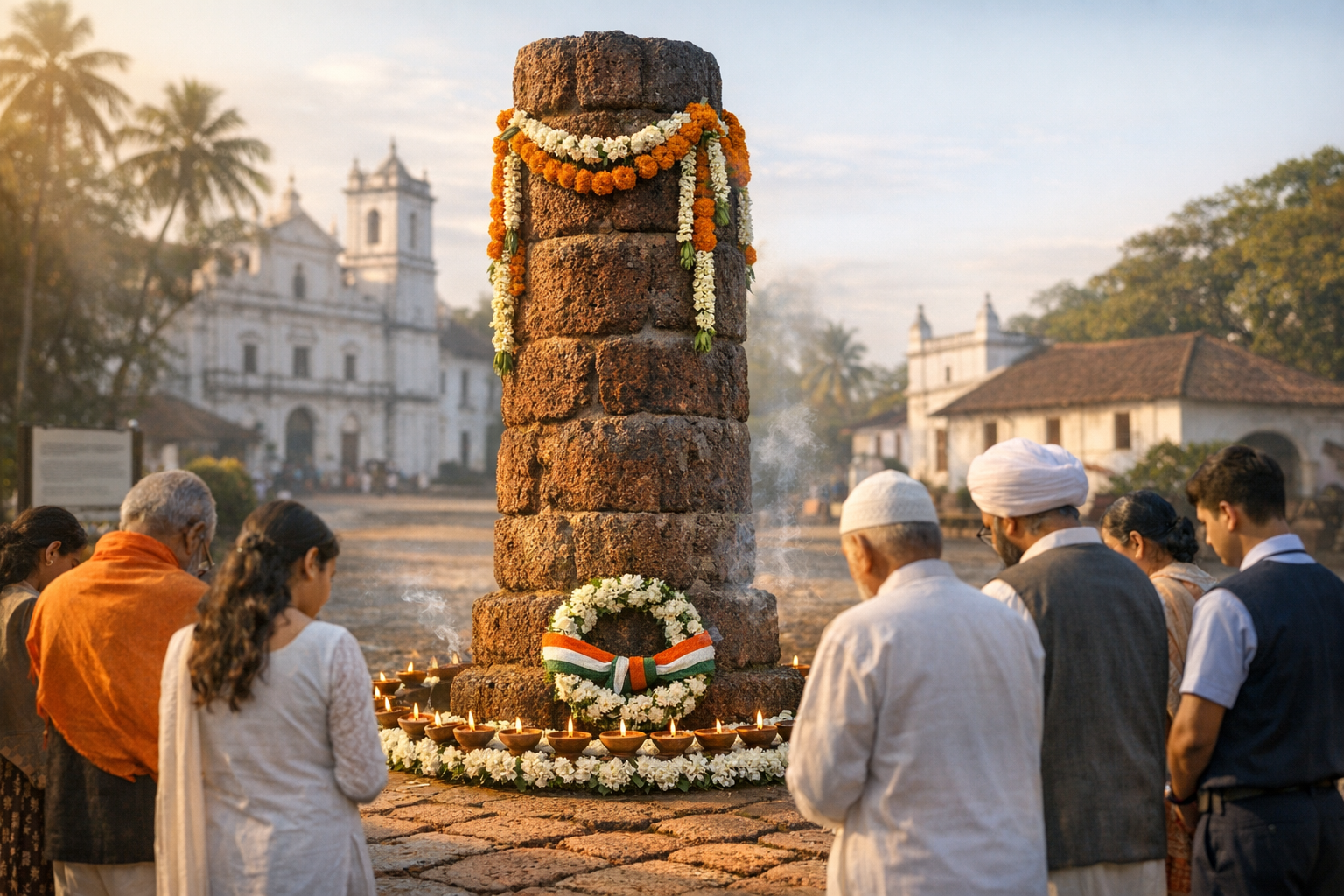
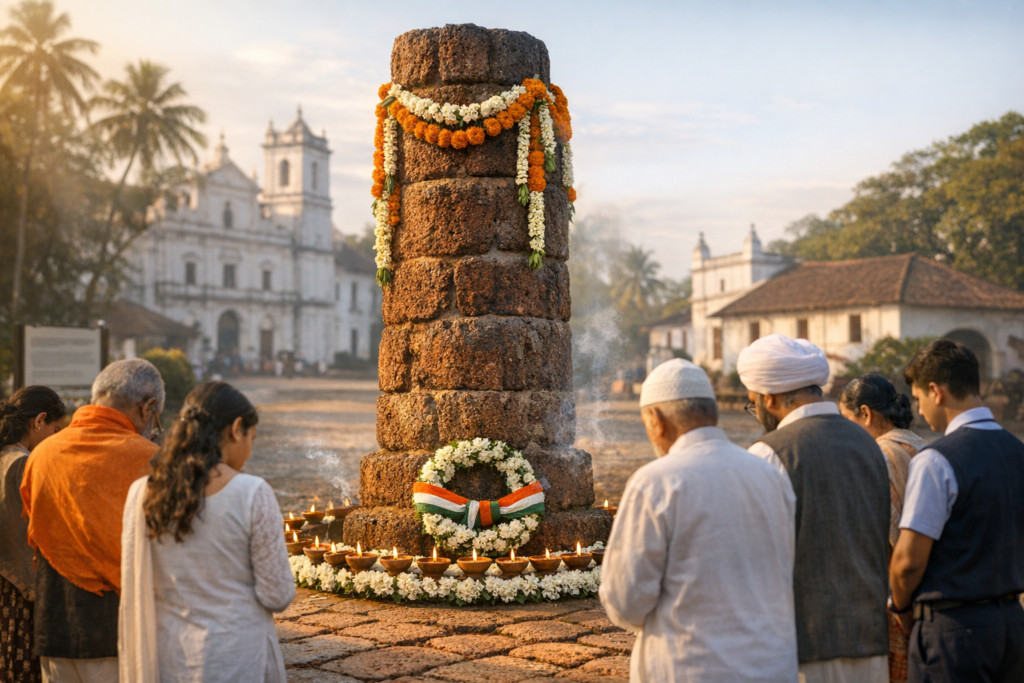
On Goa Revolution Day, the Hindu Janajagruti Samiti (HJS) held a solemn commemoration at the historic ‘Hat Katro Khamb’ in Old Goa, paying tribute to known and unknown martyrs associated with Goa’s long struggle against coercion and colonial repression. The observance foregrounded remembrance, dignity, and unity—values that resonate across dharmic traditions—while linking a pivotal date in Goa’s modern history with a tangible site of memory from an earlier epoch.
Goa Revolution Day (18 June) marks the 1946 mass civil resistance catalyzed by Dr. Ram Manohar Lohia and Dr. Julião Menezes, which revitalized the freedom movement against Portuguese rule and affirmed a plural civic identity. Commemorations each year emphasize not only the heroism of freedom fighters but also the ethical imperative to uphold pluralism, rule of law, and cultural continuity in contemporary India. In that spirit, the HJS observance framed remembrance as a bridge between historical pain and present-day commitments to non-coercion and mutual respect.
The monument itself—variously remembered locally as ‘Haat Katro Khamb’ and recorded as ‘Hat Katro Khamb’—is a monolithic stone pillar that once functioned as a pillory in the colonial justice apparatus. Situated within Old Goa’s historic precincts, part of the renowned churches-and-convents ensemble recognized for outstanding universal value, the pillar stands as a rare, material mnemonic of punitive practices under foreign rule. Archaeological stewardship and interpretive signages in the area underscore the site’s layered history and its importance for public understanding.
Within the broader historical context, the Goa Inquisition—formally instituted in 1560, suppressed in 1774, restored in 1778, and finally abolished in 1812—operated as a tribunal with jurisdiction over matters of belief and practice. Scholarly literature documents how such institutions constrained local religious, cultural, and social expressions, producing long-lasting social and psychological effects. Today’s heritage discourse engages these records not to sensationalize suffering but to cultivate an informed, empathetic public memory that rejects coercion in all forms.
The HJS tribute at ‘Hat Katro Khamb’ followed the hallmarks of a dignified civic remembrance: floral offerings, collective silence, and reflective invocations for peace and justice. Attendees included elders, students, and community members who associated the site with the resilience of Goans and the safeguarding of India’s civilizational ethos. The mood was contemplative, shaped by the recognition that remembrance is most meaningful when it nurtures social cohesion and constitutional values.
Crucially, the ceremony’s message aligned with a dharmic vision of unity that embraces Hindus, Buddhists, Jains, and Sikhs. While the monument is strongly linked to the suffering of Goan Hindus under colonial-era religious tribunals, the ethical horizon of the commemoration was inclusive: to honor all who endured injustice, to prevent future harms through education and dialogue, and to celebrate India’s living traditions of interfaith respect. Such framing anchors remembrance in shared virtues—dharma, ahimsa, satya—and the national aspiration of unity in religious and spiritual diversity.
From a heritage-management perspective, ‘Hat Katro Khamb’ benefits from approaches commonly used at global “sites of conscience”: accurate historical interpretation, multiperspectival storytelling, and community engagement that prioritizes healing over division. Integrating archival sources, local oral histories, and comparative memory studies can enrich visitor understanding, while avoiding reductive narratives or politicization of pain. This method fosters a responsible public history that is both rigorous and compassionate.
Conservation and interpretation are equally important. Continuous environmental exposure places stress on historic stone fabric; routine condition assessments, non-invasive diagnostics, and preventive conservation can extend the monument’s life-cycle. Complementary measures—QR-linked digital guides, context-rich interpretive panels, and multilingual resources—would enable students, pilgrims, and tourists to situate the pillar within Goa’s connected histories of trade, faith, colonialism, and liberation.
Educational outreach can amplify the site’s civic value. Curated school modules on Goa Revolution Day, combined with field visits to Old Goa’s heritage complex, can cultivate critical historical literacy and empathy. Public programming that invites voices from across dharmic communities further reinforces a unifying message: cultural continuity and freedom of conscience are safeguarded not only by law and scholarship but also by shared remembrance and everyday practice.
As a silent witness to a charged past and a catalyst for reflective citizenship, ‘Hat Katro Khamb’ embodies the ethics of memory that Goa Revolution Day seeks to renew each year. By honoring martyrs with sobriety and care, the HJS observance advanced a constructive public history—one that transforms remembered pain into a durable commitment to human dignity, pluralism, and the civilizational ideal of peaceful coexistence.
Inspired by this post on Hindu Jagruti Samiti.







Leave a Reply
You must be logged in to post a comment.