On 29 May 2026 in Agra, reports described a demonstration by members of the Akhil Bharat Hindu Mahasabha objecting to Eid al-Adha namaz within the Taj Mahal precincts. The incident quickly migrated from the site to broadcast and social media, where it rekindled a long-running national discussion: how to balance the Taj Mahal’s status as a UNESCO World Heritage funerary monument with the presence of a functioning mosque inside its complex, while upholding constitutional guarantees and preserving public order.
Understanding the contours of this debate requires clarity on three concurrent frameworks. First, Articles 25 and 26 of the Constitution protect freedom of religion subject to public order, morality, and health. Second, the Archaeological Survey of India (ASI) administers the conservation of protected monuments under the Ancient Monuments and Archaeological Sites and Remains (AMASR) Act, 1958 (as amended), including policies for “living” monuments. Third, district-level public-order protocols regulate gatherings, access, and security in and around high-footfall sites like the Taj Mahal.
In practice, ASI policy draws a pragmatic distinction between living and non-living monuments: worship that was historically and continuously practiced at the time of a site’s protection may continue, subject to conservation and security needs, while the initiation of new rituals or expansion of activities is generally not permitted. This approach aims to protect fabric, manage risk in crowded spaces, and respect long-standing community practices without undermining heritage value.
The Places of Worship (Special Provisions) Act, 1991, reinforces this conservation-first ethos by freezing the religious character of places of worship as it existed on 15 August 1947 (with specified exceptions). While the Taj Mahal is primarily a Mughal funerary complex rather than a typical town-temple or town-mosque, the Act’s underlying intentdiscouraging sectarian re-litigation of historical sitesremains relevant to contemporary discourse around identity claims.
Heritage management at the Taj also engages UNESCO expectations. As a World Heritage property, the monument’s Outstanding Universal Value (OUV) must be protected through integrated conservation, risk mitigation, crowd management, and community engagement. These obligations include aligning local practices with international conservation standards so that authenticity, structural integrity, and the visitor experience are not compromised by unmanaged mass gatherings or ad hoc changes in use.
Historically and art-historically, the Taj Mahal is well-documented as a 17th-century Mughal funerary ensemble commissioned during the reign of Shah Jahan. Its architectural typology (charbagh axial planning), calligraphic programs featuring Quranic verses, materials (Makrana marble; precious inlay), and the twin cenotaph-tomb arrangement are consistent with contemporaneous Mughal funerary design. Epigraphic, archival, and stylistic evidence anchor this consensus in mainstream scholarship.
Alternative narratives about the monument’s origins have periodically surfaced in public discourse. Courts and expert bodies have generally declined to treat such claims as determinative, noting the primacy of documentary, epigraphic, and material evidence in heritage adjudication. Recent judicial orders have emphasized deference to ASI’s expert judgment on conservation and access, while discouraging attempts to reframe the monument’s identity through litigation lacking robust historical proof.
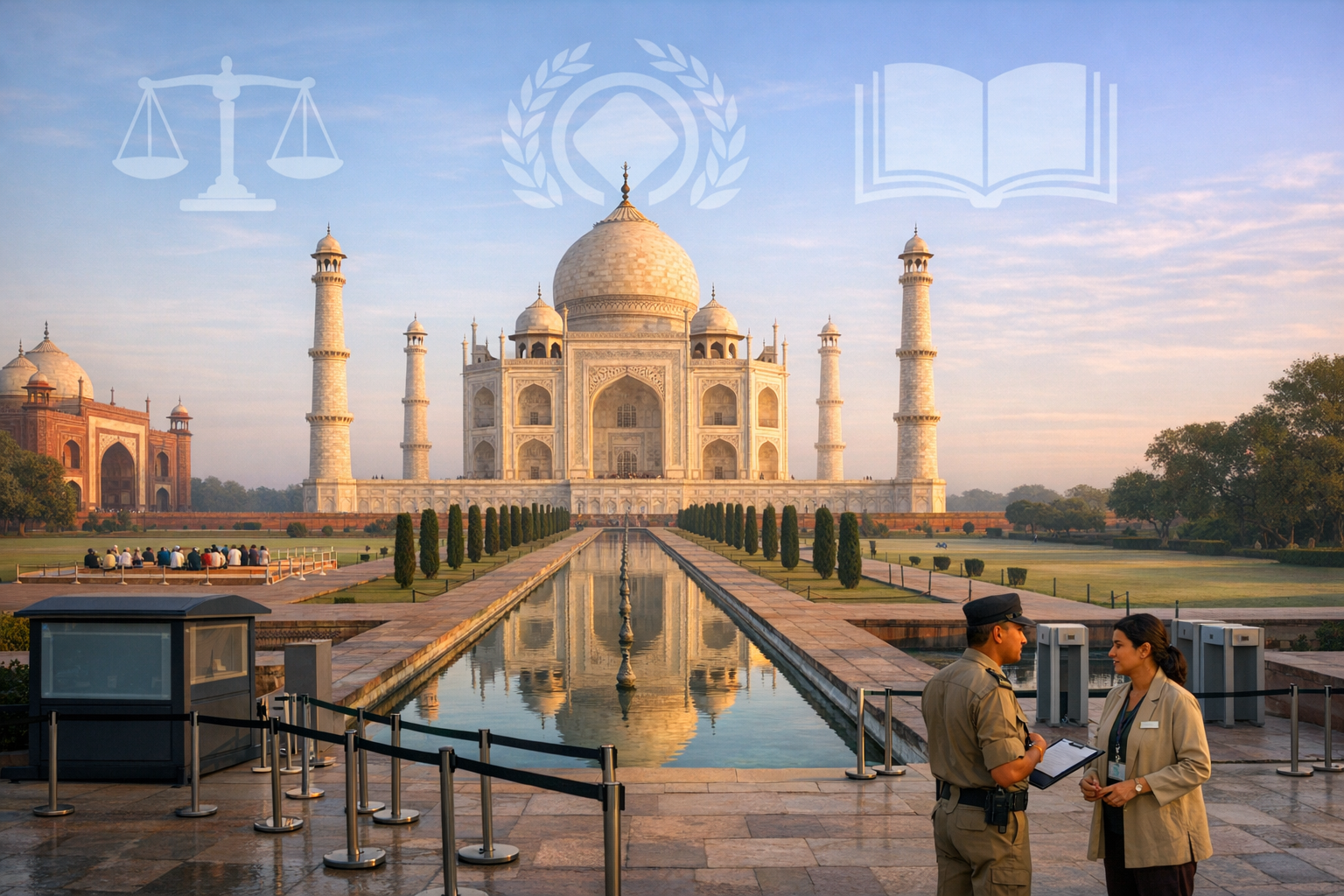
Within the Taj complex, the mosque on the western flank has been treated as a living place of worship subject to regulation. Over the past decade, local authorities have calibrated accessespecially for Friday congregational prayersthrough identity checks and time-bound entry to balance worship needs with security and conservation imperatives. On major religious dates, the city’s principal congregational spaces (such as the Idgah) typically host larger gatherings, while any worship within the protected precinct, if permitted, proceeds under ASI and district guidelines.
Against this backdrop, the protest over Eid al-Adha namaz must be read as a friction point where heritage conservation, religious freedom, and public order converge. High-visibility episodes at iconic sites are easily amplified online, often without the nuanced context of ASI policy, district administrative orders, or the monument’s conservation constraints. Precision in public communication is therefore essential to prevent polarization and protect both heritage and harmony.
The social meaning of the Taj Mahal deepens the stakes. For millions of schoolchildren, families, and pilgrims of curiosity who have stood before the marble in the quiet of an Agra dawn, the site has imprinted a memory of serenity, loss, and lovesentiments transcending sect. When a place so closely associated with aesthetic and spiritual calm becomes the stage for ideological contestation, it unsettles public sentiment well beyond Agra’s borders.
India’s civilizational traditions offer constructive pathways out of confrontation. Dharmic pluralismreflected in Hinduism’s acceptance of multiple mārga, Jainism’s anekāntavāda, Buddhism’s emphasis on compassion and skillful means, and Sikhism’s insistence on dignity and sevaencourages principled coexistence at shared spaces. These values align with constitutional secularism and can inform a locally workable, nationally resonant approach at the Taj Mahal.
A de-escalatory framework is feasible within existing law. First, the Agra administration and ASI can publish time-bound Standard Operating Procedures that clarify when, how, and by whom worship may be conducted in the precincts, distinguishing clearly between ordinary Fridays and exceptional festivals like Eid al-Adha. Second, pre-announced visitor-flow plans, queuing systems, and temporary caps on concurrent congregation sizes can safeguard the monument’s fabric and reduce crowd pressure. Third, a consultative forumbringing together ASI, law enforcement, mosque representatives, local community leaders from Hindu, Buddhist, Jain, and Sikh traditions, and civil-society heritage practitionerscan institutionalize dialogue, troubleshoot frictions, and model interfaith trust.
Equally important is transparent public communication. On high-sensitivity dates, real-time advisories through official channels should communicate permissible activities, entry rules, and alternate arrangements (for example, guiding larger congregations to capacious locations like the Idgah when necessary). This reduces rumor cascades, limits opportunistic mobilization, and makes compliance easier for residents and visitors alike.
Media and citizens also have a role. Responsible reporting that foregrounds official orders, ASI circulars, and verifiable facts can lower the temperature. Conversely, speculative claims about the Taj’s identity, or uncontextualized footage of scuffles, tend to obscure the site’s legal and conservation realities while shrinking the space for principled accommodation.
Ultimately, the Taj Mahal prayer row is not a zero-sum contest between faith and heritage. When approached through the Constitution’s guardrails, ASI’s living-monument policy, and a spirit of dharmic pluralism, it becomes an opportunity to refine a replicable model for “living heritage” governance. Such a model would preserve the monument’s OUV, respect historically sanctioned worship, and embody the civilizational ethic that diverse communities can flourish together without diminishing one another.
In practical terms, success will look ordinary: predictable SOPs; courteous, well-briefed security; worship conducted within established limits; visitors who leave both moved and informed; and a monument that enduresphysically, culturally, and symbolicallywithout being drawn into cyclical confrontation. That ordinary equilibrium, achieved through steady administration and empathetic civic leadership, is the most powerful answer to episodic discord at India’s most visited heritage site.
Inspired by this post on Struggle for Hindu Existence.