Dhumavati Jayanti (also known as Maa Dhumavathi Jayanthi) marks the first appearance day of Goddess Dhumavati, one of the Dasha Mahavidyas (Dus Mahavidyas) in the Shakta Tantra tradition. In 2026, Dhumavati Jayanti falls on Monday, 22 June, aligning with Jyeshta Shukla Ashtami, the eighth lunar day in the bright fortnight of the Jyeshta maas in the Hindu calendar.
The observance of Dhumavati Jayanti on Jyeshta Shukla Ashtami is determined by the tithi prevailing at local sunrise. Because lunar dates shift with geography and astronomical calculations, practitioners worldwide should confirm the Ashtami tithi with a reliable regional panchang for precise muhurat selection. When Ashtami spans two civil dates in a given location, the day on which Ashtami is active at sunrise is generally preferred for the Jayanti vrata.
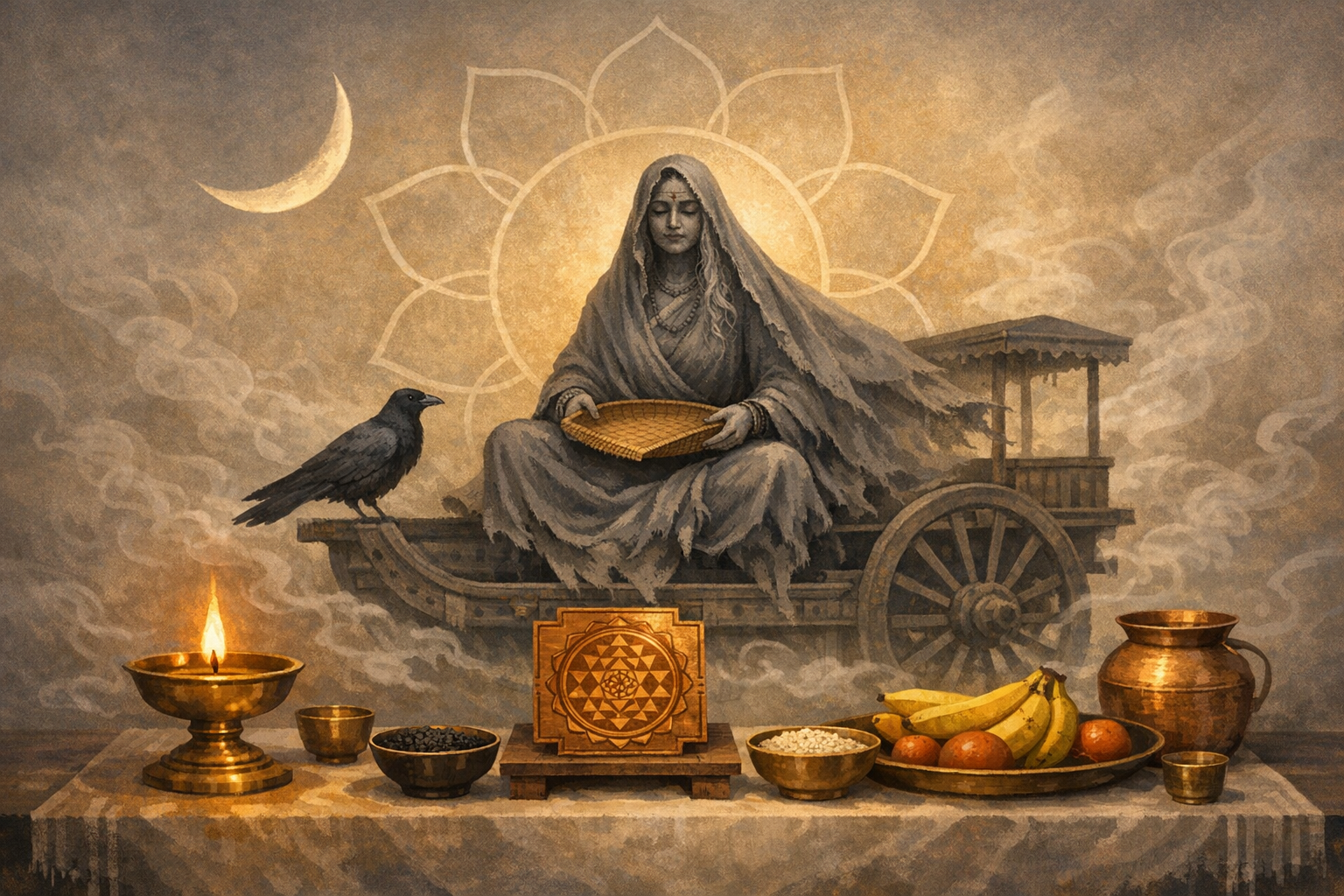
Goddess Dhumavati embodies the paradoxical wisdom of the void and the alchemy of loss. Iconographically, she is portrayed as an older, veiled, and smoke-hued deity, sometimes seated on a horseless chariot or associated with the crow, and often holding a winnowing basket (supa). These symbols do not signify inauspiciousness in a social sense; rather, they point to mature discernment, dispassion (vairagya), and the capacity to perceive truth beyond appearances and conventions.
Shakta Tantras recount Dhumavati as the smoky emanation of the Great Goddess the power that remains when names, forms, and expectations are exhausted. In narrative motifs, she is linked to the momentary dissolution of familiar supports so that a seeker may encounter the unvarnished real. Within the Dasha Mahavidya corpus, she offers a pedagogy of renunciation, endurance, and spiritual clarity in times of delay, uncertainty, or grief.
Across dharmic traditions, the contemplative spirit of Dhumavati resonates with allied insights. In Buddhism, shunyata articulates the depth of emptiness-clarity; in Jainism, aparigraha commends non-grasping; in Sikh tradition, acceptance of hukam nurtures steady-hearted resilience. Observing Dhumavati Jayanti with reverence for plural pathways underscores shared dharmic values compassion, discipline, and inner freedom and strengthens inter-traditional harmony.
Dhumavati Jayanti is observed by householders and renunciants through vrata (fasting), puja, and mantra-japa. While classical Tantric upasana of Mahavidyas often requires a qualified guru, the Jayanti itself may be honored in a sattvik, family-friendly manner that emphasizes humility, simplicity, and service (seva).
Shubh muhurat selection follows standard rules: practitioners give preference to the daylight period in which Ashtami tithi is active, with additional consideration for pratakal (early morning) or madhyahna (midday) worship where feasible. Diaspora communities should note that the Ashtami window can begin or end a day earlier or later than in India due to time zone differences, making local panchang verification essential.
Vrata on Dhumavati Jayanti is typically observed as a sattvik fast, ranging from phalahar (fruit and milk) to a light single meal after sunset, depending on health and guidance. Those with medical conditions or specific dietary needs may adapt the fast responsibly. Parana (breaking the fast) is performed after puja and japa, ideally when Ashtami has concluded or as per family tradition.
A simple home puja may include cleaning the altar, placing an image or yantra of Dhumavati, and lighting a mustard oil deepa to signify the dispelling of inner obscurations. Offerings commonly include black or white sesame, plain sattvik naivedya such as unspiced khichdi or kheer, seasonal fruits, and water. Feeding crows and extending care to elders and widows are considered especially meritorious, aligning the ritual with social compassion.
Mantra-japa on this day aims at stabilizing the mind. Practitioners often employ the bija dhum (or dhoom) and the widely attested invocation Dhoom Dhoom Dhumavati Swaha under proper guidance. For householders without formal Tantric initiation, general devotional recitations such as select chapters from Devi Mahatmyam, hymns to the Divine Mother, or a meditative repetition of the name Dhumavati may be adopted in a respectful and unassuming way.
Yantra worship, when undertaken, is approached with purity and care, traditionally on copper or bhojpatra. In a non-initiated household context, the yantra may be honored as a visual focus for meditation rather than as the focal point of advanced ritual procedure, ensuring that practice remains both reverent and responsible.
Spiritual intentions (sankalpa) for Dhumavati Jayanti frequently include prayers for clarity amid uncertainty, resilience during prolonged challenges, and the wisdom to let go of self-limiting patterns. Observers often report a deepened ability to wait patiently, make measured decisions, and transform disappointment into discernment through reflective practice.
While classical texts frequently associate Dhumavati with renunciation, modern householders may draw from her symbolism in ways appropriate to family life cultivating contentment, simplifying needs, reducing mental clutter, and practicing truthfulness in speech and action. In this sense, Dhumavati guides toward ethical gravitas and spiritual maturity that benefit the home and community alike.
Pilgrims often seek darshan at the Shri Dhumavati Mata Temple in Varanasi, an important Mahavidya shrine. Where travel is not possible, home worship with sincerity and attention to detail is upheld as spiritually efficacious. The essence of the Jayanti is inward transformation; the outer form of observance can be scaled to one’s means and responsibilities.
Texts such as the Dhumavati Tantra and compendia of Mahavidya lore position her as the teacher of life’s unsentimental lessons endurance, self-knowledge, and the courage to remain present when outcomes are delayed. Study, svadhyaya (self-reflection), and quiet intervals of meditation complement the ritual dimension of the day.
Acts of seva on Dhumavati Jayanti extend the ritual into ethical action: donating simple meals, supporting elder care, offering companionship to those navigating grief, and practicing ecological mindfulness at home. Aligning ritual purity with social conscience embodies dharmic unity in practice.
For those new to the observance, a balanced approach is recommended: keep worship sattvik, emphasize compassion, and avoid complex Tantric rites without guidance. The Jayanti’s ethos is contemplative; silence (mauna), limited digital engagement, and mindful breathing amplify the day’s introspective quality.
Because Dhumavati’s iconography includes smoke, practitioners sometimes prefer minimal incense and well-ventilated spaces, prioritizing the inner, meditative ‘clearing of smoke’ over excessive sensory inputs. The outer symbolism thus mirrors an inner process of unveiling clarity.
A concluding meditation often centers on gratitude for the lessons of impermanence and the quiet strength gained from meeting uncertainty with composure. When observed in this spirit, Dhumavati Jayanti becomes a sophisticated practice of inner alignment, helpful not only for individual transformation but also for building resilient, compassionate communities.
Key takeaway for 2026: Dhumavati Jayanti occurs on 22 June (Jyeshta Shukla Ashtami). Observers may confirm local tithis, keep the vrata and puja sattvik and simple, chant mantras with devotion, and embody the festival’s wisdom through service and solidarity across dharmic traditions.
Inspired by this post on Hindu Pad.