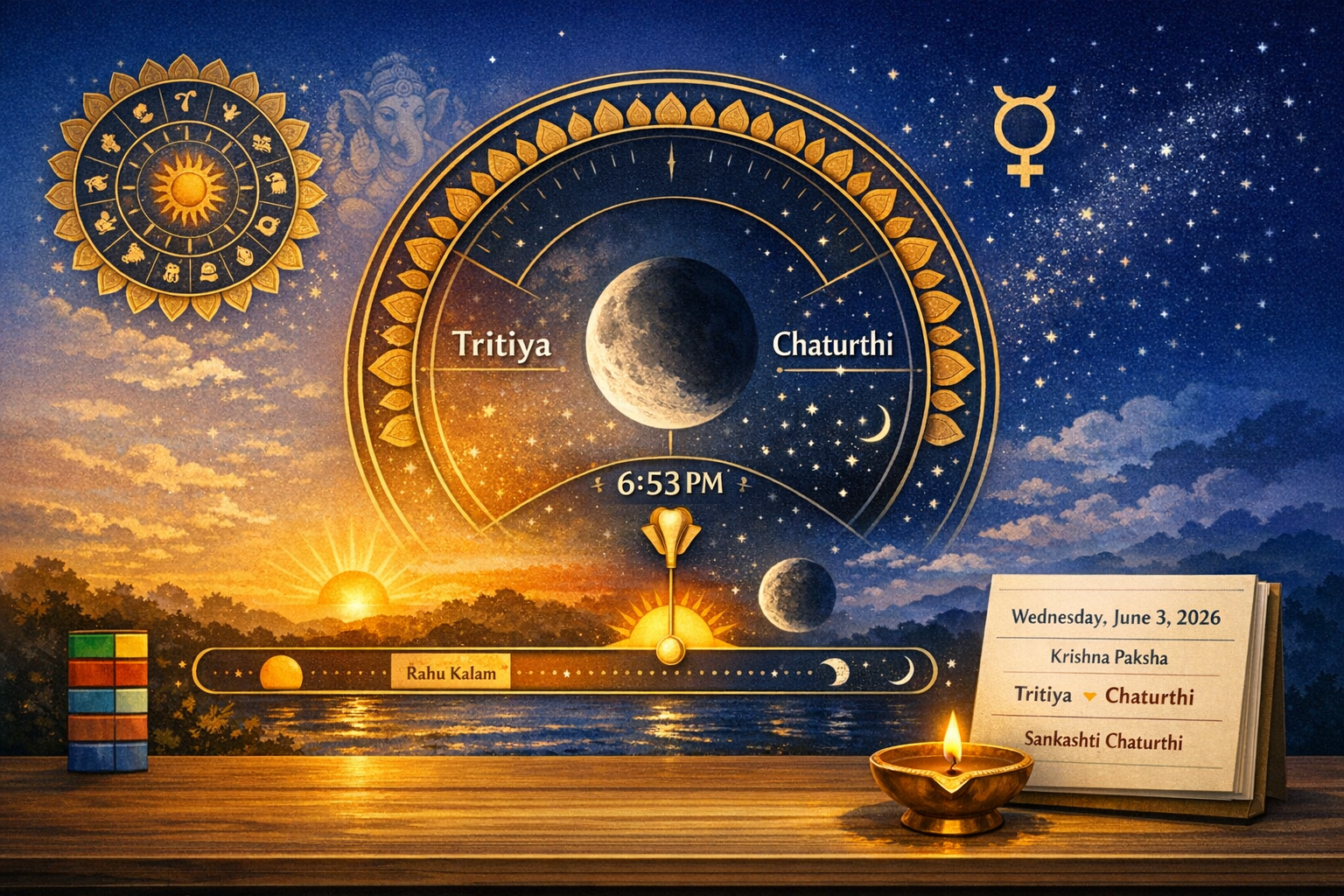
On Wednesday, June 3, 2026, the Hindu calendar (Panchang) marks Krishna Paksha Tritiya, the third day of the waning moon, until 6:53 PM in most regions. From that time onward, Krishna Paksha Chaturthi extends through the evening and into the night, a transition that shapes the day’s observances, shubh muhurat choices, and spiritual focus.
Technically, a tithi is the lunar day defined by the Moon–Sun angular separation increasing (or decreasing in the waning half) by 12°. Because the Moon’s motion is not uniform, a tithi can last roughly 19–26 hours, and it may begin or end at any clock time. Most regional Panchangs assign the civil date by the tithi at local sunrise, while many vratas and festival rites follow the tithi prevailing at a specific event time (for example, moonrise for Chaturthi). This is why regional almanacs may show slight variations even when the underlying astronomical event is the same.
Krishna Pakshathe waning fortnighttraditionally encourages introspection, simplification, and completion. Its energy is often described as conducive to consolidating efforts, refining plans, and letting go of excess. Many households notice that routines feel more settled in this phase, and devotional reading, mantra-japa, and quiet study tend to feel naturally supported.
Within this context, Tritiya (the third lunar day) during Krishna Paksha is considered moderately auspicious for learning, organization, light financial planning, and skill-based tasks that benefit from careful attention. It is also a helpful window for sacred housekeepingdecluttering altars, refreshing puja items, and arranging study materialsso that the evening’s transition into Chaturthi can be observed with composure and clarity.
After 6:53 PM, Krishna Paksha Chaturthi begins. Monthly Chaturthi in the waning phase is observed across regions as Sankashti Chaturthi (Sankatahara Chaturthi in the South), a vrata associated with Bhagavan Ganesha’s grace in removing obstacles (sankata). Traditional practice observes the fast and puja at night and concludes after moonrise with darshan of Chandra and offerings to Ganesha. Because Chaturthi commences in the evening on June 3, many regions will find the night suitable for Sankashti observances; however, the precise fasting break depends on the local moonrise time, so a location-specific Panchang should be consulted.
Wednesday (Budhavara) is linked to Budha (Mercury), symbolically connected with intellect, articulation, commerce, documentation, and analytical clarity. Tasks that require careful review, negotiation, correspondence, or data-driven decision-making usually align well with Wednesday’s temperament. When this weekday coincides with Krishna Paksha Tritiya for much of the daytime, the combination especially favors systematic study, editing, skilful craftsmanship, and methodical financial assessments, provided one respects inauspicious windows like Rahu Kalam.
Regarding shubh muhurat and protective timings, two principles are central. First, Abhijit Muhurat is a short auspicious window centered on local solar noon, traditionally used for undertakings when other strong muhurats are unavailable. Second, on Wednesdays, Rahu Kalam often straddles the midday hours. When Abhijit overlaps Rahu Kalam, classical guidance prefers avoiding major beginnings despite the otherwise auspicious Abhijit. In practice, one identifies local sunrise, computes solar noon, and then confirms whether Rahu Kalam intrudes on that noon window before scheduling important starts.
Rahu Kalam, Yamaganda, and Gulika are calculated by dividing the time from sunrise to sunset into eight equal parts and assigning each part by weekday. For Wednesday, the conventional pattern places Yamaganda in the second daylight segment and Gulika in the fourth, while Rahu Kalam occupies the fifth segment (approximately mid-day for many latitudes). Because these segments scale with season and location, they should be computed from local sunrise and sunset rather than assumed from fixed clock times.
Choghadiyaanother regional timing system popular in western Indiaclassifies the day and night into cyclical blocks (such as Amrit, Shubh, Labh, Char, Kaal, Udveg, and Rog). For routine errands and short undertakings, choosing Amrit, Shubh, and Labh blocks is favored, while Kaal, Udveg, and Rog are generally avoided. This system provides pragmatic guidance when a detailed muhurta analysis is impractical, though care should still be taken to avoid overlap with Rahu Kalam.
Nakshatra and Rashi (the Moon’s sign) refine the day’s quality. The nakshatra offers a subtle psychological and ritual tone, while the Moon’s rashi frames emotional tenor and decision-making style. Because the Moon moves swiftly, both nakshatra and rashi can change during the day, particularly around evening transitions like the one on June 3. A reliable, region-specific Panchang or astronomical ephemeris will identify the exact nakshatra and Moon-sign at any chosen moment for accurate muhurta assessment.
Beyond tithi, the five classical limbs of the PanchangVāra (weekday), Tithi (lunar day), Nakshatra (lunar mansion), Yoga, and Karanawork together. Yoga blends the longitudes of Sun and Moon into a qualitative indicator for spiritual and practical momentum, while Karana (half-tithis) sharpens timing for short-duration actions such as signing documents or beginning a short journey. On days that witness an evening tithi change, practitioners often align smaller tasks with a favorable Karana earlier and reserve contemplative or devotional work for the post-transition hours.
Month designations vary by regional tradition (Amanta versus Purnimanta systems), and in 2026 some almanacs note Adhik Jyeshta Maas 2026. As a result, the civil label of the lunar month for June 3 may differ by region while the underlying astronomical tithi sequence remains consistent. This nuance explains why festival dates across India, and among the global diaspora, can appear offset even when calculated from the same celestial motions.
Harmonizing with the broader dharmic family, many Jain communities also pace vratas by tithi; Buddhist traditions are attentive to lunar phases for uposatha-like observances; and within Sikh practice, while the Nanakshahi calendar is primarily solar, select gurpurabs are observed with reference to lunisolar cues in some communities. Recognizing these shared temporal rhythms fosters an inclusive appreciation: diverse paths can align around the same sky, honoring unity across Hinduism, Buddhism, Jainism, and Sikhism while celebrating the distinctive ways each tradition keeps sacred time.
For practical planning on June 3, 2026: daytime hours until 6:53 PM fall under Krishna Paksha Tritiya, which favors learning, maintenance, measured financial reviews, and devotional reading, subject to avoiding Rahu Kalam, Yamaganda, and Gulika. After 6:53 PM, Krishna Paksha Chaturthi begins, guiding Ganesha-focused worship. Those observing Sankashti Chaturthi or Sankatahara Chaturthi should verify local moonrise to determine the correct fasting break and puja sequence.
In summary, Wednesday, June 3, 2026, presents a two-part spiritual cadence: Krishna Paksha Tritiya until 6:53 PM, then Krishna Paksha Chaturthi through the night, with the day’s Mercury tone supporting study and communication. Thoughtful attention to shubh muhurat, Nakshatra and Rashi, and protective periods such as Rahu Kalam ensures that both practical tasks and sacred observances are aligned with the celestial flow. As always, a trusted, location-specific Panchang provides the most precise guidance for Nakshatra, Rashi, and moonrise-dependent rites.
Inspired by this post on Hindu Blog.