On 19 May 2026, Vinayaki Chaturthi aligns with Angarak Yog, creating a highly auspicious observance for seekers who honor Bhagavan Ganesha as the remover of obstacles and the granter of auspicious beginnings. In Hindu calendar terms, this is the Shukla Paksha Chaturthi of Adhik Jyeshtha Maas occurring on a Tuesday (Mangalvar), hence the designation Angarak (Bhauma) Vinayaki Chaturthi. The weekday verification is straightforward: 19 May 2026 falls on a Tuesday, intensifying the vrata’s remedial and devotional focus.
Calendar nomenclature varies regionally but converges on the same tithi. As per Purnimant calendars followed across much of North India, the day falls in the Shukla Paksha of Adhik Jyeshtha. In Amavasyant calendars prevalent in Marathi, Kannada, Telugu, and Gujarati traditions, it likewise lands in Adhik Jyeshtha Maas. Regardless of system, the Panchang guidance is consistent: the tithi’s presence during local madhyahna (midday) is preferred for puja in the Shukla Paksha variant of this vrata, while all observances prioritize worship when Chaturthi is in effect.
Angarak Yog in vrata parlance denotes the occurrence of Chaturthi on a Tuesday and should be distinguished from the Jyotisha usage of “Angarak Yoga” that can refer to a Mars–Rahu conjunction in natal charts. In the liturgical context here, Angarak Yog emphasizes the energetic intersection of Mars (Mangal/Bhauma/Angaraka) with Ganesha’s śānta (peaceful) and buddhi-pradā (intelligence-giving) qualities. The synthesis is traditionally understood to sublimate martial restlessness into disciplined initiative, aligning courage with clarity and dharmic restraint.
Significance extends beyond outward ritual. Devotees frequently describe a heightened steadiness of mind, reduced friction in day-to-day tasks, and renewed resolve to undertake complex responsibilities. In the language of dharmic practice, Vinayaki Chaturthi is a practical sādhanā that cultivates one-pointed attention (ekāgratā), transforms effort (prayatna) into ethically guided action, and harmonizes willpower with wisdom—an especially meaningful balance when Mars-associated dynamism is at play on a Tuesday.
Vrat and puja guidelines (general, with regional flexibility):
1) Sankalpa and preparation: Begin with a simple sankalpa stating the observance of Vinayaki Chaturthi in Adhik Jyeshtha Maas for removal of obstacles (vighna-vināśa) and attainment of auspiciousness (śubha-lābha). Maintain satvik food practices; many observe phalahar or ekabhukt, adjusting to health and tradition.
2) Puja window: For the Shukla Paksha Vinayaki Chaturthi, many traditions prefer madhyahna puja when Chaturthi tithi prevails. If the tithi spans other parts of the day, perform worship while Chaturthi is operative. Local Panchang and Tithi timings should guide the exact window.
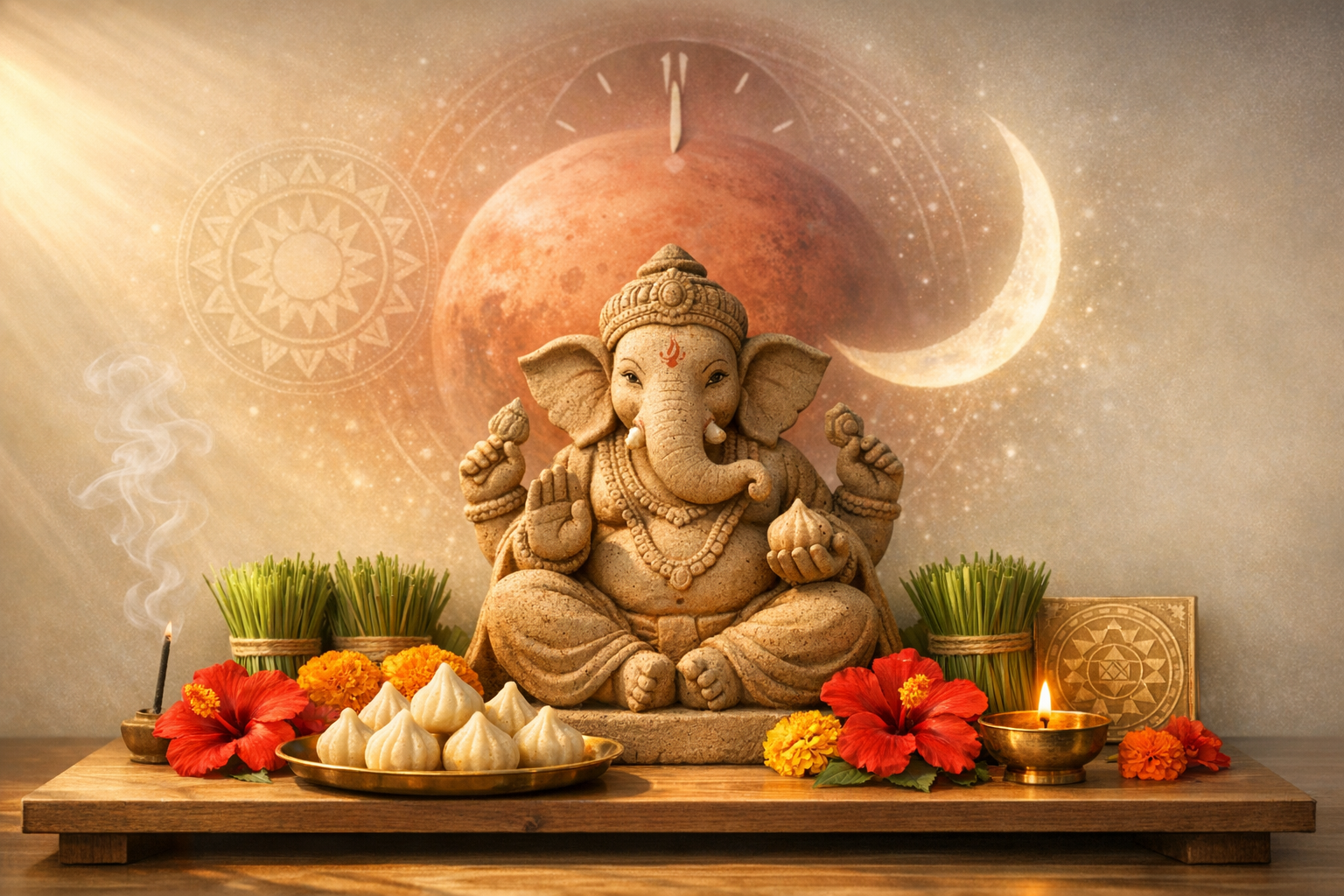
3) Alankara and offerings: Offer durva grass (traditionally 21 blades/bunches), modak or other satvik naivedya, red or yellow flowers, akshata, gandha, dhoop, and deepa. A clay, metal, or well-sourced eco-friendly Ganesha murti or a yantra may be used for avahana and upacharas.
4) Mantra and stotra: Recitation of Ganapati Atharvashirsha (Ganapati Upanishad) is widely recommended, alongside “Om Gam Ganapataye Namah” japa. Texts like Sankata Nashana Ganesh Stotra are also customary. Conclude with aarti and shared prasada.
5) Parana (fast conclusion): Practices vary by sampradaya. Many households observing the Shukla Paksha Vinayaki Chaturthi conclude the fast after midday worship, while some conclude later in the day. Follow the family/guru-parampara guidance while keeping health foremost.
Panchang and timing considerations support both accuracy and accessibility. Chaturthi tithi in Shukla Paksha manifests when the Moon–Sun elongation is approximately 72 degrees (post-amavasya). The practical rule is to privilege worship while the tithi prevails locally; if Chaturthi overlaps madhyahna, that window is often preferred for Vinayaki observance. Where uncertainty arises, reliable regional Panchang authorities and temple schedules provide clarity, ensuring that the vrata aligns with the lived rhythm of the Hindu calendar.
From a Jyotisha-informed perspective (without fatalism), Angarak Vinayaki Chaturthi is regarded as beneficial for tempering excessive Martian patterns—impatience, conflict-proneness, or impulsivity—through Ganesha’s sattvic regulation. Devotees undertaking initiatives in education, property resolution, service, or leadership often choose this day to seek inner steadiness, ethical discernment, and removal of subtle impediments. The emphasis remains on self-effort and character refinement, using ritual as a contemplative scaffold rather than a substitute for responsibility.
Ritual minimalism and ecological care strengthen the vrata’s intent. Eco-friendly murtis and biodegradable offerings honor dharma’s emphasis on stewardship (dharma-rakṣa). Donations of food (anna-dāna), notebooks for students, or support to local community kitchens resonate with Vinayaka’s role as guardian of thresholds—transforming individual worship into community well-being.
The shared civilizational values of the dharmic traditions provide a unifying backdrop to the day’s practices. Across Hindu, Buddhist, Jain, and Sikh traditions, there is a common ethic of self-mastery, compassion, disciplined effort, and wisdom-guided action. While forms and doctrines differ, the ideal of removing inner obstacles—anger, lethargy, confusion—remains a converging aspiration. Observances like Vinayaki Chaturthi, approached with humility and inclusivity, strengthen that broader harmony.
Key takeaways for 19 May 2026: it is Angarak (Tuesday) Vinayaki Chaturthi in Shukla Paksha of Adhik Jyeshtha Maas across both Purnimant and Amavasyant calendars; perform Ganesha puja while Chaturthi prevails (preferably around madhyahna by many traditions); maintain satvik vrata discipline; recite Ganapati Atharvashirsha and Ganesha mantras; and channel Mars-like energy into calm initiative and service. The vrata thus becomes both a precise Panchang-aligned observance and a practical pathway to clearer judgment, steadier courage, and compassionate action.
Inspired by this post on Hindu Pad.