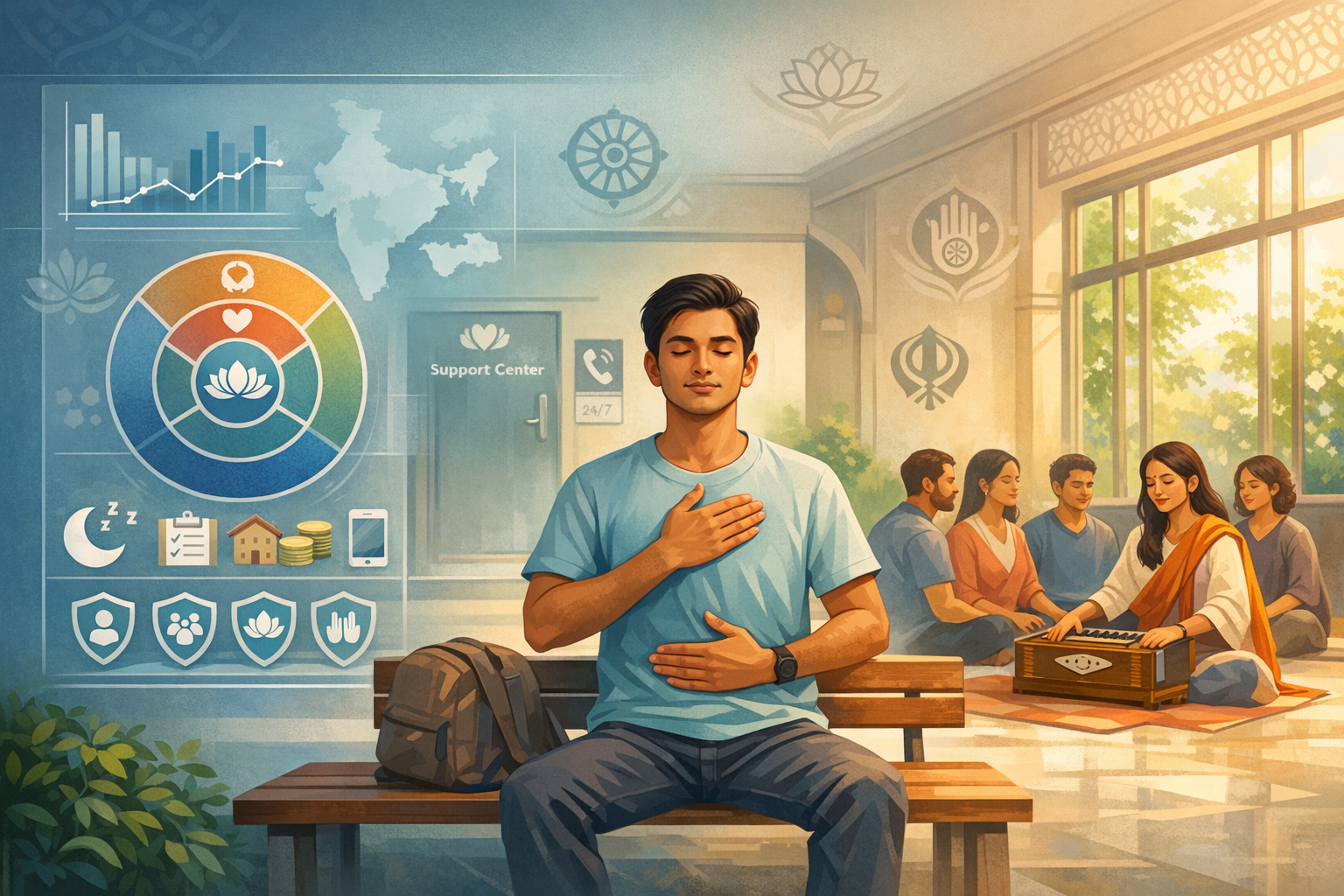
During a Satsang, Sri Sri Ravishankar (Founder of Art of Living) was asked why students are increasingly dying by suicide. He answered that many were never taught spiritualityespecially practices such as pranayama and meditation. That perspective points to an important protective pathway, yet the phenomenon itself is multifactorial and calls for an integrated, evidence-based response that combines clinical care, educational reform, family and peer support, and the shared contemplative wisdom of Hinduism, Buddhism, Jainism, and Sikhism.
This analysis adopts the public-health convention of saying “died by suicide” rather than “committed suicide” to reduce stigma and to emphasize prevention. The aim is to synthesize what data show about student suicides in India and globally, explain the mechanisms that elevate risk, and outline actionable, dharmically-informed, evidence-based solutions for schools, colleges, families, and communities.
Globally, the World Health Organization estimates that more than 700,000 people die by suicide each year, with youth and young adults disproportionately affected; among those aged 15–29, suicide consistently ranks among the leading causes of death worldwide. In India, official National Crime Records Bureau (ADSI) reports show that student suicides have reached record highs in recent years, crossing 13,000 annuallyan alarming trend that aligns with rising academic pressure, migration to coaching hubs, social isolation in hostels, and post-pandemic stressors. Behind every number is a life abbreviated and a network of families, classmates, and teachers navigating grief and unanswered questions.
Suicide risk in students emerges from the convergence of biological vulnerability, psychological processes, social context, and environmental stressorsa bio-psycho-social-spiritual framework. No single cause is sufficient; risk accumulates when multiple adversities co-occur while protective buffers are thin.
At the individual level, depressive and anxiety disorders, substance misuse, neurodevelopmental conditions, and undiagnosed mood instability often elevate risk. Neurobiologically, chronic stress dysregulates the hypothalamic–pituitary–adrenal (HPA) axis, reduces heart-rate variability, and biases attention toward threat and self-criticism; early adversity can sensitize these systems. Cognitively, hopelessness, rigid perfectionism, and catastrophic thinking narrow problem-solving and increase entrapment.
Educational ecosystems can amplify that vulnerability. High-stakes examinations (for example, NEET and JEE), tightly packed syllabi, relentless assessments, and rank-based comparisons reinforce fear of failure. Many students relocate to unfamiliar cities and coaching centers, experience cultural and linguistic shifts, face financial strain, and lose everyday sources of belongingall while sleep and nutrition deteriorate.
Within families, love and aspiration can inadvertently turn into unrelenting expectations, conditional approval, or silence around emotions. Romantic relationship stress, bullying or ragging, discrimination, and cyberharassment further erode belonging. Stigma around help-seeking, especially for young men taught to “tough it out,” delays intervention until crises become acute.
Digital environments add complexity. Continuous notifications, algorithmic comparison on social media, and late-night screen exposure fragment attention and impair sleep architecture. Sleep deprivation alone heightens emotional reactivity, degrades executive control, and correlates strongly with suicidal ideation in adolescents and young adults.
Contemporary models help explain how risk translates into action. The Interpersonal–Psychological Theory of Suicide highlights perceived burdensomeness and thwarted belongingness, coupled with an acquired capability to overcome fear of harm. The Integrated Motivational–Volitional model adds the roles of defeat, humiliation, and entrapment, progressed by volitional factors such as impulsivity, access to means, and exposure to suicide in peers or media. Understanding these pathways informs precise points for prevention.
Common warning signs include sustained hopelessness, withdrawal from friends or usual activities, drastic changes in sleep or appetite, sharp declines in academic performance, giving away possessions, or explicit talk about death or being a burden. Any of these signs warrant compassionate, immediate connection to professional support and trusted adults.
Evidence-based prevention couples early identification with accessible care. Gatekeeper training for teachers, hostel wardens, and student leaders improves recognition and referral. Confidential counseling services, crisis triage pathways, and partnerships with nearby hospitals reduce service gaps. Environmental safety measures that limit access to common means, respectful postvention protocols after a campus death, and adherence to safe-messaging guidelines reduce contagion risk.
Universal mental-health literacy embedded in curricula builds coping skills before crises arise. Teaching students to name emotions, challenge unhelpful thoughts, cultivate problem-solving, and schedule restorative sleep are low-cost, high-yield strategies. Academic policies that allow compassionate leave, flexible assessment during illness or bereavement, and anti-bullying enforcement further reduce risk.
Spirituality, when offered inclusively and voluntarily, strengthens protective buffers without replacing clinical care. Across dharmic traditions, accessible practices share core mechanisms: stabilizing attention, softening self-criticism, and reweaving belonging through sangha or sangat. Slow yogic breathing (pranayama) enhances vagal tone and heart-rate variability, reducing physiological arousal; mindfulness and dhyana reduce rumination and increase cognitive flexibility; Jain preksha dhyana cultivates equanimity and self-restraint; Buddhist anapanasati trains gentle, continuous attention; Sikh simran and kirtan combine repetition, melody, and community to restore hope and meaning. Emerging randomized and observational studies in university and medical cohorts report reductions in perceived stress, anxiety, and depressive symptoms, alongside improvements in sleep and emotional regulation, for such practices when taught safely by trained facilitators.
Mechanistically, regulated breathing at approximately six cycles per minute can strengthen respiratory sinus arrhythmia, signaling parasympathetic safety; meditative training downshifts default-mode self-referential chatter, improves prefrontal–limbic connectivity, and moderates cortisol responses to exams. Compassion and gratitude practices increase positive affect and social connectedness, both of which are robust protective factors against suicidal ideation.
A practical campus model integrates four concentric layers: universal well-being education (study skills, sleep, nutrition, digital hygiene, contemplative practices open to all faiths and none); selective supports for at-risk groups (first-year migrants, scholarship holders under financial strain, LGBTQ+ students, and those in high-pressure tracks); indicated clinical care for individuals with active symptoms or crises; and postvention that tends to the entire community after loss. Importantly, participation in spiritual activities remains non-coercive and pluralistic, honoring Ishta and the freedom of conscience.
Parents and caregivers reduce risk by shifting from outcome-centric conversations to process and effort, modeling emotion talk, and scheduling predictable check-ins for students living away from home. Encouraging help-seeking, praising self-care behaviors such as sleep and exercise, and avoiding shaming around grades build durable resilience. Shared ritualsfamily prayer, collective meals, or weekend nature walksanchor belonging.
Teachers protect students by setting clear expectations, offering humane flexibility, and normalizing the use of counseling services. Peer leaders can host listening circles, organize study-buddy networks, and redirect alarming posts toward support rather than debate. After a suicide, communities should avoid memorials that romanticize the death and instead emphasize healing, help resources, and remembrance grounded in service.
At system level, governments and universities can scale 24/7 helpline integration, mandate campus suicide-prevention protocols, and fund evidence-based gatekeeper training. Regular anonymous climate surveys, early-alert systems for academic decline with strict privacy protections, and transitions support for students moving across states or languages close critical gaps. Alignment with the National Education Policy 2020 and UGC well-being advisories can institutionalize these measures.
Media, institutions, and families should avoid graphic details and sensational framing. Using the phrase “died by suicide,” removing method descriptions, limiting repetitive coverage, and always appending help resources reduces harm. Compassionate, accurate language is itself prevention.
The insight voiced in Satsangthat students benefit profoundly from spirituality, pranayama, and meditationfinds meaningful support when situated within a comprehensive strategy. The way forward is not a contest between medicine and meditation, or between one tradition and another, but a partnership: clinical science, humane pedagogy, family and peer care, and the shared contemplative strengths of Hinduism, Buddhism, Jainism, and Sikhism. When campuses become places where a student can access therapy without stigma, breathe steadily before an exam, find a circle for kirtan or mindfulness, call a helpline at midnight, and still feel loved after failure, lives are saved.
If someone is at immediate risk, contacting local emergency services or a trusted campus authority is critical. Many regions maintain crisis helplines and counseling centers; making those numbers visible on identity cards, hostel notice boards, and learning portals ensures help is one glance away.
Inspired by this post on Hindu Pad.