What is love in Hinduism? The question surfaced in a satsang setting where it was observed that love is not merely an emotion but an organizing intelligence that holds life together. Within a dharmic framework, love (prema) functions as both an ontological principle and a cultivated virtue, informing ethics, relationships, spiritual practice, and social harmony. This exploration synthesizes scriptural insights, classical philosophies, and lived practices across Hindu traditionswhile drawing resonances with Buddhism, Jainism, and Sikhismto present a comprehensive, pluralistic view aligned with “Vasudhaiva Kutumbakam.”
Hindu thought distinguishes among related termskāma (desire), sneha (affection), maitri (friendliness), karuṇā (compassion), and prema (self-transcending love). Kāma aims at personal gratification and can be dharmically regulated within gṛhastha (householder) life. Prema, by contrast, is expansive, non-possessive, and stabilizes as a disposition to benefit all beings. Maitri and karuṇā describe relational attitudes that translate love into equanimity and care in everyday conduct.
Upaniṣadic insight gives love its metaphysical ground. “Atmanastu kāmaya sarvam priyam bhavati” teaches that all is loved for the sake of the Self; love endures because reality is ultimately non-separate. “Sarvam khalvidam brahma” situates this recognition in non-duality: love is sustained when Self is intuited in all beings and all beings in the Self. Within this horizon, love matures from an emotion to a steady vision (darśana) that shapes thought, word, and deed.
The Bhagavad Gita clarifies how this vision acts. Equal regard for all (samatva) and impartial friendship arise from abiding in the Self. A mature devotee expresses love through fearlessness, compassion, forbearance, and the absence of malice. These qualities are not sentimental; they are rigorous markers of inner integration, transforming interpersonal dynamics, community life, and public ethics.
Vedānta schools nuance love’s ontology and practice. In Advaita, love unfolds as non-dual compassion once ignorance (avidyā) recedeswhat appears as “other” is recognized as Self. In Viśiṣṭādvaita, love is participation in the Lord’s body, realized through prapatti (surrender) and service, where grace is central. In Dvaita, love is directed toward a Lord forever distinct from the individual self; intimacy with the Divine deepens through devotion, gratitude, and obedience. These interpretations diversify pathways without fracturing the goal: the stabilization of love as the highest good.
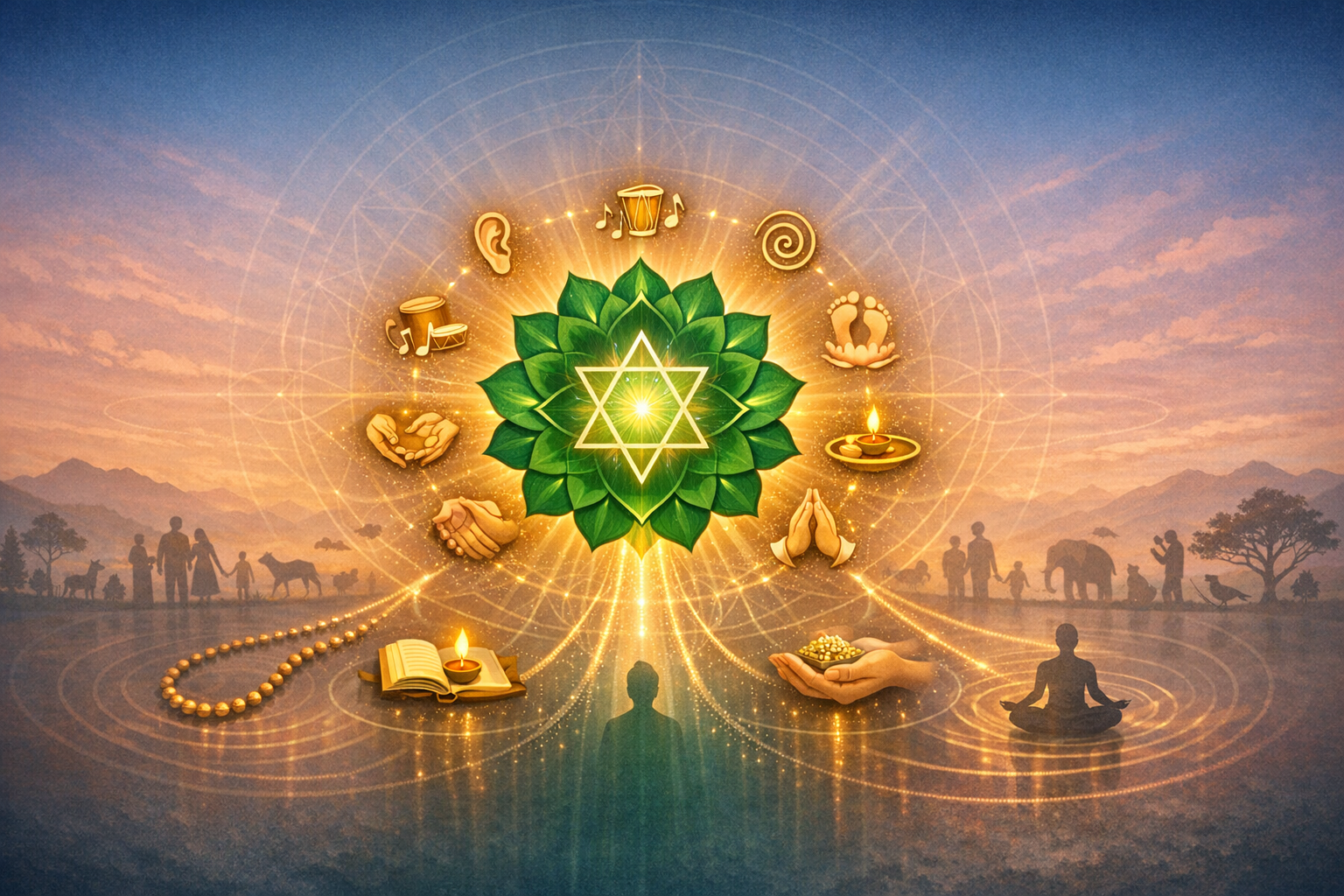
Bhakti theology articulates love with technical precision. Narada Bhakti Sūtra literature defines bhakti as wholehearted, causeless, and unbroken love of the Divine. The Bhāgavata Purāṇa maps nine modalities (śravaṇa, kīrtana, smaraṇa, pāda-sevana, arcana, vandana, dāsya, sakhya, ātma-nivedana) through which love is practiced. Ācintya-bhedābheda syntheses explain how love thrives in the paradox of unity and differencesimultaneously belonging to the Lord and yet relating to the Lord as “other,” which safeguards intimacy without collapsing alterity.
Śaiva and Śākta traditions illuminate love as an energetic recognition of unity-in-diversity. Kashmir Śaivism reads love as the spontaneous pulse (spanda) of Consciousness that manifests and reabsorbs the universe. In Śākta frameworks, the inseparability of Śiva and Śakti models a love that is neither possessive nor inert but dynamically creative, empowering the practitioner to transmute narrow attachment into expansive compassion.
Aesthetic theory (rasa) explains the felt texture of sacred love. Classical alaṅkāra-śāstra identifies śṛṅgāra as the king of rasas; bhakti movements reframe its essence as God-centered sweetness (mādhurya) rather than ego-centered desire. Devotional poeticsfrom Āṇḍāl to Jayadevademonstrate how artistry refines emotion into spiritual relish (bhakti-rasa), conserving intensity while redirecting intention toward transcendence.
Yoga systematizes love as trainable attention and emotion. Patañjali prescribes cultivating maitrī, karuṇā, muditā, and upekṣā to stabilize the mind (Yoga Sūtra 1.33). Traditional yogic anatomy locates the harmonizing of love in the anāhata (Heart Chakra), refined through prāṇāyāma, mantra-japa, and meditative absorption (dhyāna). Contemporary research tentatively correlates gentle breath regulation and prosocial affect with autonomic balance, yet classical texts emphasize that the deepest transformation is ethical, cognitive, and contemplative rather than merely physiological.
Guna theory shows why love must be ethically cultivated. Sattva supports clarity and altruism, rajas can distort love into restlessness or control, and tamas can degrade it into indifference or possessiveness. The yamas and niyamas purify motivation so that love can stabilize as a virtuekṣamā (forbearance), dayā (compassion), ārjava (integrity), and dama (self-restraint) become expressive forms of love in action.
In a widely noted satsang exchange, it was explained that love is the cohesive intelligence within and between all forms of life. When awareness widens, love naturally includes what was previously excluded; when awareness narrows, love collapses into preference and fear. Practical counsel emphasized softening judgment, deepening breath awareness, and anchoring affection in freedom rather than controlso that relationships foster growth instead of dependence. This aligns with classical teachings: love ripens when guided by viveka (discernment) and sustained by vairāgya (dispassion).
Ishta offers a profound principle of pluralism. “Ishta” honors the right of each seeker to relate to the Divine in a form or ideal resonant with temperament, culture, and stage of life. This leads to religious tolerance in Hinduism not as concession but as metaphysical consistency: truth is one, paths are many. Such acceptance harmonizes communities and supports unity among dharmic traditions, avoiding the imposition of a singular route and instead celebrating complementary insights.
Cross-dharmic resonances deepen this unity. Buddhism cultivates mettā (loving-kindness) and karuṇā (compassion) as boundless states (brahmavihāras), integrating wisdom (prajñā) with care to alleviate duḥkha. Jainism centers ahiṃsā and anekāntavāda, encouraging non-violence and many-sided truth, which translate into universal friendliness (maitri-bhāva). Sikhism grounds love in remembrance of the One (Ik Oṅkār), expressed through sevā and fairness, with community practices such as langar embodying equality and care. These traditions, while distinct, converge on love as a disciplined, world-affirming commitment.
Hindu mārga-s outline multiple approaches to realizing love. In Bhakti Yoga, the nine forms of devotion cultivate intimacy with the Divine through listening, chanting, service, and self-surrender. Karma Yoga expresses love as selfless action (sevā) and responsibility for loka-saṅgraha (social cohesion), offering the fruits to Īśvara. Jñāna Yoga refines understanding so that love is grounded in the recognition of Self in all. Rāja Yoga trains attention and emotion so that love becomes a steady state rather than episodic sentiment.
Embodied practice integrates contemplation with life. Daily japa or kīrtana steadies affect; brief pauses of mindful breath before speaking reduce reactivity; intentional listening transforms conversations into offerings; and a regular sevā commitment universalizes concern beyond family or group boundaries. Modest routinesgratitude journaling, ethical reflection (svādhyāya), and cultivating satya (truthfulness) in speechslowly convert goodwill into dependable virtue.
Gṛhastha dharma provides a rigorous field for love’s maturation. Household life tests love’s stability under stress, time constraints, and conflicting duties. Anchoring family rhythms in shared remembrance, honest dialogue, and mutually agreed boundaries prevents love from hardening into entitlement. In community, love advances as fairness in trade, compassion in leadership, and care for the vulnerable, echoing the civilizational ethic of “Vasudhaiva Kutumbakam.”
Differentiating love from attachment protects relationships and practice. Attachment contracts awareness and treats others as means; love expands awareness and treats others as ends. Warning signs include jealousy, coercion, and resentment when expectations are unmet. Correctivessatsang, svādhyāya, contemplative pauses, and consultation with a trusted guiderestore alignment with dharma.
Common obstacles and their remedies are well documented. Rāga–dveṣa (grasping and aversion) are tempered by contentment (santoṣa) and equanimity. Harshness softens through kṣamā; judgment loosens through inquiry into motives rather than blame; fatigue and cynicism yield to measured rest, simplicity, and periodic retreats into silence (mauna). These disciplines keep love resilient in the face of uncertainty and change.
Practical indicators of maturation help evaluate progress. Over time, there is a reduction in anger and envy, increased steadiness under praise and blame, spontaneous generosity, and durable empathy that extends beyond affinity groups. Relationships become less transactional, speech becomes more truthful and gentle, and ethical dilemmas are navigated with clarity rather than compulsion. In devotional terms, remembrance becomes effortless, and gratitude stabilizes independent of circumstance.
Ethically, love insists on courage and boundaries. Ahiṃsā never justifies passivity in the face of harm; love may require firm refusal, protective action, or principled dissent. Dharma-yukta (ethically guided) strength prevents sentimentality from enabling injustice, ensuring that compassion is paired with wisdom and accountability.
In sum, Hinduism presents love as the very texture of reality and the highest human possibility. Whether approached through bhakti’s sweetness, jñāna’s clarity, karma’s service, or rāja yoga’s discipline, love matures as freedom from self-centeredness and as responsibility to all beings. In harmony with Buddhism’s brahmavihāras, Jainism’s ahiṃsā and anekāntavāda, and Sikhism’s sevā and remembrance of the One, this vision sustains unity across dharmic traditions and offers a coherent ethic for personal flourishing and social trust.
Inspired by this post on Hindu Pad.