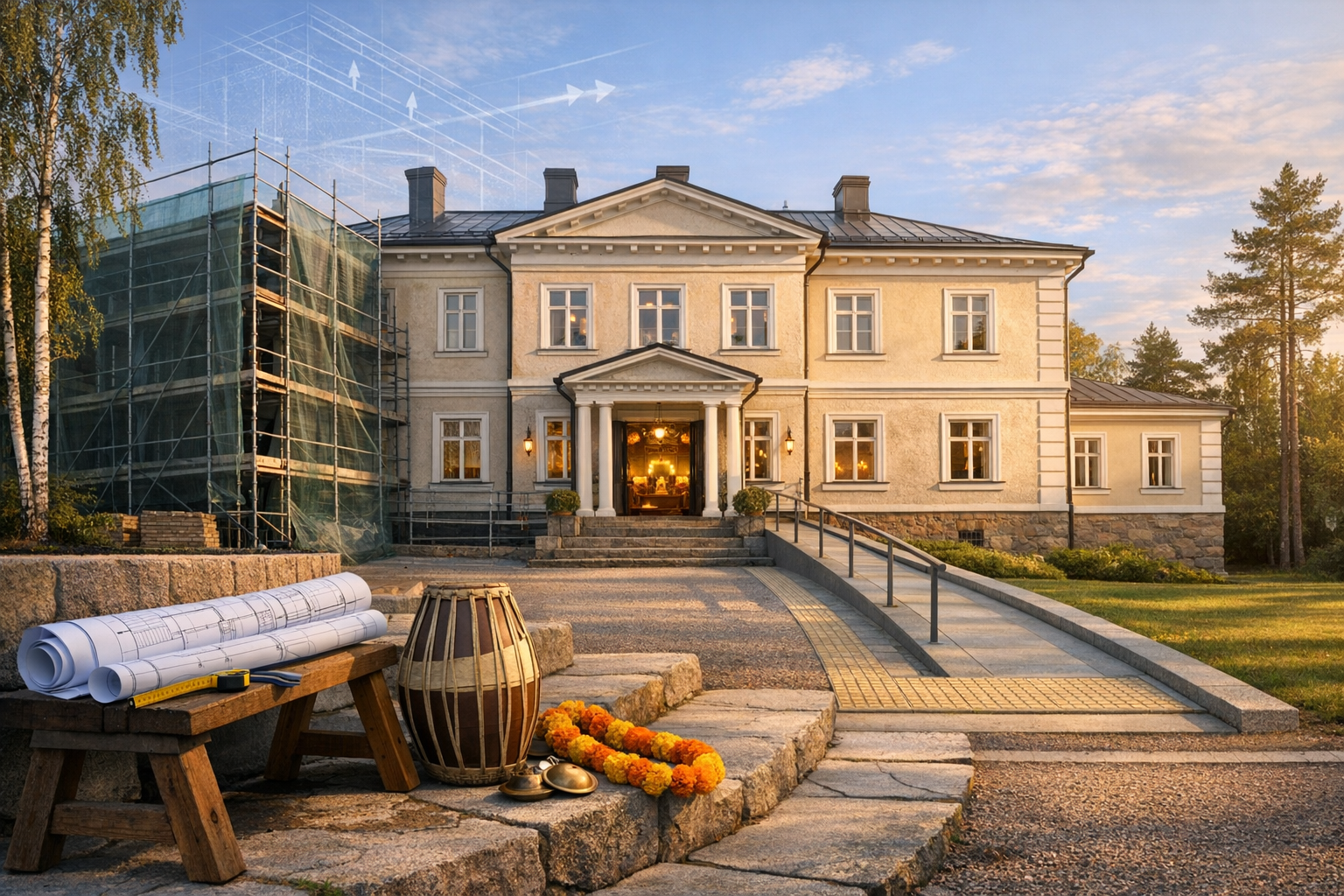
ISKCON Helsinki has initiated a comprehensive restoration and modernization of its temple complex at Malmi Manor, a historic setting that has, for over four decades, anchored Krishna consciousness in Northern Europe. The initiative aims to protect a vital cultural and spiritual landmark while adapting the campus to contemporary expectations for safety, sustainability, and accessibility. In doing so, the project preserves a living heritage that gathers people for kirtan, scriptural learning, festivals, and community outreach, while strengthening the long-term resilience of a respected Vaishnava center in Finland.
Situated within a heritage manor environment in Helsinki’s Malmi area, the temple complex embodies layered valuesarchitectural, historical, and living-intangible. The restoration strategy recognizes this dual character by treating the site not merely as a historic artifact but as an actively used spiritual and community space. The approach balances conservation fidelity with pragmatic upgrades so that devotional life and community service can continue without compromise.
The conservation framework follows internationally accepted principles of heritage stewardship, including minimal intervention, reversibility where feasible, and thorough documentation before, during, and after works. Priority is given to retaining original materials and craft techniques when these remain serviceable, while integrating modern components in a way that is visually and structurally sympathetic to the manor context. This methodology aligns heritage preservation with the daily functional needs of the temple and its visitors.
Technically, the program is expected to address the building envelope and structural performance in response to Nordic climatic realitiesfreeze–thaw cycles, wind-driven precipitation, and snow loads. Sensitive roof and façade refurbishment, targeted insulation that avoids thermal bridging, and controlled moisture management protect original fabric while improving comfort. Where necessary, structural reinforcement is designed to be discrete, maintaining the architectural character of load-bearing walls and timber elements.
Modernization of building serviceselectrical, plumbing, and ventilationaddresses both safety and energy efficiency. Mechanical ventilation with heat recovery, high-efficiency heating solutions, and low-energy LED lighting are planned to reduce the operational footprint. Where conservation constraints permit, measures such as selective window retrofits, improved airtightness, and building automation contribute to stable indoor conditions suitable for devotional practice and public programming.
Liturgical functionality receives particular attention. The main kirtan hall stands to benefit from calibrated acoustic treatments that preserve the rich tonal qualities of congregational chanting while controlling reverberation for clarity during lectures. Daylighting and shading strategies are proposed to maintain serenity in the altar area, while resilient, low-VOC finishes and durable flooring support barefoot movement and frequent gatherings. Fire detection, alarm, and egress enhancements are incorporated with minimal visual intrusion, aligning with both devotional sensitivity and local life-safety codes.
Community outreach is integral to ISKCON Helsinki’s mission. The renovation envisages a hygienic, code-compliant prasadam kitchen with optimized workflows for preparation and distribution. Food-safety improvements, robust storage, and efficient dishwashing and waste-handling systems enhance capacity for festivals and daily service, supporting a tradition that nourishes body and spirit.
Universal accessibility is a core design driver. Step-free entries, thoughtfully graded ramps, and where feasible, lift access enable inclusive circulation. Tactile wayfinding cues, clear sightlines, and multilingual signage (Finnish, Swedish, English, and standardized transliterations for Sanskrit terms) broaden participation. Quiet rooms and family-friendly amenities make the campus comfortable for elders, children, and visitors with diverse needs.
Education and inter-community dialogue will be strengthened by upgraded classrooms and multipurpose learning spaces designed for seminars on sacred texts, philosophy, music, and culture. In line with the shared dharmic values of ahimsa, seva, and satya, the campus intends to welcome collaborative programming across Hindu, Buddhist, Jain, and Sikh communities. This inclusive orientation affirms unity among dharmic traditions while respecting distinct practices, encouraging cultural literacy and mutual regard.
Digital infrastructure is planned to support hybrid engagement. Discrete fiber backbones, high-quality audio–video capture, and streaming capabilities enable remote participation in kirtan, lectures, and cultural events. This extends the temple’s educational reach across Northern Europe and supports diaspora communities seeking continuity of practice, learning, and community connection.
Environmental stewardship guides decision-making from concept through operations. Lifecycle thinking, careful material selection, and repair-over-replacement principles reduce embodied carbon and honor the conservation ethos. Construction-phase waste sorting, water-saving fixtures, and site-appropriate landscaping collectively reduce environmental impact, while ongoing energy monitoring fosters continuous improvement.
Phased delivery minimizes disruption to worship and public programming. Where necessary, temporary arrangements for darshan and kirtan maintain devotional continuity. Dust, noise, and vibration controls protect sensitive areas and artifacts, and work sequencing is coordinated around major festivals to safeguard community rhythms. Volunteer engagement is welcomed for non-technical tasks under professional supervision, reinforcing a culture of stewardship and care.
Governance, compliance, and risk management are central to execution. The project aligns with local building regulations and heritage guidance, supported by specialist consultants in conservation architecture, structural engineering, and building services. Clear documentation, tendering oversight, and quality assurance protocols protect heritage fabric and ensure that upgrades meet performance targets while honoring the historic manor context.
The social and emotional dimensions of the temple’s renewal are profound. For long-time congregants and neighbors, the campus holds memories of life passagesnaming ceremonies, marriages, festival processions, and the quiet solace of daily darshan. For newcomers, it often becomes a first point of contact with the Hare Krishna Movement and a welcoming portal to India’s sacred traditions. Preserving that atmosphere of warmth and belonging is as important as the technical rigor of the works themselves.
A multi-year roadmap is anticipated: investigative surveys and immediate stabilization, followed by envelope and systems upgrades, then interior refinements and site enhancements. Each stage builds toward a cohesive outcomeone that secures the temple’s devotional life, amplifies educational and cultural offerings, and upholds the dignity of a historic setting.
Post-occupancy plans include preventive maintenance schedules, volunteer training for basic custodial care, and periodic performance reviews of energy and indoor environmental quality. Such routines embed resilience, ensuring the building continues to serve future generations without recurring cycles of neglect or intrusive repair.
By restoring and modernizing the Malmi Manor temple complex, ISKCON Helsinki strengthens a cornerstone of Krishna consciousness in Northern Europe and safeguards an enduring cultural asset for Finland. The result is a living, breathing example of heritage preservationone that integrates devotional practice, community service, and inter-dharmic unity within a carefully conserved historic landscape. This measured, forward-looking effort positions the campus to serve with integrity, openness, and spiritual depth for decades to come.
Inspired by this post on Dandavats.