
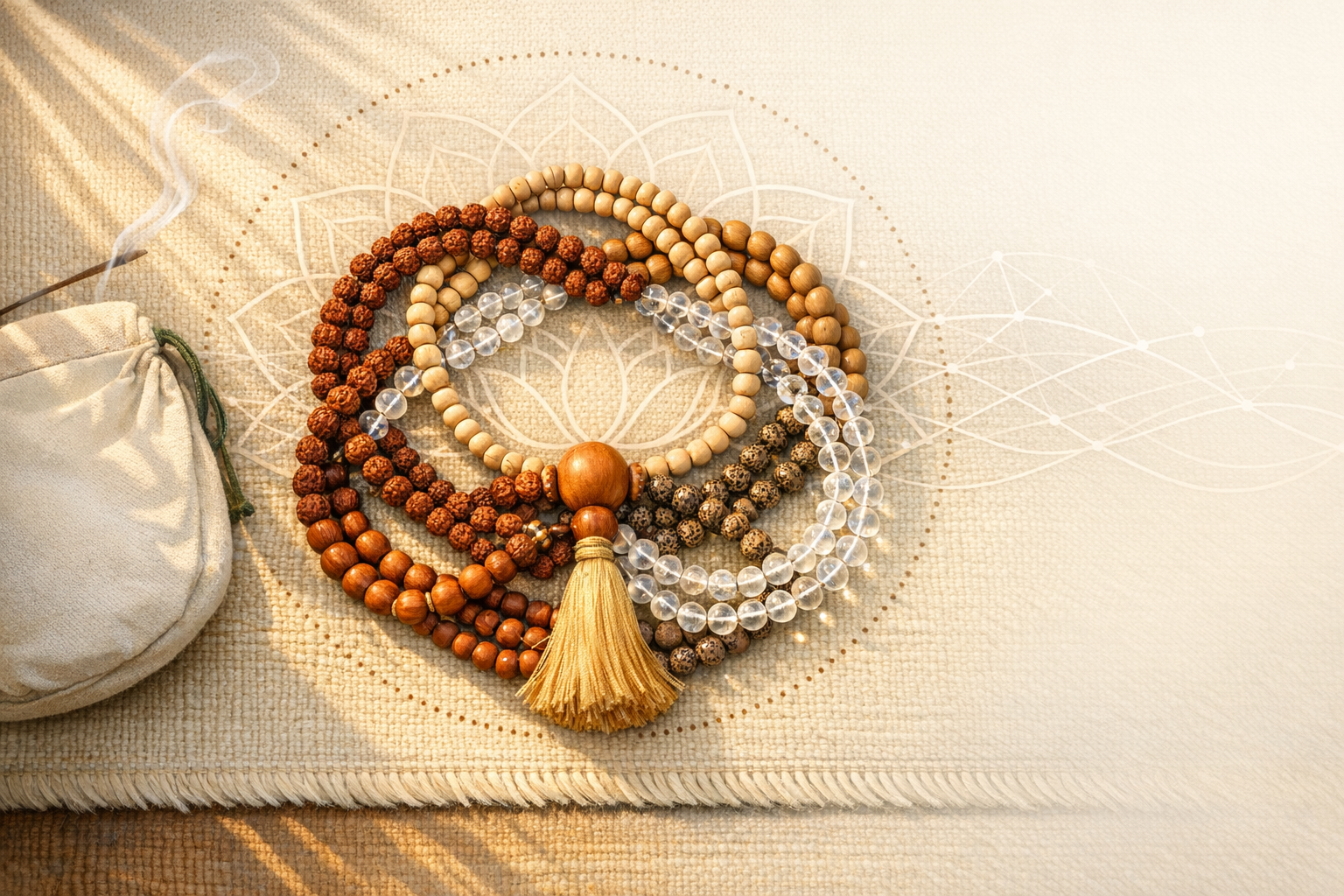
Japa malaoften called prayer beadsserves as a simple yet highly sophisticated instrument for training attention, refining devotion, and stabilizing awareness. Within Hinduism, Buddhism, Jainism, and Sikhism, it anchors mantra recitation (japa) in a tactile, rhythmic process that steadies breath, mind, and emotion. The practice brings together body, speech, and thought into a single current of contemplative energy.
As Sri Sri Ravishankar has explained in satsang, when love ripens it expresses itself through the repeated utterance of the beloved’s name; japa channels the same impulse Godward. That observation articulates the devotional core of the mala: repetition is not mechanical redundancy but a progressive deepening of intimacy and remembrance (smarana).
In classical yoga, japa is a recommended method for cultivating steadiness and insight. Patanjali directs practitioners to the japa of Om conjoined with contemplation of its meaning (Yoga Sutra I.27–I.29), while the Bhagavad Gita (10.25) extols japa as a foremost sacrificial act. Across dharmic iconography, an akshamala (string of letters/beads) in the hands of sages and deities symbolizes ongoing remembrance and the unbroken transmission of sacred sound.
Across dharmic traditions, the mala appears in varied yet harmonizing forms. Hindu lineages commonly use rudraksha, tulsi, sandalwood, lotus seed (kamal gatta), or crystal (sphatik); Buddhists often favor bodhi seed, sandalwood, or bone and jewel substitutes adapted to regional ethics; Jains emphasize ahimsa-sourced materials such as sandalwood, crystal, or seeds; and many Sikhs practice naam-simran with or without a mala, with some groups employing simple wooden or wool-counter malas. Despite differences in material and mantra, the intentsteadying attention and nurturing compassionis shared.
Structure reveals purpose. A typical mala has 108 beads plus one larger meru or guru bead. The 108-count is traditional and richly symbolic: practitioners sometimes relate it to 27 lunar mansions each with four padas (27×4), to 12 solar aditya multiplied by the nine grahas (12×9), to 108 nadis converging in the heart, or to the conventional count of major Upanishads. While no single explanation is exclusive, the multiplicity itself signifies completeness.
The guru bead (meru) is not crossed; one turns the mala around at this point to begin a new round. This design encodes an ethic: the guru or the Divine is the orienting summit of practice, not a rung to be stepped over. Traditional malas are often hand-knotted between beads, both to space the count and to symbolize inner granthis (psychophysical knots) that practice seeks to gently loosen.
Material choice carries philosophical and practical nuances. Tulsi malas are favored in Vaishnava traditions for cultivating bhakti and sattva; rudraksha is revered in Shaiva lineages and associated with steadiness and protection; sandalwood cools and calms, suiting many forms of mantra meditation; crystal is prized for clarity and neutrality across traditions; lotus seeds evoke purity emerging from the world’s waters. Practitioners often choose ethically sourced, smoothly finished beads that neither snag the skin nor distract attention.
Selecting a mala benefits from a clear intention (sankalpa). Consider the mantra tradition, the tactile feel, bead size (smaller beads slow the pace subtly), durability, and workmanship. Knotting aids longevity and counting accuracy; a soft japa bag (gomukhi) preserves sanctity, cleanliness, and concentration.
Foundational method may be summarized step by step: sit at a consistent timeideally Brahma muhurta or a quiet eveningon a dedicated seat (asana) such as wool or kusa grass to reduce ground conductivity and stabilize energy. Establish a gentle posture with aligned spine, soften the gaze or close the eyes, and frame the session with a concise sankalpa. Hold the mala in the right hand (or per lineage), using the thumb to advance beads toward oneself over the middle or ring finger; the index finger is traditionally avoided to symbolize the quieting of egoic reactivity.
Begin with the bead immediately following the guru bead. Recite the mantra in one of three modes: vachika (audible), upamshu (whispered/tonal breath), or manasa (mental), progressing naturally from gross to subtle as attention matures. When the meru is reached, do not cross it; turn the mala and continue. Synchronizing mantra gently with exhalation or a relaxed breath cycle can promote parasympathetic balance; avoid strain and do not force kumbhaka (breath retention) without proper guidance.
Mode selection has practical implications. Vachika supports beginners by providing auditory feedback and rhythm. Upamshu reduces externalization and sharpens inwardness. Manasa japa, entirely mental, conserves prana and cultivates fine-grained attention (ekagrata). All three are valid; suitability depends on context, constitution, and instruction.
Counting, while helpful for consistency, should not eclipse presence. One round of 108 beads is a classical unit; multiple rounds are undertaken as time and capacity allow. Traditional purashcharana frameworks sometimes prescribe counts tied to mantra syllables, but even then, most teachers emphasize devotion, clarity, and ethical living (yama–niyama) over numeric accumulation. The aim is transformation, not performance.
Contemplative science helps clarify how a japa mala works cognitively. Gentle tactile input from bead movement engages somatosensory circuits; rhythmic repetition entrains attention; and the mantra’s stable auditory or sub-vocal pattern reduces mind-wandering. Evidence from meditation research associates such practices with improved attentional control, stress reduction via vagal tone increases, and down-regulation of default mode network activity. While not a medical treatment, consistent japa can support emotional regulation and resilience when integrated with a balanced life.
Mantra selection expresses both universality and lineage. Examples include Om, Gayatri, Om Namah Shivaya, Hare Krishna maha-mantra, and bija-mantras in Hindu traditions; Om Mani Padme Hum and Namo Amitabha in Buddhist lineages; the Navkar Mantra in Jain practice; and Waheguru in Sikh simran. Each sound-current carries its semantic heartpraise, refuge, remembrance, awakeningyet all point to one reality approached through diverse names and methods. This unity in spiritual diversity underlines a core dharmic insight: many paths, one summit.
Care and etiquette embody reverence. Keep the mala clean, preferably within a japa bag when not in use; avoid placing it on the ground or carrying it into unclean spaces; do not treat it as jewelry or a display object. If wooden beads dry out, a trace of natural oil can preserve them; crystal and seeds should be kept away from harsh chemicals or prolonged moisture. Many practitioners periodically waft incense or sunlight over the mala as a symbolic purification.
Common obstacles and supportive adjustments are straightforward. Restlessness suggests shortening sessions and returning to breath-synchronized japa. Mechanical repetition benefits from re-engaging meaning and devotion between rounds. If counting induces pressure, alternate timed practice with count-based practice. Fatigue indicates softer pacing and perhaps beginning with vachika before moving subtler. Above all, do not rush; japa ripens through constancy and kindness toward one’s own process.
Ethical foundations stabilize results. Truthfulness, non-harming, contentment, discipline, and generosity (shared across dharmic ethics) prevent inner conflict from eroding contemplative gains. By integrating japa with compassionate conduct, practice matures from self-regulation into service, fostering harmony in families and communities.
For those seeking a compact protocol: choose a lineage-appropriate mantra, a comfortably knotted 108-bead mala, and a consistent daily slot. Sit steady, anchor attention with breath, recite one to three rounds without crossing the guru bead, and close with silent gratitude. Record brief notes on mood and clarity; incremental improvements in focus and calm tend to accumulate over weeks, not hours.
Ultimately, a japa mala is a humble technology of remembrance. It refines attention, opens the heart, and, as Sri Sri Ravishankar’s observation suggests, redirects the natural repetition of love toward the source of love itself. Whether held by a Vaishnava with tulsi beads, a Shaiva with rudraksha, a Buddhist with bodhi seed, a Jain with sandalwood or crystal, or a Sikh immersed in naam-simran, the mala quietly affirms a shared dharmic horizon: steady remembrance that flowers into wisdom, compassion, and peace.
Inspired by this post on Hindu Pad.










