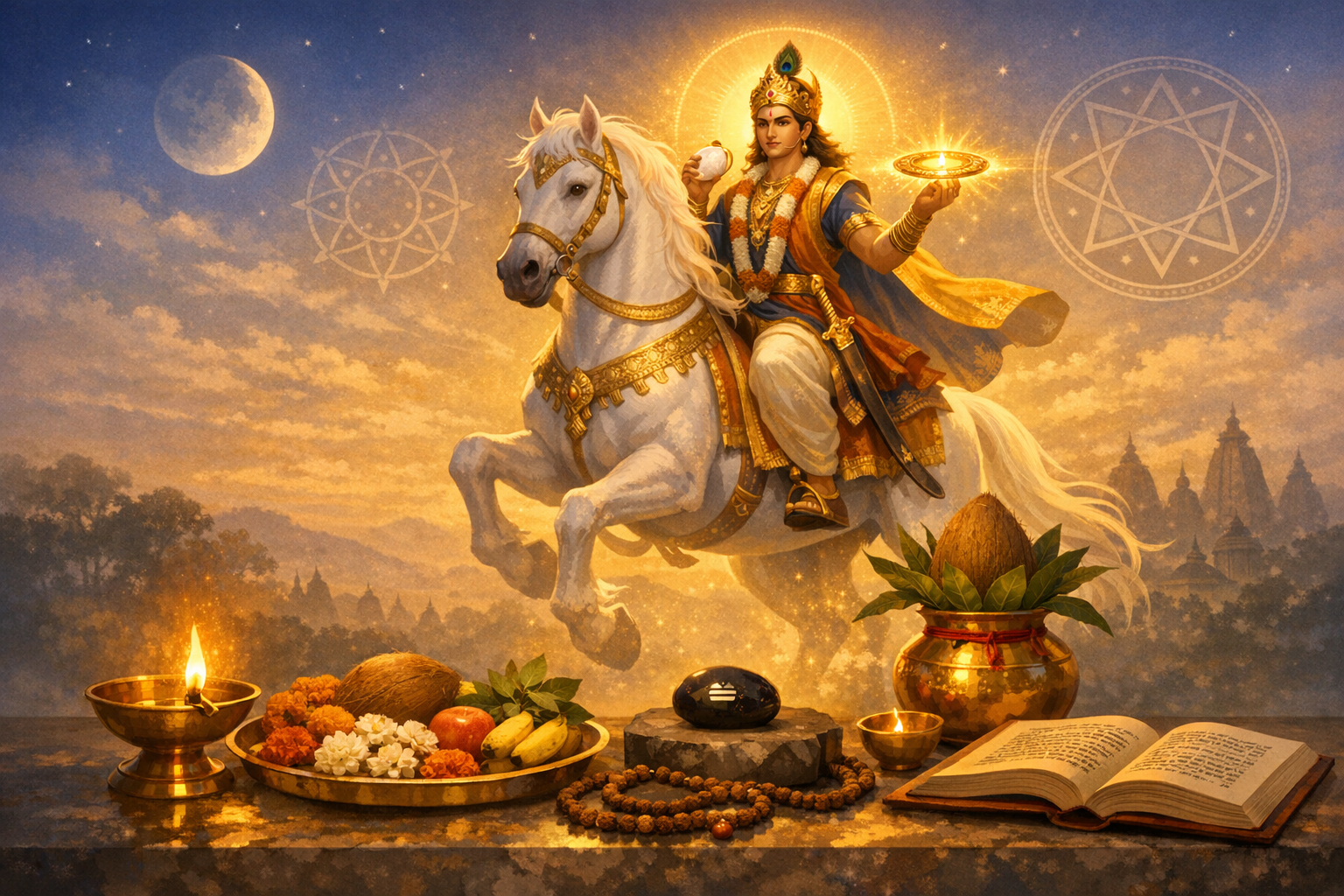
Kalki Jayanti (also spelled Kalki Jayanthi, and known as Kalki Avatara Jayanti) in 2026 falls on Monday, 17 August, observed on Shravana Shukla Shashthi (Shukla Paksha Sashti). The observance honors Lord Kalki, revered as the tenth incarnation of Sri Maha Vishnu in the Dashavatara tradition, and serves as a solemn reminder of dharma’s ultimate renewal at the close of Kali Yuga. While the prophesied advent lies in the remote future, the annual festival cultivates ethical clarity, disciplined devotion, and communal harmony in the present.
Although Kalki’s canonical appearance is destined for the end of this age, the festival functions as a yearly meditation on moral courage and social responsibility. Households and temples mark the day through vrata, puja, japa, svadhyaya, and acts of seva that reaffirm the values of satya, ahimsa, and compassion. In this way, Kalki Jayanti 2026 becomes a living practice rather than a speculative inquiry into eschatological timelines.
Scriptural grounding for the Kalki narrative is found primarily in the Vishnu Purana and the twelfth skandha of the Srimad-Bhagavatam, which describe the manifestation of Kalki in the village of Shambhala, the white horse Devadatta, and the re-establishment of righteous order. Later textual traditions, including the Kalki Purana, expand narrative detail while preserving the central theological arc: when adharma peaks, divine intervention restores equilibrium and reorients society to dharma.
Hindu cosmology envisions time as cyclical, with ages (yugas) recurring in a patterned descent and renewal of virtue. Within this schema, the Dashavatara express Vishnu’s protective role across epochs; Kalki epitomizes the principle that disorder is transient and that the arc of dharma bends back toward balance. The emphasis of Kalki Avatara Jayanti is therefore ethical and contemplative, inviting renewed commitment to truthfulness, restraint, generosity, and service.
Calendar practice places the observance on Shashthi tithi of the bright fortnight of Shravana. In 2026, this aligns with 17 August, a Monday. Regional almanacs may display minor shifts depending on tithi boundaries and sunrise at specific locations. Communities following the Purnimanta system (prevalent in North India) and the Amanta system (prevalent in much of peninsular India) both observe during Shravana; Tamil panchangams will situate it in Avani, and Malayalam panchangams in Chingam. For muhurta-sensitive worship, consulting a local panchang ensures precise alignment.
A simple home puja can be performed using a murti or image of Vishnu, an aniconic Shaligrama, or a traditional depiction of Kalki, as guided by family sampradaya. After a sankalpa for Shravana Shukla Shashthi, one may perform achamana, light the deepa, and dwell in a focused dhyana on Kalki as restorer of dharma. Abhishekam with panchamrita, followed by vastra or alankara as appropriate, concludes with naivedya and deepa arati, allowing the mind to internalize the festival’s guiding virtues.
Chanting and study reinforce the observance. Common practices include the japa of Om Namo Narayanaya and recitation of Vishnu Sahasranama, along with selected verses from the Bhagavad-Gita (notably 4.7–8 on divine protection of dharma). Many lineages also recite a Kalki Gayatri such as Om Kalkiney vidmahe Vishnuroopaya dhimahi tanno Kalkih prachodayat. Vaishnava communities frequently include kirtana and readings from Srimad-Bhagavatam’s twelfth skandha to deepen scriptural reflection.
Vrata on Kalki Jayanti is traditionally sattvic, emphasizing purity in food and conduct. Observers often refrain from tamasic foods, cultivate brahmacharya for the day, and dedicate time to quiet japa and svadhyaya. Those with health considerations may undertake a partial fast or fruit-only upavasa under the guidance of elders or local acharyas, with focus placed on inner restraint, truthfulness, kindness, and humility as the core disciplines.
Temple observances vary by region and sampradaya. Some temples perform homa invoking Narayana Sukta and Purusha Sukta, others organize sahasranama archana, group kirtana, and anna-dana. In places with distinctive Kalki shrinessuch as the historic Kalki Mandir in Jaipurspecial alankara and processions may be arranged. Most Vishnu and Krishna temples integrate the festival into broader Shravana month programs centered on devotion and disciplined living.
Panchang guidance for 2026 emphasizes performing the primary worship while Shashthi prevails, preferably after sunrise. Where Shashthi spans two civil dates, many traditions prioritize the date on which the tithi is operative at sunrise; some follow the practice observed by the local temple. As with all tithi-based festivals, regional sampradaya and family custom take precedence, and alignment with the local panchang ensures coherence with community practice.
From a comparative dharmic perspective, this focus on renewal resonates across related traditions without conflating distinct doctrines. Jain cosmology affirms the recurrent advent of Tirthankaras who guide beings across cycles; Buddhist traditions anticipate the future Buddha Maitreya as a beacon of compassion; Sikh praxis centers on seva, satya, and sarbat da bhala. These parallel intuitions reflect a shared civilizational aspiration for truth, restraint, and service, supporting unity within the wider dharmic family.
Community programs on Kalki Jayanti often integrate social outreach to translate theology into action: blood donation drives, tree-planting, river and neighborhood clean-ups, and educational support. Such seva operationalizes the festival’s message of dharma-samsthapana, ensuring that devotion manifests tangible benefit for society and environment.
On frequently asked points, mainstream exegesis situates Kalki’s advent at the far end of Kali Yuga; contemporary claimants are not endorsed by traditional sampradayas. The annual jayanti is a vrata of hope and ethical resolve rather than a proclamation of imminent eschatology. The guiding question becomes how one can, here and now, restore dharma within family, profession, and community life.
With Shravana’s broader emphasis on devotion, discipline, and introspection, Kalki Jayanti 2026 offers a structured opportunity to realign intention and action. Through mantra, puja, and service, households and temples reaffirm the Dashavatara message that divine assistance accompanies sincere effort and steadfast virtue.
Observed on Monday, 17 August 2026, during Shukla Paksha Shashthi of Shravana, Kalki Jayanti invites thoughtful study, quiet resolve, and compassionate action. Honoring Vishnu’s promised restoration of dharma, the observance strengthens unity across Hindu sampradayas and finds meaningful resonances with kindred values in Buddhism, Jainism, and Sikhism, nurturing harmony within the larger dharmic tradition.
Inspired by this post on Hindu Pad.