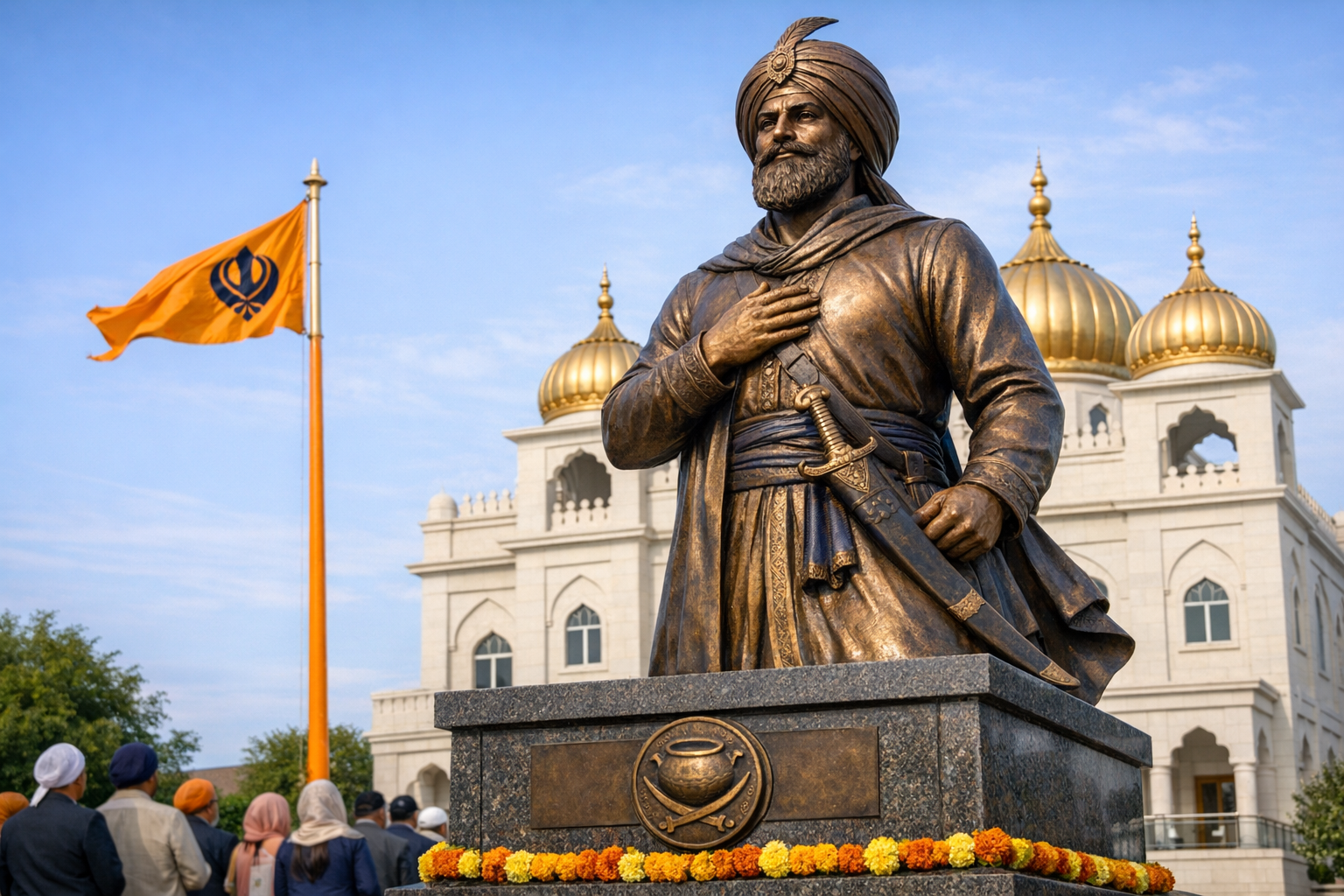
The unveiling of a statue of Baba Banda Singh Bahadur at Guru Nanak Darbar Gurdwara in Gravesend marks a compelling milestone in British–Sikh public memory. Situated at one of Europe’s largest gurdwaras, the installation does more than commemorate a legendary figure; it anchors Sikh history and valuesdharma, seva, justice, and resiliencewithin the cultural landscape of the United Kingdom. In doing so, it strengthens intergenerational ties within the Sikh community while extending an open invitation to broader society to engage with a nuanced, evidence-based understanding of Khalsa history and its civilizational ethos.
Baba Banda Singh Bahadur (1670–1716) occupies a distinctive place in history as the commander entrusted by Guru Gobind Singh to lead the Khalsa after the tumult of the early eighteenth century. Originally known as Madho Das Bairagi, he underwent a profound spiritual and civic transformation upon meeting Guru Gobind Singh in late 1708 at Nanded. That transformationspiritual conviction fused with disciplined actionbecame the foundation of a brief yet consequential era that reshaped the political and social map of northwestern India.
Historically, Banda Singh Bahadur’s leadership is inseparable from the formative ideals articulated at Anandpur Sahib in 1699, when the Khalsa was revealed as a community committed to ethical courage, equality, and the defense of the vulnerable. Under Guru Gobind Singh’s guidance, the Khalsa embodied the dual responsibilities of spiritual steadfastness and temporal guardianship. Banda Singh’s mandate drew directly from this paradigm, emphasizing principled governance, protection of noncombatants, and moral clarity in times of duress.
Banda Singh Bahadur’s campaigns against oppressive governance structures culminated in the capture of Sirhind in 1710, a strategic and symbolic victory. In the territories that briefly came under Khalsa administration, contemporary and later accounts point to egalitarian measures that challenged feudal extractions and restored dignity to cultivators. Although short-lived due to overwhelming imperial resistance, these changes left an ethical imprint that subsequent generations would recognize as an early expression of social justice aligned with the Khalsa’s moral vision.
One of the most evocative symbols of this era is the coinage attributed to Banda Singh Bahadur, bearing the Persian legend: “Deg Tegh Fateh, Nusrat be-darang, Yaft az Nanak Guru Gobind Singh”loosely, the victory of charity (deg) and the sword (tegh), divine assistance without delay, obtained from Guru Nanak and Guru Gobind Singh. This succinctly unites sustenance and defense, spiritual authority and temporal responsibility, capturing the Khalsa’s ideal balance between nourishment of society and protection of the common good.
Banda Singh Bahadur’s martyrdom in 1716preceded by a protracted siege and captivityhas been remembered not merely as the end of a life but as the moral culmination of steadfastness under unimaginable trial. Within Sikh remembrance practices, his legacy is framed by sarbat da bhala (the welfare of all), a value that ensured the memory of struggle would be accompanied by the imperative of universal care. Commemoration at Gravesend, in this register, is less about a figure cast in bronze than about a living tradition of service, courage, and inclusive hope.
Gravesend’s Guru Nanak Darbar Gurdwara is an apt site for such a memorial. As a spiritual, cultural, and civic hub for British Sikhs and their neighbors, it exemplifies the openness of the langar, the pedagogical depth of guided tours, and the aesthetics of devotional architecture. The presence of a Banda Singh Bahadur statue in this context broadens the gurdwara’s interpretive landscape, providing a tangible focal point for discussing early eighteenth-century transformations in Punjab and their resonance in today’s multicultural Britain.
The social impact of the unveiling can be read across several registers. For elders, it validates decades of diasporic effort to preserve language, memory, and liturgy in a new homeland. For youth, it offers a historically grounded role model whose life integrates ethics, intellect, and responsibility. For visitors beyond the Sikh community, it creates a gateway to learn how Khalsa history intersects with universal themes: integrity under pressure, the moral boundaries of force, and the possibility of just governance even under constrained circumstances.
Crucially, the commemoration resonates across the wider dharmic familyHinduism, Buddhism, Jainism, and Sikhismthrough shared commitments to truth, compassionate action, and the ethical use of power. While Sikhi articulates a unique synthesis of bhakti and shakti, its insistence on justice in defense of the defenseless aligns with the dharmic principle of righteous duty. The installation thus advances a unifying message: diverse dharmic paths can converge in upholding dignity, non-coercion in matters of conscience, and the common good.
From a heritage-management perspective, public statuary invites technical, curatorial, and conservation best practices. Bronze is often selected for its durability, yet it requires careful specification of alloys, proper patination, and a preventive maintenance plan to mitigate corrosion in maritime climatesrelevant in Kent. Secure anchoring of the plinth, unobtrusive drainage channels to prevent water pooling, and scheduled condition surveys (visual inspection, photographic records, and periodic surface analysis) help safeguard the sculpture’s integrity. Collaboration with accredited conservators and adherence to UK conservation guidance further ensures long-term stewardship.
Effective interpretation is central to educational value. Multilingual signage (English and Punjabi), clear timelines, and QR-linked digital exhibits can connect visitors to primary sources, maps, and peer-reviewed scholarship on the Khalsa, Guru Gobind Singh, and early eighteenth-century Punjab. Integrating the coin inscription “Deg Tegh Fateh, Nusrat be-darang, Yaft az Nanak Guru Gobind Singh” into the interpretive design enables concise discussion of the Khalsa’s social charterfeeding the hungry, defending the innocent, and deriving authority from spiritual exemplars rather than from coercive power.
Educational programming can align with UK curricula in history and religious education. Age-tiered modules might explore: the formation of the Khalsa at Anandpur Sahib (1699); ethical criteria in the use of force (distinguishing defense from aggression); the structure of early modern polities; and the role of communal institutions (sangat and langar) in building social resilience. Workshops can foster critical skillssource analysis, historical empathy, and civic dialoguewhile encouraging cross-community participation to strengthen bonds among neighbors of all faiths and none.
In the broader context of the UK’s multicultural fabric, the statue underscores the contributions of over half a million Sikhs to public life, healthcare, education, business, and defense. In tandem with exhibitions on Sikh service during global conflicts and on everyday seva, the memorial can serve as a node in a larger heritage trail, connecting sites across Britain where Sikh and other dharmic communities have enriched civic institutions and nurtured intercultural understanding.
Equally important is how commemoration is framed: not as triumphalism but as ethical remembrance. By situating Banda Singh Bahadur within a dharmic vocabulary that emphasizes justice with compassion, strength with restraint, and identity with inclusivity, the installation avoids sectarian reductionism. It invites reflection on how principled leadership can emerge from spiritual discipline and how such leadership remains relevant to contemporary debates on equality, freedom of conscience, and responsible governance.
The unveiling at Guru Nanak Darbar Gurdwara, therefore, accomplishes several interrelated goals: it honors a pivotal figure in Sikh history; it offers a robust, research-informed platform for public education; it models conservation-minded custodianship of public art; and it amplifies a unifying message across dharmic traditions. In bringing history into the shared civic square, the statue becomes a catalyst for learning, empathy, and collaborative community-buildingan embodiment of sarbat da bhala in the heart of Gravesend.
Inspired by this post on SikhNet – News.