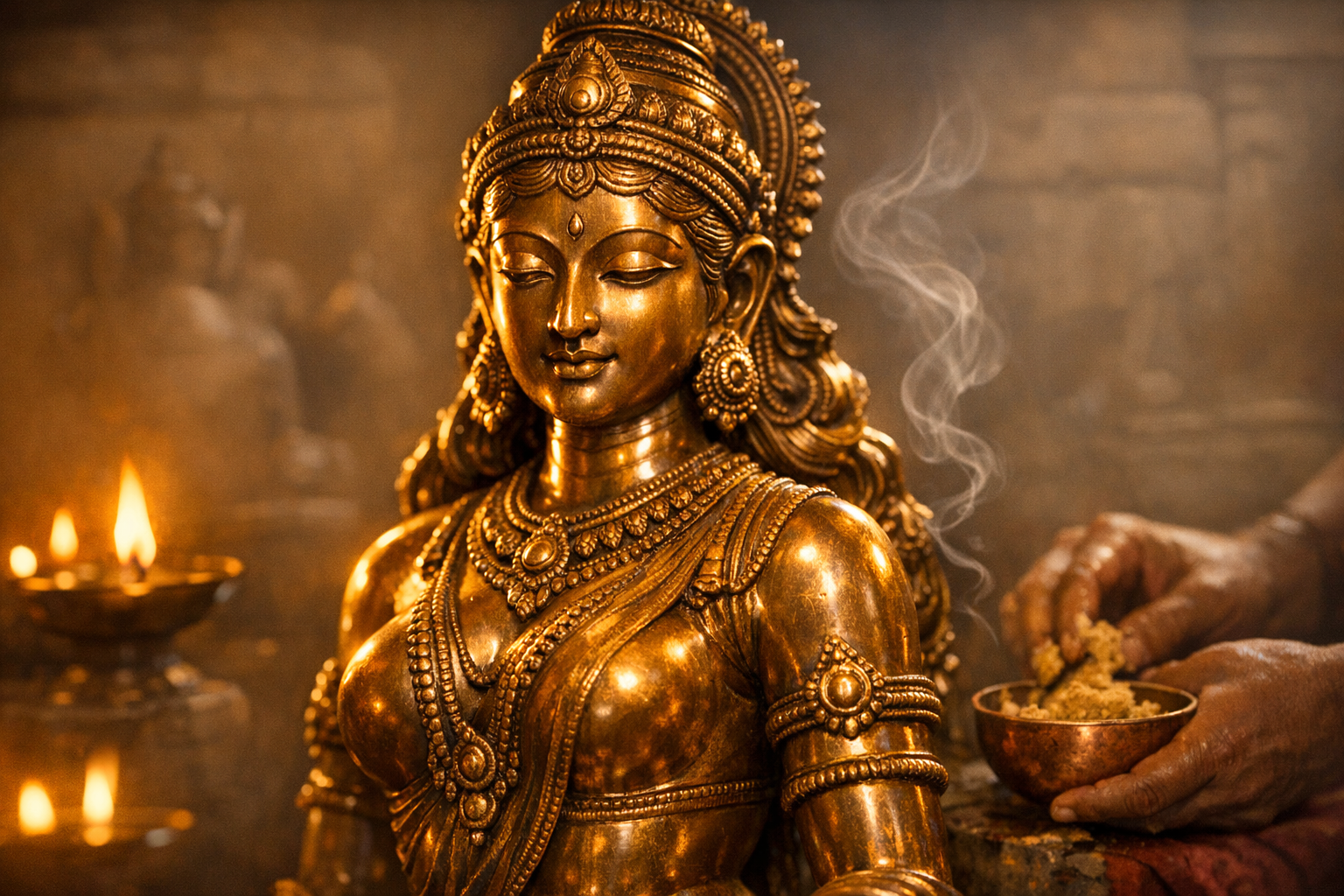
The first encounter with a temple bronzegleaming beneath the dance of lamps and incenseoften stirs the quiet conviction that it must be gold. In reality, the luminous golden sheen is a triumph of sacred metallurgy and ritual care rather than precious metal content. Temple bronzes across Bharat and the broader dharmic world reveal how alloy design, artisanal finishing, and centuries of Abhishekam, lamp soot, incense, and gentle hand-burnishing together build a warm, dignified radiance that endures.
Contrary to common assumption, this radiance rarely comes from gilding. While isolated examples of gilded details exist, most Hindu temple bronzesespecially the famed Chola bronzesowe their golden appearance to copper-rich alloys and ritual maintenance. The result is a living surface: one that registers touch, fragrance, and flame as delicately as it does metallurgical intent.
At the heart of this glow is alloy chemistry. Many South Asian liturgical images are cast as bronze (copper–tin–lead, sometimes with zinc) or as brass (copper–zinc, sometimes with tin and lead). In devotional parlance, such images are often called panchaloha (five-metal) icons. Historical and analytical studies show considerable regional and temporal variation, but a typical range for copper content in South Indian bronzes lies highoften above 85–90%with tin and lead in low single digits for strength, fluidity, and castability; zinc, when present, nudges color toward a bright yellow. Iron and other trace elements can appear as incidental or intentional additions. Where gold or silver is ritually added, the amounts are usually symbolic and too low to govern surface color.
Color emerges from physics as much as from faith. Copper’s intrinsic reflectance has a warm red-gold character. Adding zinc (brass) shifts reflectivity toward yellow, enhancing a golden tone, while tin (bronze) deepens reds and browns. Lead, though dull in color, improves cast flow and suppresses porosity, enabling finer surfaces that polish to higher specular gloss. After casting, traditional finishingfiling, scraping, abrasion with fine minerals, and chemical pickling using organic acidsthins or removes dark oxides and smooths asperities. The smoother the surface, the more mirror-like the highlights; the thinner and more uniform the oxide, the warmer and more even the hue.
Craft meets cosmos in the cire perdue (lost-wax) process, practiced masterfully since the Chola era. Beeswax or plant wax models are detailed, encased in refractory clay, dewaxed by heat, and cast with molten alloy through carefully designed sprues. The as-cast surface, already fine from wax detailing, is then refined and polished. This artisanal heritagevisible in the fluid torsion of a Shiva Nataraja or the poised serenity of a Somaskandayields a surface predisposed to brilliance even before ritual life begins.
Ritual sustains that brilliance. Daily and festival practicesAbhishekam with panchamrita (milk, curd, ghee, honey, sugar), water, sometimes tamarind or lemon rinses; the anointing of sandalwood paste and kumkum; the wafting of karpūram (camphor) and incense; the steady glow of deepaminteract subtly with the metal. Mild organic acids from citrus and tamarind dislodge tenacious oxides; alkaline ash and chalk in vibhuti and ritual powders gently burnish. Oils and resins form ultrathin, hydrophobic films that repel moisture and deepen color. Repeated over decades, these cycles reduce uneven tarnish, maintain a thin, stable surface layer, and encourage a mellow, gold-like warmth.
Temple environments amplify the effect. The air of sanctums often carries fine aerosols from lamps, incense, and floral offerings. These settle and are then wiped away during routine care, effectively creating a micro-polishing regime. Cloths infused with a trace of ash or micro-mineral residues act as exceptionally gentle abrasives, lifting dull oxides while preserving inscriptions, ornaments, and the delicate modeling that makes sacred sculpture legible even in low light.
The living gleam also records human presence. Processional utsava murtis are bathed, dressed, garlanded, and carried. Contact pointsshoulders, hands, feetoften display a more pronounced luster from repeated touch and careful wiping. This tactile dimension, inseparable from darshan, ensures that the image does not merely survive time; it ripens with it, retaining depth and warmth that static display rarely achieves.
A common misconception holds that the yellow-gold hue must imply plating. In fact, copper-rich brass can look remarkably like gold under lamp light, especially when the oxide layer is thin and even, and when a transparent organic film from oils or incense resins enhances specular highlights. On the rare occasions where gilding is present, it is usually a localized accent rather than the principal cause of the sculpture’s overall golden appearance.
Beneath the aesthetics lies sound materials science. Stable patinas on copper alloys typically involve very thin layers of cuprous oxide (Cu2O), which appears red-brown at bulk scale but can look warmly golden in nanometric films. Mild acidic rinses (lemon, tamarind) remove patchy, thicker oxides; subsequent alkaline or neutral rinses, drying, and oiling limit rapid re-oxidation. Over time, this produces a low-roughness surface with a consistent, thin oxide that refracts and reflects light in a warm band. In short, ritual practice functions like a controlled cleaning, passivation, and lubrication cyclean elegant analogue to a conservator’s toolkit, achieved without modern chemicals.
This union of metallurgy and practice is not confined to Hindu temples. Across dharmic traditions, related phenomena appear. In Buddhist monasteries, the glow of copper-alloy images is nurtured by butter lamps and incense, then evened out by careful wiping; in Jain temples, frequent jal abhishek and anointments keep bronze and brass images clear and radiant; within Sikh traditions, the reverence for sarabloh (iron/steel) and the disciplined polishing of liturgical metalware reflect the same ethic of care. The shared vocabulary is one of stewardship, respect, and the transformation of matter through mindful, repeated acts.
For conservators and temple committees, the lesson is collaborative. Rituals that maintain thin, even oxide layers and hydrophobic films are allies of preservation. Risks arise mainly from chlorides (for example, salts in some cleaning agents or water sources), standing moisture, or abrasive scouring that scratches and roughens the surface. Practical guidelinesuse of clean water, thorough drying, gentle organic acids from traditional sources when needed, and thin oil or paste anointmentsalign closely with longstanding custom while reducing the likelihood of bronze disease (cuprous chloride-driven corrosion).
Historical context illuminates why so many images look “golden” and not merely “coppery.” The Chola tradition favored high-copper alloys cast with superb surface quality, enabling bright finishes. In other regions and periods, higher zinc contents yielded brassier, sunflower tones. In either case, the chromatic destinationan inviting gold-like warmthwas made inevitable by daily worship: lamp light enriching yellows and reds, aromatic resins behaving like micro-varnishes, and priestly hands guiding the image toward equilibrium with its ritual ecosystem.
Equally important is the symbolic grammar. A golden aura signals auspiciousness, abundance, and divine presence across the dharmic spectrum. That the glow is achieved through humble substancesmilk, curd, ghee, honey, water, sandalwood, ashand patient human care is the deeper aesthetic revelation. The sheen is not a display of wealth but the visible imprint of seva, an outward sign of inward devotion. By linking material transformation to spiritual intention, temple bronzes embody unity-in-diversity: distinct rites and lineages, converging on a shared ideal of reverent, restorative attention.
Myth and fact can be reconciled without diminishing either. The belief that panchaloha includes gold and silver speaks to sacral symbolism; metallography shows that bronze and brass compositionsusually copper-dominant with tin, lead, and sometimes zinclargely set the optical baseline. The eye, the lamp, the oil, and the hand then complete the alchemy, bringing forth a glow that is at once technical and transcendental. The result is a surface that looks like gold yet proclaims something more enduring: a community’s unbroken conversation with the sacred, carried in metal, light, and time.
In this way, temple bronzes shine like gold not by pretending to be precious metal but by revealing a more profound preciousnessthe convergence of skilled alloying, meticulous casting, and compassionate ritual care practiced across Hindu, Buddhist, Jain, and Sikh traditions. The science explains the color; the lived tradition explains why the color matters. Together, they ensure that the radiance seen today is not a relic of the past but a promise continually renewed.
Inspired by this post on Hindu Blog.