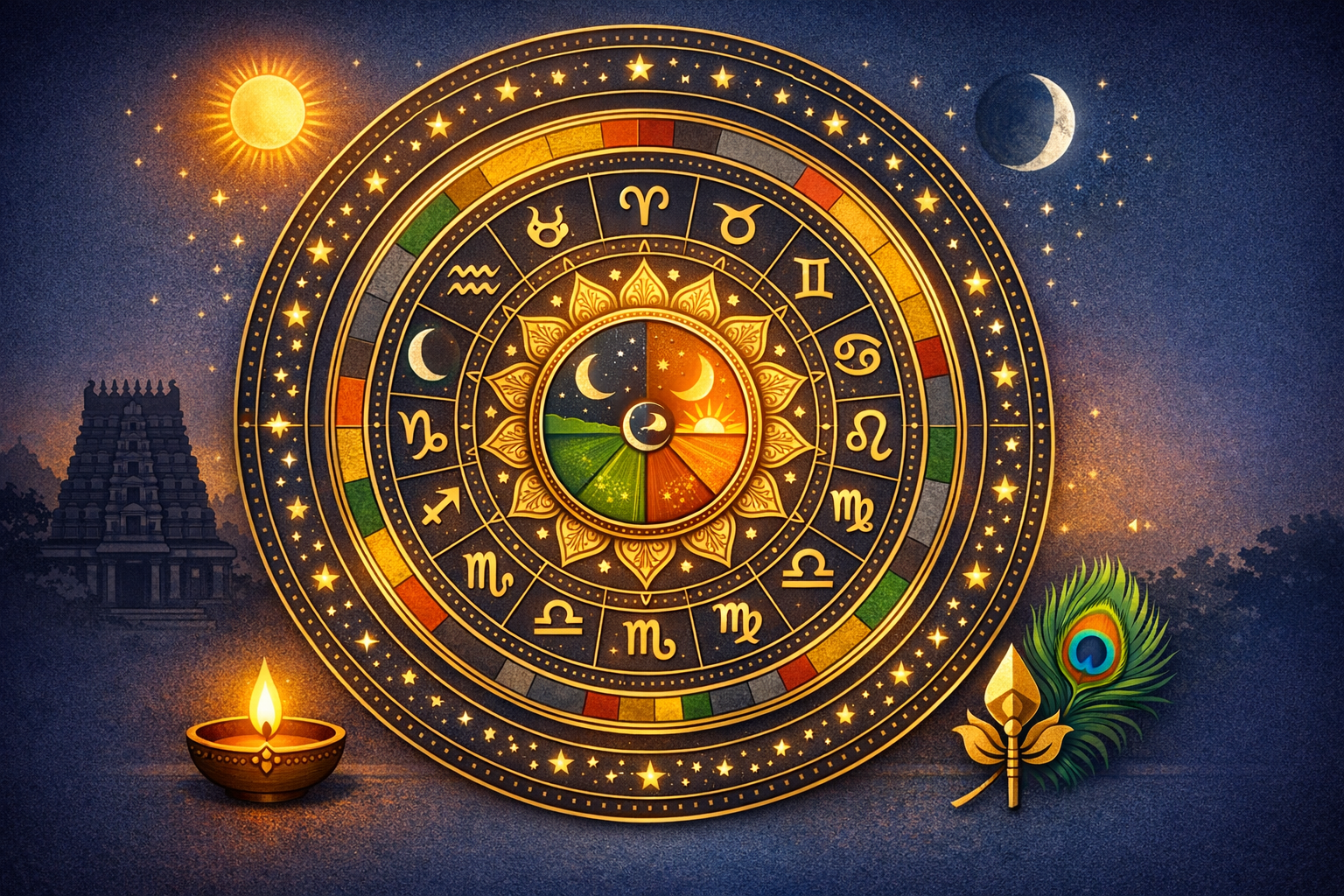
On Monday, March 23, 2026, the Hindu calendar (Panchang) in most regions of India marks Shukla Paksha Panchami (the fifth lunar day of the waxing Moon) until 21:18 IST. From 21:18 IST onward, the day transitions to Shukla Paksha Sashti (the sixth lunar day). Minor variations by a few minutes can occur depending on local longitude, latitude, and altitude, so regional Panchangam references remain authoritative for final timing.
This Tithi progressionPanchami to Sashtioffers a clear framework for scheduling worship, study, travel, charity, and community activity within the traditional Daily Hindu Calendar. Panchami is widely regarded as conducive to learning, recitation, household worship, and starting moderate undertakings, whereas Sashtiespecially valued by devotees of Subrahmanya (Kartikeya)is linked to disciplined spiritual practice and vow observance. Many households find that anchoring study and seva on Panchami cultivates serenity, while Sashti evenings draw a natural pull toward Kartikeya upasana and focused tapas.
Technically, a Tithi is defined by the Sun–Moon angular separation increasing in steps of 12 degrees (30 Tithis map one synodic month). Because Tithi boundaries are astronomical and not tied to the civil day, a Tithi can begin or end at any clock time. Hence, the Panchami-to-Sashti shift at 21:18 IST on this date is governed by the precise ecliptic longitudes of the luminaries, not by midnight or sunrise alone.
Observance norms differ by ritual intent. For temple visits, daily puja, learning, and routine auspicious tasks, the practical window for Panchami extends until its end time (21:18 IST). For vow-based rites (vrata) that follow a sunrise rule, many traditions observe the Tithi that prevails at sunrise; others apply the vyapini rule (choosing the date when the Tithi prevails for the larger, effective portion of the day). In all cases, local sampradaya guidance should be honored.
With Sashti commencing at 21:18 IST, those planning monthly Skanda Sashti worship can begin their preparations after the Tithi starts, while communities that follow a sunrise-based vrata-day will generally keep the main observance on the following civil day if Sashti does not prevail at sunrise on March 23. This approach preserves both astronomical precision and ritual continuity across temples and households.
Good Time (Shubh Muhurat) selection on this date benefits from the full Panchang setTithi, Vara (weekday), Nakshatra, Yoga, and Karanaalong with practical filters such as Rahu Kalam, Gulika Kalam, Yamaganda, and (for many households) Choghadiya. Because these depend on local sunrise and sunset, specific clock times vary by city. Still, the underlying method is stable and reproducible, making it straightforward to identify favorable intervals once sunrise is known.
Abhijit Muhuratconsidered broadly propitious for many urgent or essential undertakingscenters on local solar noon and typically spans about 24 minutes on either side of it. Although many traditions avoid Abhijit for marriage and certain samskaras, it remains a reliable fallback for high-priority actions when no other muhurat is readily available. On March 23, 2026, Abhijit Muhurat should be determined from one’s exact location using the day’s local solar noon.
Rahu Kalam, Gulika Kalam, and Yamaganda are inauspicious filters derived by dividing daytime into eight equal parts from local sunrise. On Mondays, the segment corresponding to Rahu Kalam typically falls in the morning after sunrise; with a notional 06:00–18:00 daytime, many almanacs illustrate Monday’s Rahu Kalam approximately as 07:30–09:00. This is only an example to show the methodactual start and end times must be calculated from the local sunrise. The same procedure yields Monday’s Gulika Kalam and Yamaganda, which should also be avoided for new or sensitive undertakings.
Choghadiya (widely used in western India) divides day and night into eight segments each, repeating a sequence of qualities such as Amrit, Shubh, Laabh (considered favorable) and Chal, Udveg, Rog, Kal (generally avoided). On March 23, 2026, one can generate location-specific day and night Choghadiya from sunrise and sunset and then pick a Shubh, Laabh, or Amrit period that also steers clear of Rahu Kalam, Gulika, and Yamaganda.
Nakshatra and Chandra Rashi (Moon’s sign) on any date depend on the Moon’s precise ecliptic longitude at that time. These factors enhance muhurat refinement: when the Moon is strong by Nakshatra and comfortable relative to one’s Janma Nakshatra and Chandra Rashi, tasks that require stability and goodwill tend to proceed smoothly. For March 23, 2026, the relevant Nakshatra and Chandra Rashi should be taken from a reliable local Panchangam or astronomical almanac, since they can change during the same civil day as the Moon moves across the sky.
Yoga (a function of Sun–Moon combined longitudes) and Karana (half-Tithi divisions) also sharpen muhurat selection. Many traditions prefer Siddha, Subha, Dhriti, and similar Yogas and avoid Vyatipata or Vaidhriti for sensitive work. Likewise, Bava, Balava, Kaulava, and Taitila Karanas are generally preferred over Vishti (Bhadra) for initiating auspicious tasks. As with other elements, these must be read from a local Panchang for the date and place.
Month designations can differ across India. Purnimanta calendars (common in North India) count lunar months from Purnima (Full Moon) to Purnima, whereas Amanta calendars (common in South India) count from Amavasya (New Moon) to Amavasya. Consequently, the same civil date can be labeled as late Phalguna or early Chaitra depending on the regional tradition, while the underlying Tithi remains identical. When planning fasts and vratas with community participation, aligning with the locally observed convention preserves harmony.
The Panchang serves as a shared cultural compass across dharmic communities. While most commonly referenced in Hindu and Jain practiceand also intersecting with Buddhist and Sikh cultural calendars in many regionsthe intent remains inclusive: to cultivate rhythm, remembrance, and mutual respect. Choosing auspicious times with sensitivity to local sampradayas strengthens unity and allows diverse spiritual lineages to thrive together.
Practical planning for March 23, 2026 can follow a simple, time-tested approach. Tasks aligned with Panchamistudy, japa, household worship, and moderate beginningsfit well before 21:18 IST. After the Tithi changes, devout observances connected with Sashti and Subrahmanya may begin, while sunrise-rule vrata traditions can keep the principal observance to the following civil day if required. In all cases, one can overlay Shubh Muhurat windows from Abhijit or Choghadiya while avoiding Rahu Kalam, Gulika Kalam, and Yamaganda to strengthen outcomes.
To verify local specifics for March 23, 2026: note the location’s sunrise and sunset; compute Rahu Kalam, Gulika, and Yamaganda from eightfold daylight division; read Nakshatra, Chandra Rashi, Yoga, and Karana from a trusted regional Panchangam; and confirm the Tithi boundary at 21:18 IST against the local time zone if outside India. This simple checklist keeps planning precise yet tradition-sensitive.
In summary, Monday, March 23, 2026 carries Shukla Paksha Panchami until 21:18 IST and Shukla Paksha Sashti thereafter. Framed by careful muhurat selection and considerate local practice, the day supports learning, worship, and vrata with a steady, inclusive spirit consistent with the broader dharmic heritage.
Inspired by this post on Hindu Blog.