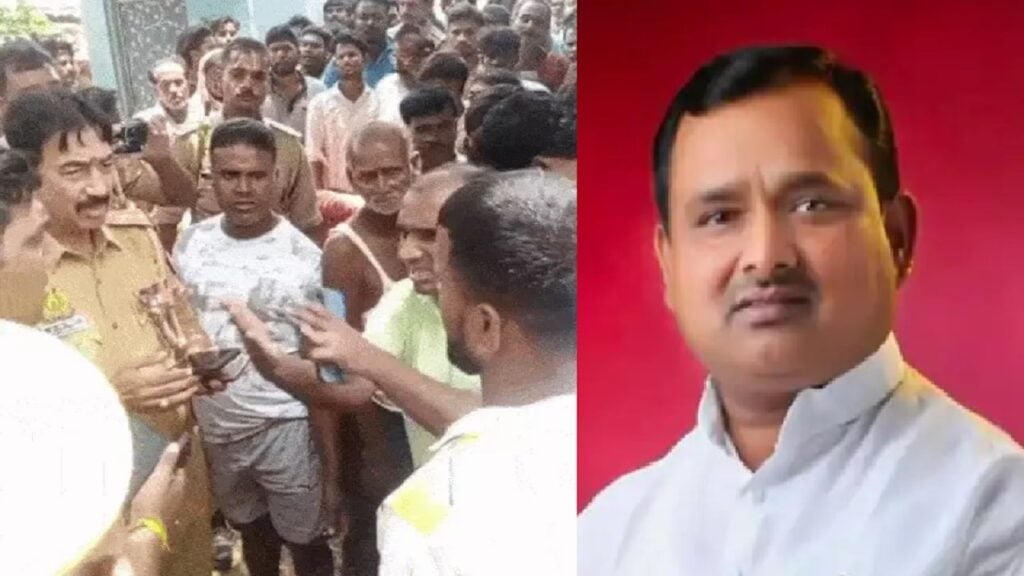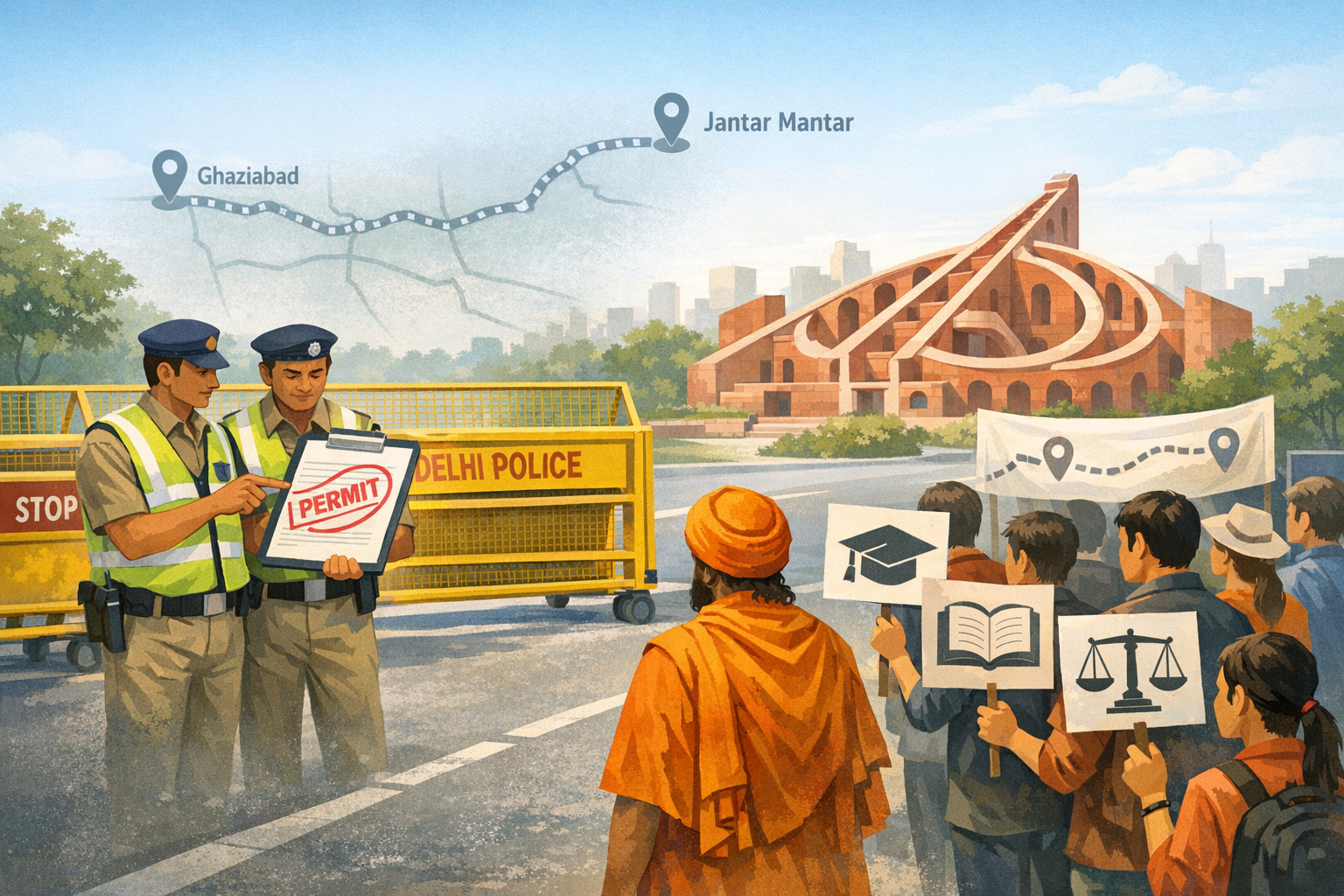
On 7 March 2026, Ghaziabad Police halted a yatra led by Dasna Devi Mandir priest Yati Narsinghanand that sought to proceed to Delhi’s Jantar Mantar in protest against a proposed UGC Bill. Police on the spot cited the absence of requisite permission for an intercity procession and for assembly at the designated protest site in New Delhi. The intervention reframed the day’s events from a planned demonstration into a debate about the right to protest in India, the legal architecture governing public assemblies, and the pace and direction of higher education reform.
Jantar Mantar occupies a unique place in New Delhi’s civic landscape as a regulated venue for demonstrations, where permissions typically stipulate participant caps, time windows, sound limits, and liaison protocols with the Delhi Police. When a rally originates outside Delhihere, in Ghaziabadorganizers generally require coordinated approvals from both jurisdictions for the route, crowd management, and the intended assembly. In practice, such dual-jurisdiction permissions aim to balance constitutional freedoms with predictable traffic, safety, and emergency response arrangements across district and state lines.
The constitutional touchstone for this situation is Article 19(1)(b), which guarantees the right to assemble peacefully and without arms, read with Article 19(3), which allows reasonable restrictions in the interests of public order and the sovereignty and integrity of India. Operationally, police rely on the Code of Criminal Procedure (for example, provisions dealing with unlawful assemblies and public order) and on any lawfully issued prohibitory orders, including those commonly referred to under Section 144 when in force. The legitimacy of a restriction turns on proportionalitywhether the measure is lawful, necessary, and narrowly tailored to the stated objectivean approach that has become central to contemporary Indian constitutional jurisprudence.
Against this legal backdrop, the Ghaziabad Police decisionframed as a permissions issuehighlights a recurrent administrative question: how to ensure that intercity processions culminate at Jantar Mantar without creating undue disruption en route. Standard operating expectations in such cases usually include advance applications, detailed route maps, projected headcounts, named conveners, self-regulating marshals, and contingency and first-aid plans. Where permissions are declined, best practice is to provide written, reasoned orders and, where feasible, offer an alternative venue, time, or route that achieves the demonstrators’ objectives with a lower risk profile.
For many students, educators, and community members across Dharmic traditions, Jantar Mantar functions as a civic commonsa space where concerns over policy are aired in a visible yet regulated manner. The yatra’s halt therefore resonated emotionally beyond the immediate participants, signaling how procedural roadblocks can be experienced as substantive barriers. At the same time, administrative clarity and responsible complianceby both organizers and officialsremain indispensable to sustaining trust in the system that enables lawful, peaceful protest.
The UGC Bill referenced in the protest sits within a decade-long conversation about aligning higher education governance with evolving national priorities. Public debates around such proposals typically focus on institutional autonomy versus centralized oversight, quality assurance and accreditation frameworks, funding flows, faculty recruitment norms, and the interface with the National Education Policy. These are complex, high-stakes questions: they shape academic freedom, research ecosystems, student affordability, and the role of universities as plural spaces serving Hindu, Buddhist, Jain, Sikh, and other communities alike.
An academic lens suggests that robust reform benefits most from transparent drafting, time-bound public consultation, and impact assessments that consider diverse institutional archetypesfrom state universities and institutes of national importance to minority-administered and dharmic heritage institutions. When inclusive consultation is paired with clear regulatory design, regulatory certainty increases, compliance costs decline, and policy legitimacy strengthens. In turn, peaceful protest retains its core democratic function: to prioritize citizen concerns without derailing everyday life.
Within this broader context, the Ghaziabad Police action underscores a narrow but crucial procedural point: permissions are not mere formalities; they are instruments to operationalize the constitutional promise of peaceful assembly. Organizers planning intercity marches toward Jantar Mantar can strengthen their position by submitting comprehensive documentation early, appointing trained marshals, coordinating with both Ghaziabad and Delhi authorities, and publishing a code of conduct that explicitly commits to nonviolence, communal harmony, and minimal disruption. Such measures not only improve the likelihood of permission but also reflect a shared civic ethic rooted in dharmic values of restraint and responsibility.
Equally, police and civic administrations can deepen public confidence by adopting single-window digital systems for protest permissions that provide real-time status, reasons for decisions, and standardized safety templates. Time-bound, reasoned approvals or denialscoupled with an offer of alternate arrangements when constraints are genuineembody the proportionality principle and reduce friction at assembly points. The result is a predictable pathway that channels public energy into constructive, lawful expression.
From a societal perspective, education policy is not a zero-sum contest among communities. Dharmic traditionsHinduism, Buddhism, Jainism, and Sikhismshare a civilizational regard for knowledge, inquiry, and disciplined debate. Unity across these traditions during moments of contention strengthens the moral authority of civic action and helps keep the discourse anchored to substantive educational outcomes: access, quality, inclusion, and research excellence.
The events of 7 March 2026 in Ghaziabad therefore carry two intertwined lessons. First, the right to protest in India thrives when permissions, routes, and responsibilities are approached with rigor by all sides. Second, the quality of higher education reformand public trust in itimproves when diverse stakeholders are invited into a transparent process that honors both constitutional rights and public order. In this equilibrium, peaceful demonstration remains a safety valve, and policy reform remains a deliberative, knowledge-driven enterprise.
In summary, the halted yatra led by Yati Narsinghanand brought the procedural mechanics of protestpermissions, jurisdictional coordination, and proportionate restrictionsinto sharp relief. It also highlighted the enduring symbolism of Jantar Mantar as a site where voices from Ghaziabad and beyond converge on national questions, including the UGC Bill. Maintaining unity across dharmic communities, foregrounding academic substance over polarization, and adhering to constitutional procedure together offer a clear path to principled and effective civic engagement.
Inspired by this post on Struggle for Hindu Existence.