At the ‘Hindu Rashtra-Jagruti Sabha’ held at Shri Ram Temple in Vasco, Anand Jakhotia articulated Goa’s cultural identity through the prism of Parshuram Bhoomi, urging a reframing of the region beyond its popular association with material indulgence. In this framing, references to “Hindu Rashtra” were presented as an ethical-cultural horizon of dharmic unity rather than an exclusionary political project, emphasizing shared values and lawful, plural coexistence.
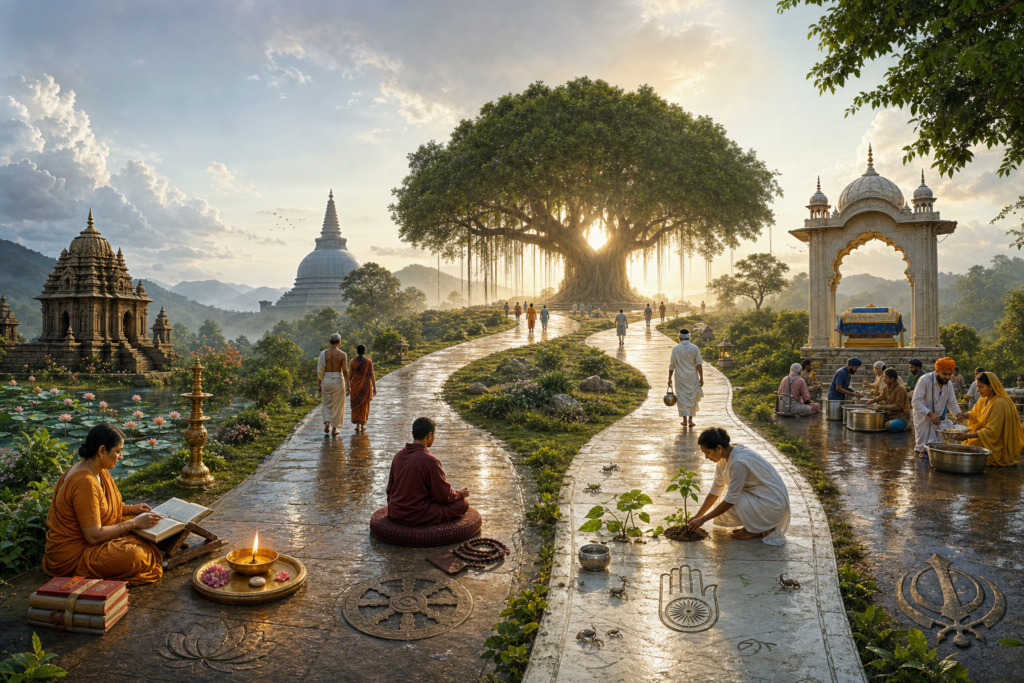
Situated within the wider Indic memory, the Konkan coastlinelinked in sacred narratives to Bhagwan Parshuramfunctions as a living “sacred geography.” This perspective highlights reverence for land and sea, self-restraint, and stewardship as core civic virtues. Such dharmic ethics resonate across Hindu, Buddhist, Jain, and Sikh traditions, underscoring a unifying civilizational ethos that privileges compassion, non-violence, service (seva), and truthfulness.
The Sabha also engaged with contemporary legal-discursive questions related to the Waqf Board and the Places of Worship Act. Framed academically, these debates concern transparency, accountability, and parity before law in the stewardship of sacred sites. A principled approachone that safeguards temples, mathas, gurdwaras, viharas, and other places of worship alikewas emphasized as consistent with constitutional norms and the dharmic ideal of fairness and mutual respect.
Rather than foregrounding confrontation, the address centered on personal adherence to Dharma as the foundational pathway to social renewal. Ethical conduct, inner discipline, ecological care, and everyday acts of service were presented as practical means to strengthen community cohesion. Interfaith respect and neighborhood cooperation were further highlighted as relational practices that translate inner commitments into public harmony.
Reframing Goa’s public image entails moving beyond a narrow, consumption-driven narrative to one that recognizes cultural heritage, living traditions, and the quiet sanctity of shrines, rivers, and ghats. This reframing does not dismiss livelihoods or visitors; instead, it argues for aligning tourism and development with heritage conservation, local custodianship, and spiritual sensitivity so that economic activity complements cultural continuity.
In synthesis, the vision of Parshuram Bhoomi advances dharmic unity, constitutional dialogue, and evidence-based policy to protect sacred geography while fostering social trust. By holding together multiple paths within a shared ethical framework, Goa can model inclusive cultural renewalrooted in Dharma and open to the plural spiritual journeys that characterize the subcontinent. This approach affirms that lasting transformation is achieved through inner refinement expressed as civic responsibility.
Inspired by this post on Hindu Jagruti Samiti.