
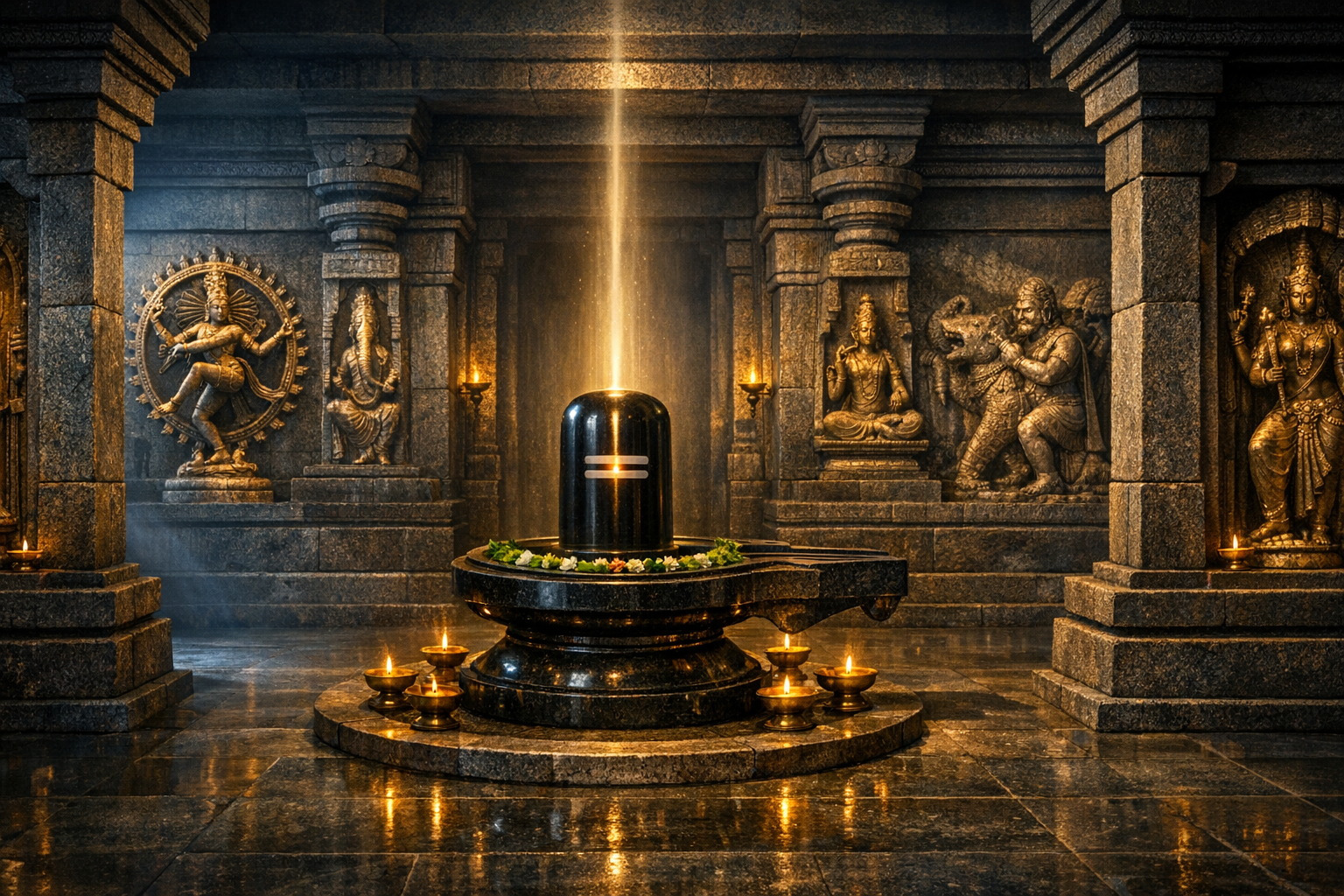
Across Shaivite temples in India, the eye is drawn to vivid stone and bronze images of Shiva in motion: Nataraja whirling in cosmic rhythm, Tripurantaka loosing the fatal arrow, Gajāsura-saṁhāra subduing the elephant-demon, Ravana lifting Kailāsa, or Parameshwara in intimate play with Pārvatī. Pilgrims pause before these compelling narratives and often ask a simple but subtle question: if these forms stir such devotion, why are they so rarely the focus of daily worship?
The answer begins with understanding what these images represent. Lilāmūrtis are the narrative, anthropomorphic forms of Shivaicons that depict the divine “līlā,” or play, in specific acts and moods (rasa). They are designed to teach theology through sight: to make metaphysics memorable, emotion palpable, and dharma visible. Yet in the standard ritual hierarchy of a Śiva temple, these forms are not usually the primary recipients of nitya-archana (daily worship). That role typically belongs to the Śiva-liṅga, the aniconic emblem that anchors the sanctum.
Shaiva Āgamas, the authoritative ritual and architectural manuals, consistently center the liṅga as the supreme emblem of Śiva. The liṅga signifies the axis mundi (brahmastambha), an unbounded column of consciousness without beginning or enda form that is, paradoxically, the symbol of the formless. Where lilāmūrtis externalize Śiva’s qualities and deeds, the liṅga internalizes Śiva’s transcendence. This theological primacy explains why the garbhagṛha (sanctum) across regionsKashi, Bhubaneswar, Chidambaram, Thanjavurmost often houses a liṅga as the mūla-bhera (mūlavar).
Temple architecture translates this theology into space. The garbhagṛha cultivates a śānta (tranquil) rasa in darkness and silence, where the liṅga invites inward contemplation. Around this still center radiate the maṇḍapas and prākāras, where narrative and pedagogical imagery flourishes. The built form thus stages a journey: inward to non-dual awareness at the liṅga, outward to the manifold expressions of divine action through lilāmūrtis.
Consecration practice further explains the differential ritual status. Through prāṇa-pratiṣṭhā, life is ritually invoked into images specifically designated for regular worship. In most temples, the mūla-bhera (liṅga) and select parivāra-devatās (attendant deities) receive full consecration and daily upacāras (offerings). Many narrative panels on walls, pillars, and prākāra niches function as śilpa (sacred art) and śāstra (visual scripture) rather than as independent consecrated deities; they are revered through darśana but do not receive the same abhiṣeka, alaṅkāra, or naivedya as the principal icons.
In Drāviḍa temple architecture, devakoṣṭha niches commonly present a canonical set: Dakṣiṇāmūrti (south), Liṅgodbhava (west), and Durgā (north), among others. These are not casual decorations; they are carefully prescribed by Agamic texts such as the Kāmīka, Suprabheda, and Ajita Āgamas, as well as by Śilpa Śāstras like the Māyamatam and Mānasāra. Even when these images are consecrated, the nitya-archana protocol remains focused on the liṅga in the sanctum, while the koṣṭha-devatās receive periodic or festival-based honor.
Ritual aesthetics (rasa) also shape placement. Ugra (fierce) formsAndhakāsura-vadha or certain Bhairava iconographiesradiate intense tejas that the Āgamas often situate away from the innermost sanctum to preserve the sanctum’s tranquil mood. This is not a negation of devotion; it is a calibrated arrangement so that devotees experience Śiva’s compassion and power without overwhelming the sanctum’s contemplative core. Where fierce forms are primary (as in certain Bhairava shrines), specialized rites govern their worship.
Public devotion is not neglected; it is channeled through utsava-bheras (processional icons). Many temples keep a metal lilāmūrti of Nataraja, Somāskanda, or Chandrasekhara as utsava-mūrtis, fully consecrated for festivals and processions. During utsavas, these icons receive elaborate worship, music, dance, and vāhana-sevā, carrying Śiva’s presence into the streets. Thus, while the liṅga anchors daily worship, lilāmūrtis animate communal celebration.
Somāskandathe triad of Śiva, Pārvatī, and Skandais especially instructive. In numerous Chola-era temples (e.g., around Thanjavur and Kanchipuram), a Somāskanda panel appears behind the liṅga in the sanctum. It is not a separate object of daily worship; rather, it theologically frames the liṅga with a gentle, familial mood that resonated with royal ideology and community life, without displacing the liṅga’s primacy.
Exceptions illuminate the rule. At Chidambaram, Nataraja is the presiding deity; the daily sequence centers on the dancing form. Yet even there, the liṅga (often in the Chitsabhā or associated shrines) remains integral to the temple’s Agamic order. Elsewhere, icons like Tyāgarāja at Tiruvarur or Nataraja at Konerirajapuram receive rigorous worship, particularly during Arudra Darśanam, when lilāmūrtis become the liturgical focus by explicit Agamic sanction.
Iconographies such as LiṅgodbhavaŚiva manifesting as an endless column of lightsummarize the doctrine: anthropomorphic figures of Brahmā and Viṣṇu fail to find the liṅga’s limits. This west-facing niche image is central to the temple’s visual theology but, again, it frames rather than replaces the sanctum’s aniconic liṅga worship.
Textual prescriptions support this architecture of meaning. The Kāmīka Āgama and allied Shaiva Siddhānta Āgamas delineate mūrti types (mūla-bhera, kautuka-bhera, utsava-bhera) and their ritual rights; Śilpa Śāstras set pro- portions, gestures (mudrās), and placements. The outcome is a consistent pattern from Lingīrāja (Bhubaneswar) and Somnāth to Bṛhadīśvara (Thanjavur): the liṅga holds the center; lilāmūrtis instruct, inspire, and participate through defined ritual channels.
Regional theologies vary in flavorKashmir Śaivism’s non-dual expositions, Tamil Śaiva Siddhānta’s liturgical precision, Odisha’s Kalinga architectureyet practice converges on liṅga-primacy for nitya-archana. This convergence reflects a shared conviction: Śiva’s essence is most powerfully evoked in the liṅga’s austere, limitless presence, while lilāmūrtis render that essence intelligible and intimate.
Much confusion stems from conflating darśana (reverential seeing) with formal pūjā (ritual offering). Devotees rightly bow before narrative panels or touch the base of a revered niche image, but the full sequence of upacāras is reserved for those icons invested with prāṇa-pratiṣṭhā for daily worship. In many temples, priests will wave a lamp to koṣṭha-devatās or offer occasional flowers, acknowledging their sanctity while maintaining the Agamic hierarchy.
There are also practical concerns of stewardship. Many lilāmūrtis are ancient stone reliefs; frequent abhiṣeka could damage surfaces, pigments, or inscriptions. Restricting liquid offerings to consecrated icons designed for such rites helps preserve temple heritage while honoring the Āgamic logic of image care (vigraha-rakṣaṇa).
For pilgrims, this arrangement deepens experience. Standing before the liṅga, many feel an inner hushthe mind meets a form that refuses easy narrative, encouraging stillness. Circling the prakāra, devotees encounter Śiva’s play in stone and bronze; lessons in courage, humility, devotion, and cosmic law come alive. The temple becomes a curriculum: silence at the center, story in the circumambulation.
Parallels across dharmic traditions underscore a shared civilizational grammar. Buddhist stupas and Jain temples present narrative friezes that teach, while the central focus remains the stūpa or the Jina’s serene icon. In Sikh practice, the Guru Granth Sahib is the living spiritual center, while images related to Gurus are treated with deep respect but do not displace the primacy of the shabad (Word). Across Hinduism, Buddhism, Jainism, and Sikhism, narrative images educate and elevate, while the core of worship or contemplation anchors a unifying spiritual principle.
Festival cycles periodically foreground lilāmūrtis. On Arudra Darśanam, the utsava Nataraja receives grand abhiṣeka and procession; during Mahāśivarātri, certain narrative icons receive special lamps or adornments. In these moments, the “sportive” forms become liturgical protagonists with Agamic authorization, reaffirming that their place is not marginal but carefully timed and theologically meaningful.
In short, “seen but not worshipped” is an oversimplification. More precisely: lilāmūrtis are venerated as visual theology and, when duly consecrated as utsava or parivāra icons, they are worshipped according to specified times and modes. The liṅga remains the axis of nitya-archana because it embodies Śiva’s limitless, formless truth; the lilāmūrtis surround this truth with story, mood, and instruction.
This calibrated harmonyaniconic center, iconic circumferenceexpresses a profound insight shared across dharmic paths: transcendence is approached through both silence and story, essence and expression. Honoring that balance preserves the integrity of temple worship, strengthens inter-dharmic understanding, and invites every seeker into a deeper, more integrated encounter with the Sacred.
Inspired by this post on Hindu Blog.
