
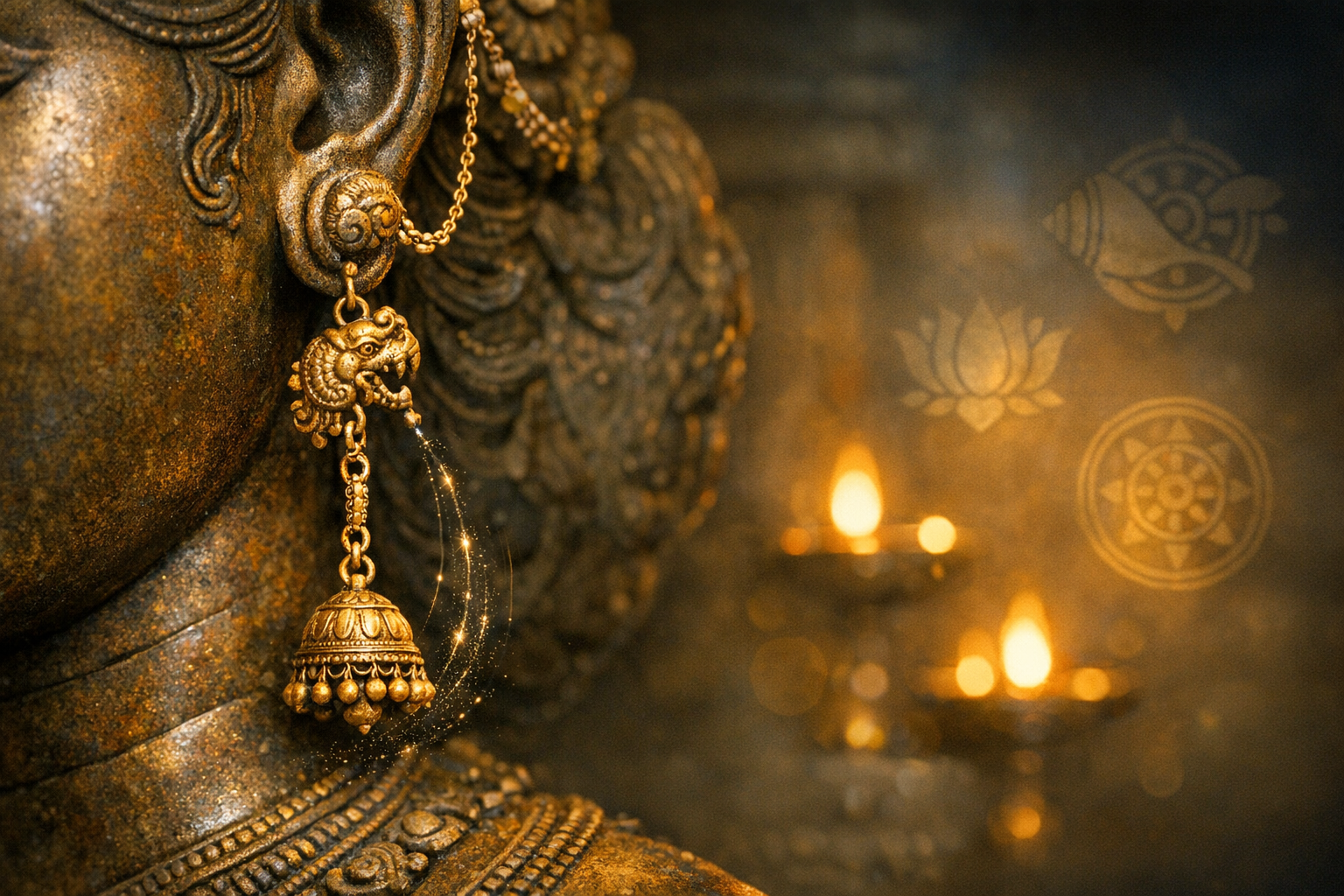
The first glimmer often noticed in a sanctum or gallery is a gentle arc traced in the air by a swinging jewel at the ear. That oscillationsubtle yet decisiveanimates the countenance of the divine and draws the gaze upward. In Hindu sacred art, this pendulous earring is known as the dola kundala: doḷa, the swing; kuṇḍala, the earring. Far more than decoration, the dola kundala operates as a kinetic device that enlivens the image, a sign of auspiciousness and vitality, and a visual metaphor for the rhythmic pulse of the cosmos that temple ritual seeks to mirror.
Etymologically, the term aligns motion (doḷa) with ornament (kuṇḍala), expressing a core aesthetic truth long cultivated in the subcontinent: beauty is most persuasive when endowed with life-like movement. Across Hindu sculptures and ritual assemblagesbronzes, stone icons, painted panels, and festival alankarathe dola kundala signifies a confluence of visual grammar, spiritual meaning, and artisanal engineering. The device is also culturally ecumenical. Related pendulous ear-ornaments appear in Buddhist bodhisattva imagery and in Jain yaksha–yakshi iconography, while Sikh communities have preserved regional jewelry traditions that share techniques and motifs with broader dharmic craft lineages. The result is a unifying sign across India’s sacred arts, expressing refinement, grace, and the hearable nearness of the sacred.
Classical treatises on image-making and ornamentationsuch as sections of the Vishnudharmottara Purana (with prescriptions for painting and sculpture), Manasara, and Shilparatnaclassify ear ornaments (karṇa-bhūṣaṇa) by form, iconographic suitability, and devotional affect (rasa). Among widely attested types are the makara-kundala (featuring the aquatic makara), the patra- or pātra-kundala (leaf- or dish-like), the bell-shaped jhumka, the disc-like tāṭaṅka, and the explicitly pendulous dola kundala whose primary aesthetic is measured by its swing. Texts pair specific forms to deities and moods, ensuring that jewelry contributes to iconographic integrity as much as to visual splendor.
In the iconographic grammar of Hindu Sculptures, the dola kundala appears where movement, compassion, or regal sweetness is to be conveyed. Shaiva dancing forms, Vaishnava images of Vishnu and Krishna, and the many facets of the Goddess (Shakti) frequently incorporate pendulous earrings to heighten presence and evoke auspicious vibration. The choice of a swinging earring is therefore not incidental: it is a design decision grounded in shastra and bhakti, orchestrating how viewers perceive the deity’s face, head-tilt, and the soft play of light that accompanies motion.
Few ensembles display the persuasive logic of the dola kundala better than the Chola bronzes of Tamilakam. In Shiva Nataraja bronzes, the dynamic spiral of the ananda tandava finds a resonant echo in earrings that arc outward as if caught in the god’s perpetual turn. Even slight asymmetries in the earrings or their suspension amplify the sense of rotation. South Indian bronzes often include a mattal, a supporting chain that links the earring to the hair ornament; this stabilizer also choreographs the swing and prevents damage to elongated earlobes, quietly revealing the engineer’s hand behind devotional aesthetics.
Vaishnava icons equally reveal a codified ear grammar. Vishnu is frequently described in texts and hymns as makara-kundala-dhara; the sea-creature terminals signify protection and fertility, while the hanging element supplies the kinetic grace of doḷa. In Krishna imageswhether Mathura–Gupta stone or later metal and wood utsava murtisthe pendulous earring animates the compassionate gaze (karuṇa-rasa), catching light as the murti turns during circumambulation or during Jhulan Yatra, the Vaishnava swing festival that itself underscores the theological poetics of oscillation and divine play (lila).
Shakti traditions, especially in southern temples, highlight large, commanding ear ornaments for the Goddess. The disc-like tāṭaṅka is renowned at shrines such as Madurai and Thiruvanaikaval (where temple tradition attributes the installation of Śrīcakra tāṭaṅka to Ādi Śaṅkara), while smaller pendulous kundalas appear in daily alankara to infuse the murti with gentle motion. The Andal tradition, iconic for the Andal Kondai hairstyle, often pairs hair and ear ornaments to balance volume and sway; while Andal’s tāṭaṅka are typically disc-like, the adjacent use of pendulous pieces in allied bronzes shows how South Indian design languages coordinate mass and movement across the headgear ensemble.
Dharmic visual cultures converge around the meaning and mechanics of ear ornaments. In Buddhist art, bodhisattvas such as Avalokiteshvara and Manjushri are adorned with pendulous earrings that signify royal renunciation and immeasurable compassion; the swing softens the face and guides attention to a serene mouth and listening ear. In Jain art, Tirthankaras remain unadorned, yet their elongated earlobes recall past princely life, while attendant yakshas and yakshis often wear pendulous earrings that evoke sovereignty, abundance, and protection. This shared vocabulary across Hindu, Buddhist, and Jain visualities reinforces the unity of dharmic aestheticsbalancing renunciation with auspicious presence through subtle kinetic cues.
Regionally, the dola kundala acquires distinctive signatures. In the Tamil and Chola Dynasty heartlands, bronze casting via the lost-wax (cire perdue) method enables fine, mobile loops and separately suspended elements. In Odisha and Bengal, the pendant earring appears in Pattachitra painting and in metal icons linked to Dola Yatra and Ratha Yatra cycles; the jewelry’s swing is implied by curving outlines and rhythmic linework. In western and northern India, Gupta and post-Gupta sculptural idioms favor slender, elongated earlobes with delicate pendants; later Rajasthani and Gujarati craft traditions expand the jhumka family with granulation, kundan setting, and meenakari enameling, creating vibrant, acoustically lively pieces for both images and devotees.
From an art-technology perspective, the dola kundala is an elegant feat of miniature mechanics. Artisans must calculate weight, moment, and clearance so that motion is perceptible but controlled. Suspension rings must be resilient yet fine; mattal supports distribute load; fasteners and pegssometimes aided historically by organic lac or resinscushion stress points around the karṇapatra (ear plate) or lobe. In festival murtis, jewelers and temple silversmiths often craft detachable ear units, permitting seasonal variation while safeguarding structural integrity during processions where oscillation increases dramatically.
Materials and techniques follow the demands of form and function. Gold and silver predominate for permanence and ritual purity; copper alloys enable durable, finely cast pendants. Repoussé and chasing articulate lightweight forms; filigree produces intricate lattices that enhance shimmer and reduce mass; kundan and meenakari add color and reflective surfaces to amplify visual vibration under temple lamps. In all cases, the objective is a calibrated swing that registers under low, warm lightan effect that brings the face to life during darshan without overwhelming the physiognomy of the murti.
Ritual practice turns the dola kundala from object to experience. Daily alankara in temples aligns earrings to the day’s bhava; during utsava processions, the increased tempo and motion produce a distinctly felt cadence as earrings sway in time with cymbals and drums. Vaishnava traditions celebrate oscillation explicitly in Dola Purnima and Jhulan Yatra, where the swing of the deity becomes theology in motiontime, devotion, and cosmic breath converging in a gentle arc. Many devotees report a perceptible hush at the moment a pendulous earring changes direction, a tiny pause that seems to hold the temple’s breath before movement resumes.
Philosophically, the dola kundala sits at the ear, the organ of śravaṇalisteningthrough which Veda, mantra, and upadeśa are received. Its measured swing evokes spanda, the subtle vibration central to many Shaiva and Shakta metaphysics, and Nada Brahma, the insight that primordial reality is sound. As the earring oscillates, it scripts a visual allegory for yogic balance (sthira–sukha): neither static nor erratic, it embodies the middle rhythm by which attention steadies and devotion flowers. In this sense, the ornament is pedagogy; it teaches by moving.
Socially and ritually, ear piercing (karṇavedha) has marked initiation across India in Hindu, Buddhist, and Jain communities, sustaining a shared body-memory of adornment. While practices vary, the cultural association of the ear with learning and restraint is strikingly consistent. In sacred imagery, the dola kundala therefore resonates not only as an aesthetic device but as a recollection of disciplined hearing and graceful speechthe ethics of the ear become the ethics of the tongue. This convergence of ethics and aesthetics is a signature of dharmic visual cultures, where outward beauty points inward to inner refinement.
Conservation and curatorship present distinct challenges for pendulous earrings in historic sculptures. Moving parts invite metal fatigue; dust and residues may abrade contact points. Best practice in museums and temples entails minimal, reversible stabilization; corrosion control suited to the specific alloy; avoidance of aggressive cleaning agents; and, when necessary, the fabrication of replica earrings for protocol-heavy processions to spare vulnerable originals. Documentation of craft knowledgehow mattal are sized, how weight is balanced, how seasonal alankara modifies suspensionforms a crucial part of intangible heritage stewardship.
A field-reading of ear ornaments benefits from a few practical distinctions. A tāṭaṅka is typically disc-like and frontal, broadcasting presence by area; a makara-kundala announces itself by its terminal sea-creature motif; a jhumka is bell-like with beaded fringes that add shimmer and subtle sound; a dola kundala is defined first by its pendular behavior: a suspended element on a slender linkage engineered to arc freely. Many icons synthesize types, but attending to how the earring moves (or is designed to suggest motion) often reveals the artisan’s intent and the theological mood inscribed into the face.
Archaeological horizons underscore the antiquity of India’s ear-ornament arts. Harappan figurines show ear perforations and metal spirals; Mauryan and Shunga pieces at Bharhut and Sanchi display a growing sophistication in karṇa-bhūṣaṇa; Gupta art refines elongation and pendants into an idealized, serene physiognomy that becomes foundational for later Hindu, Buddhist, and Jain idioms. Throughout, pendulous forms track a constant desire to animate the visage, to let the sacred appear not as a fixed mass but as presence in time.
In sum, the dola kundala of Hindu art is a small masterpiece of meaning. It fuses shastra with craft, philosophy with engineering, and aesthetics with devotion. It speaks a language shared across dharmic traditionsHinduism, Buddhism, and Jainismwhere listening, balance, and compassion are prized. Whether glinting beside Nataraja’s cheek, enhancing Vishnu’s makara-kundala with gentle sway, or softening a bodhisattva’s smile, the pendulous earring carries forward a living legacy: unity in diversity, motion in poise, and the luminous tenderness of the divine face meeting a devotee’s gaze.
Inspired by this post on Hindu Blog.
