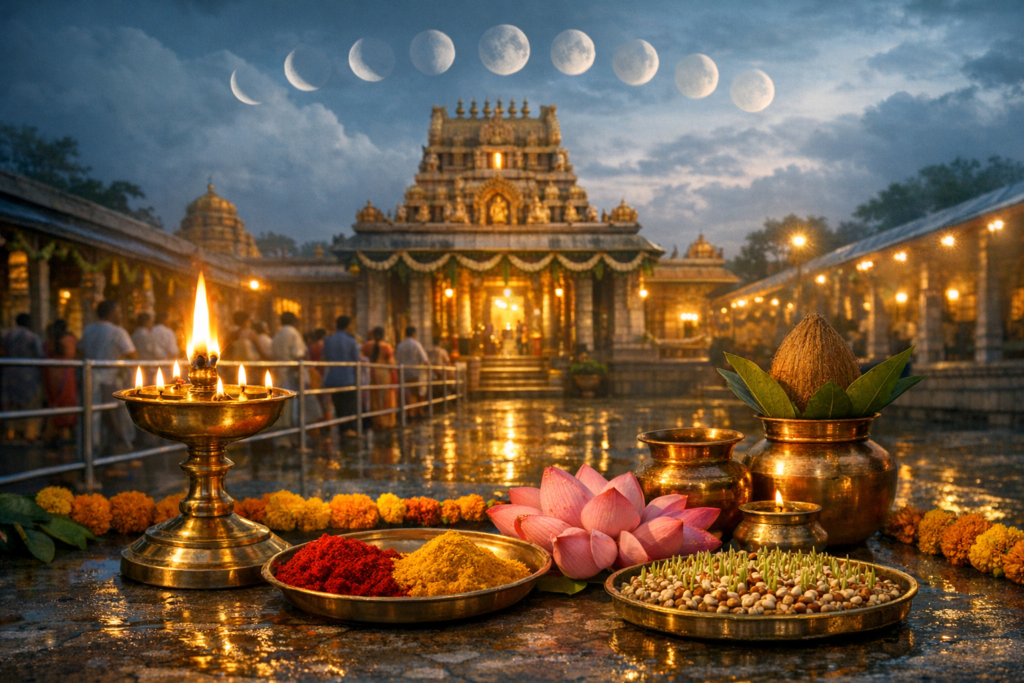
Tuesday, February 3, 2026 in the Hindu calendar (Panchang) marks a transition of tithi during the night. The day begins with Krishna Paksha Pratipada—the first day of the waning lunar phase—lasting until 2:32 AM on February 3. From that point onward, Krishna Paksha Dwitiya—the second day of the waning phase—prevails across most regions.
This tithi sequence is significant in daily observance. Because the Dwitiya tithi begins well before sunrise in many locations, household rites, temple visits, and personal sadhana on this date will generally align with Krishna Paksha Dwitiya. As with all Panchang details, slight regional and timezone variations may occur; practitioners commonly refer to a local almanac for the precise sunrise and tithi boundaries applicable to their place.
Within the waning fortnight, devotees often emphasize practices of reflection, steadiness, and simplicity—such as quiet japa, svadhyaya (study), and daana (charitable giving). Many families find that this rhythm supports mindful living between festivals and fasts, reinforcing shared cultural values that are also respected across the broader dharmic spectrum—Hindu, Buddhist, Jain, and Sikh communities—through an appreciation of cyclical time and inner discipline.
Regarding Shubh Muhurat (good time) on February 3, 2026, auspicious windows are calculated from the full Panchang components—Tithi, Nakshatra, Yoga, and Karana—together with local sunrise and sunset. In practice, many avoid inauspicious segments such as Rahu Kalam and Yamaganda and select favorable intervals based on region-specific calculations. For precision, consulting a local or regional Panchang is recommended to identify the most suitable muhurat for rituals, travel, or new undertakings.
Nakshatra and Chandra Rashi (Moon sign) for the date are likewise determined by the Moon’s longitude and may change during the day. Since these factors directly influence Shubh Muhurat and the suitability of specific activities, reference to a location-adjusted Panchang or reliable app is advisable. This careful approach ensures that observances remain aligned with the exact celestial configuration at a given place and time.
For sankalpa formulations or vratas that require a dominant tithi at sunrise, the practical takeaway is straightforward: with Krishna Paksha Dwitiya commencing at 2:32 AM, sunrise on February 3, 2026 will generally occur during Dwitiya for most regions. This facilitates consistent planning for daily worship, home rites, and temple offerings.
Across the dharmic traditions, the Panchang functions as a shared cultural compass that encourages cooperative observance and mutual respect. By approaching February 3, 2026 with attentiveness to tithi, muhurat, Nakshatra, and Rashi—while honoring local calculations—communities sustain a unifying rhythm that supports both spiritual continuity and everyday well-being.
Inspired by this post on Hindu Blog.