
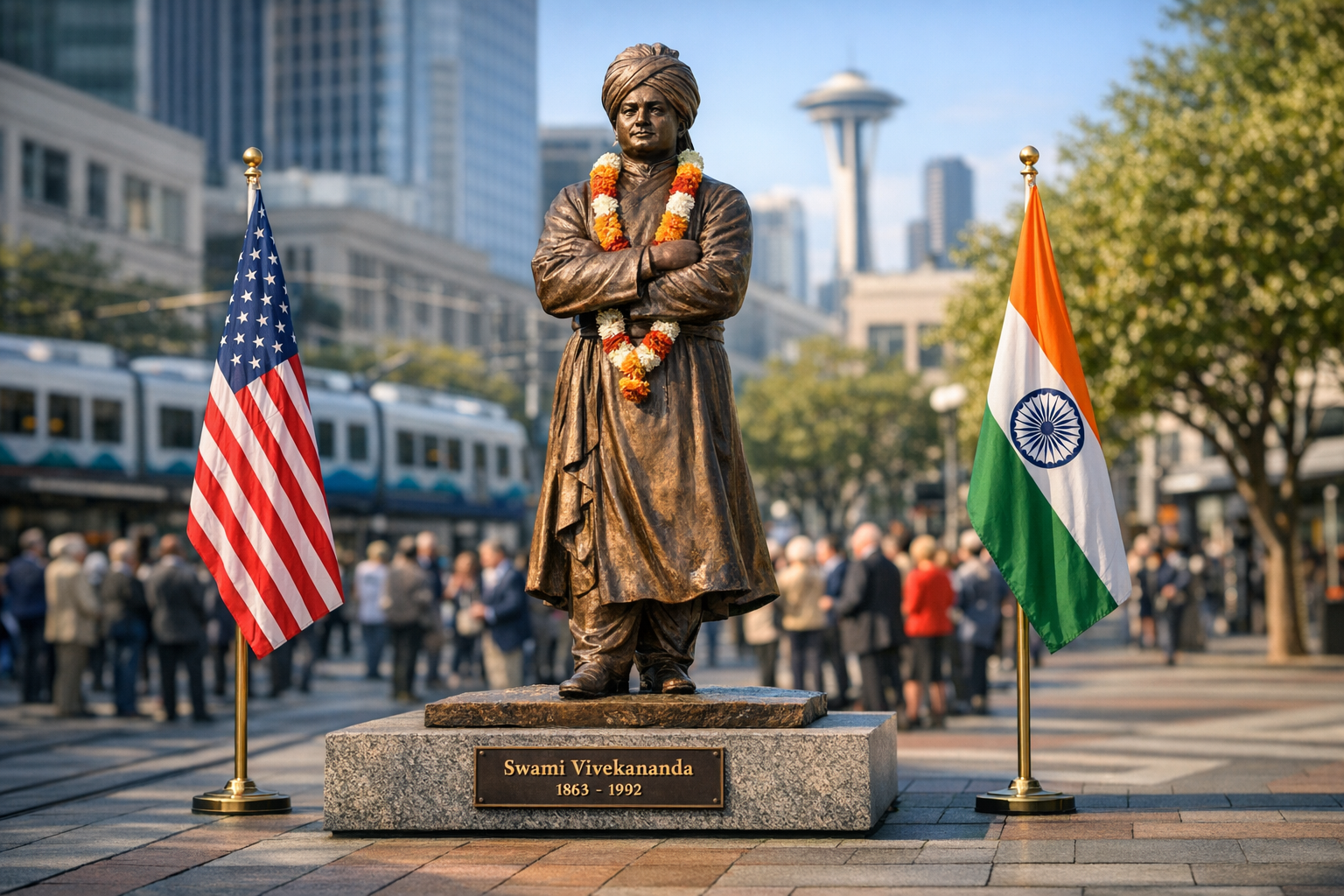
Seattle has become the first U.S. city government to host a life-size statue of Swami Vivekananda, installed at Westlake Square in downtown Seattle. The bronze monument was ceremonially unveiled by Seattle’s mayor alongside the Consul General of India in Seattle, Prakash Gupta, in the presence of U.S. city leaders and a broad cross-section of the Indian-American community.
According to the Consulate General of India in Seattle, this is the first city-government-hosted monument to Swami Vivekananda in the United States. Gifted by the Indian Council for Cultural Relations (ICCR), the installation advances cultural diplomacy, soft power, and people-to-people ties between India and the U.S. Pacific Northwest.
Swami Vivekananda’s legacy is foundational to modern global understanding of India’s spiritual heritage. His 1893 address at the Parliament of the World’s Religions in Chicago articulated a vision of universalism, mutual respect, and service that resonates across Hindu Dharma as well as the broader dharmic traditions of Buddhism, Jainism, and Sikhism. The public placement of his statue affirms a shared commitment to pluralism and unity in diversity.
Westlake Squareat the heart of Seattle’s retail and transit corridorprovides exceptional accessibility and visibility. Amid the flow of commuters, residents, and visitors, the site functions as an open classroom where public art catalyzes dialogue about culture, ethics, and the interconnected histories of India and the United States.
City-hosted monuments of this kind typically undergo a rigorous, multi-agency process that balances aesthetics, safety, and stewardship. In Seattle, comparable projects usually involve coordination among the Office of Arts & Culture, transportation and public-space authorities, and community stakeholders to ensure ADA compliance, sightline safety, and long-term maintenance, reflecting best practices in municipal governance.
As a life-size bronze, the statue exemplifies public-art durability. Standard silicon-bronze alloys withstand marine air and urban pollutants, while patination and clear-coat systems help manage color stability. Structural anchoring, concealed footings, and vandal-resistant fasteners are commonly used to meet seismic and security standards typical of Pacific Northwest installations.
From a diplomatic perspective, the statue operates as a soft-power node. ICCR’s cultural diplomacy, combined with municipal partnership, signals trust at the subnational level and complements national U.S.–India engagement. Attendance by multiple U.S. city mayors highlights the emergence of city diplomacy as a practical instrument for international cooperation.
Educationally, the monument provides a focal point for schools, universities, and civic groups to examine Vivekananda’s articulation of Vedanta, service (seva), and universal ethics. It invites inquiry into how ancient Indian philosophical insights converse with contemporary civic life, science, and social cohesion.
Consistent with dharmic unity, the statue symbolizes acceptance of multiple spiritual pathsa principle Vivekananda often expressed through the inclusive ethos of Vedanta and the practice of honoring one’s Ishta while respecting others’ chosen ways. This approach aligns with the shared ethical core found across Hinduism, Buddhism, Jainism, and Sikhism, encouraging dialogue without erasing distinct identities.
In the Pacific Northwesthome to dynamic technology, education, and arts ecosystemsthe installation creates new opportunities for interfaith programs, cultural exchange, and community research. Its presence complements regional initiatives that foreground diversity, inclusion, and the ideal of Vasudhaiva Kutumbakam, the world as one family.
For many Indian-American families and well-wishers, the unveiling evoked pride and belonging; children encountered a figure they may have read about only in textbooks, and passersby asked about the monk whose message of fearlessness and compassion helped shape a global conversation on spirituality. Such everyday interactions transform a statue from an object into a living civic touchpoint.
Vivekananda’s historical footprint across the United Statesthrough lectures and the establishment of Vedanta centershas long rested within educational and spiritual institutions. A city-hosted installation in Seattle adds a civic dimension to that legacy, embedding his ideas within the shared domain of urban public space.
The monument’s interfaith resonance is significant. By modeling respect across traditions, it offers a platform for collaborative programs with Christian, Jewish, Muslim, and other communities, while strengthening bridges among dharmic traditions in a manner that is dialogical rather than competitive.
Community engagement can extend beyond viewing: docent-led walks, public-art curricula, and dialogue circles can help residents and visitors connect Vivekananda’s teachings to contemporary questions of ethics, well-being, and social service. Such programming, when co-created with community partners, deepens inclusivity and long-term stewardship.
Watch the ceremony video: http://www.hinduhumanrights.info/wp-content/uploads/2026/04/YTDown.com_YouTube_Long-India-Seattle-Relationship-Swami-Vi_Media_dgo5o3ba9NE_005_240p.mp4
For related perspectives, see Swami Vivekananda, Hinduism and Quantum Physics and Swami Vivekananda’s talk on Shivaji.
Taken together, the Seattle installation stands as a carefully considered milestoneculturally resonant, civically integrated, and educationally generative. By honoring Swami Vivekananda in a prominent public space, the city and its partners affirm a shared commitment to pluralism, cultural diplomacy, and the enduring bonds between India and the United States.
Inspired by this post on Hindu Human Rights Blog.







