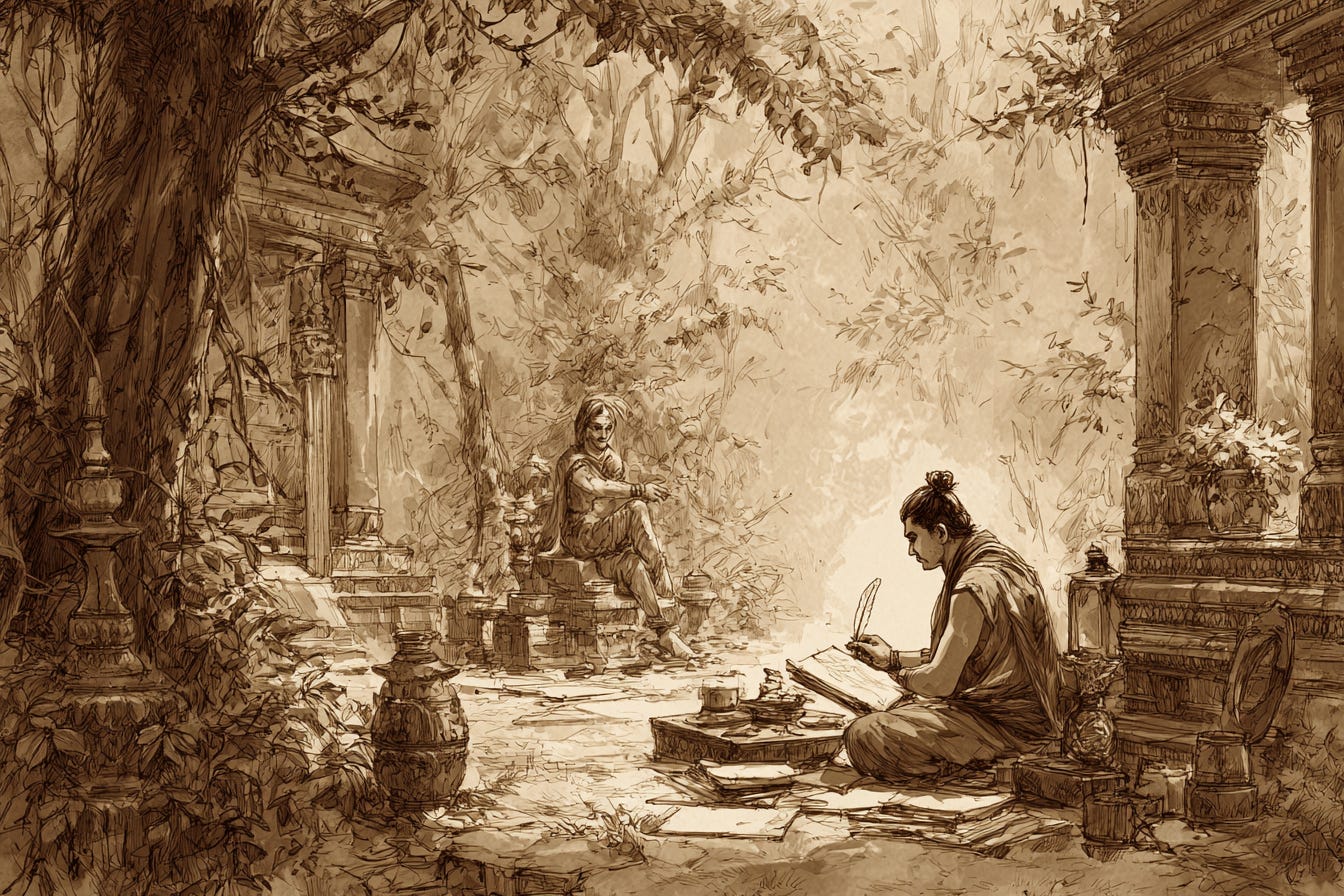
Rabindranath Tagore’s literary vision, deeply rooted in Sanskrit literature and Indian civilisation, offers a luminous framework for reading Kalidasa. Sensitive to beauty and steeped in cultural memory, Tagore consistently returned to the wellsprings of classical thought to interpret India’s civilisational ethos with clarity and grace.
One of the most evocative expressions of this engagement appears in The Springhead of Indian Civilisation, first composed in Bengali and translated into English by Acharya Jadunath Sarkar. In this essay, Tagore examines the forces that nurtured the Sanatana civilisation, tracing a living lineage from the forests of the North Indian plains to the refined sensibilities of Sanskrit poetry. In doing so, the analysis resonates with Swami Vivekananda’s emphasis on the forest-dwelling Rishis, even as it advances along a literary path through Kalidasarevered as Kavikulaguruwhose poetry embodies India’s inner temperament.
Tagore situates the forest as a formative cradle of reflection and compassion. The forest, he observes, sent the Indian mind inward, toward the mystery of existence, and outward, toward a kinship with all life. The sages, dwelling in open communion with trees, seasons, and the rhythms of the earth, perceived a gentle, pervasive sacredness. Hence the axiom“All that exists has issued from the Supreme Life, and is vibrating in our souls”feels less like abstract doctrine and more like lived awareness.
This awareness is ethical as much as metaphysical. The forest sustained the Rishis with shade, fruit, fuel, grass for Yajna, and the hospitality of an animate world. In return, their lives exemplified restraint, reciprocity, and gratitudea civilisational method of “acquiring” the world not through domination but through kinship. Breath, light, food, and water become gifts received with reverence, signs of an Infinite Delight present in the ordinary. The result is an education of feeling and judgment: a refined sense that Nature is neither vacuous nor inert but companion and guide.
Tagore observes that both the Vedic age and the Buddhist age drew nourishment from the forest, a continuity that unites the broader dharmic family. This ethos of contemplation and compassionate actionvisible across Hindu, Buddhist, and Jaina traditions, and resonant with Sikh teachings on humility and servicereveals a shared civilisational grammar. It does not erase differences of doctrine or practice; rather, it harmonises them within a common ethic of inner discipline and outer care.
Even as kingdoms, empires, and cities arose, this memory of the forest persisted. India’s polities often honoured tapasya, tracing dignity to hermit lineages and acknowledging the ethical authority of restraint. In Tagore’s portrait, the hermitage becomes emblematic of what is grand, noble, and pure in India’s storyan imaginative center of gravity that tempers power with wisdom.
It is in this light that Tagore turns to Kalidasa, whose depictions of hermitages reveal a distinctly Indian poetics. In Raghuvamsa, the opening tableau is evening in the hermitage: Rishis return with Darbha, fuel, and fruit; deer, treated like children by the hermits’ wives, recline without fear; the daughters water trees and step aside so birds might drink in peace; the sun declines as Yajna-incense purifies the air. The scene is vivid yet tranquil, suffused with a quiet, ethical beauty.
The inward meaning of this tableau is the harmony between human life and the more-than-human world. Kalidasa’s aesthetics here are inseparable from a civilisational pedagogy: gentleness toward animals, stewardship of the land, hospitality to guests, and an atmosphere where study, ritual, and affection are mutually reinforcing. The hermitage forms characterrefining sensitivity, training attention, and aligning desire with Dharma.
Abhijnana-Sakuntala advances the same insight through dramatic contrast. The hermitage appears as a space of purity and relational abundance, subtly shaming the palace’s restless pursuit of pleasure. Animate and inanimate alike are kin, and the social order thrives because it is rooted in care. This is not escapism; it is critique and correctivea reminder that political authority and household life must be regulated by tapasya-inspired discernment.
Read together through Tagore’s exposition, these Kalidasa scenes illumine a core of Sanatana civilisation: humility before the living world, gratitude for sustenance, and the discipline to convert power into service. They also speak across dharmic traditions, modelling an ethic that invites Hindu, Buddhist, Jaina, and Sikh readers into shared reflection during auspicious times such as the Parva of Navaratri. The result is not merely literary appreciation but a civilisational self-understandingan invitation to let Sanskrit literature educate feeling, harmonise reason, and reawaken a sense of sacred reciprocity with the world.
Inspired by this post on Dharma Dispatch.