The present moment valorizes simplified outputs marketed as artificial intelligence. However impressive these tools may be in applied science, their social cost has fallen heaviest on the humanities—especially philosophy, classical learning, language, literature, and history. Until the early twentieth century, deep training in these disciplines defined a cultured education; viewed against those standards, contemporary intellectual life often appears impoverished.
Allan Bloom’s diagnosis in Closing of the American Mind (1987) remains strikingly prescient for the current predicament: “Only Socrates knew, after a lifetime of unceasing labor, that he was ignorant. Now every high-school student knows that. How did it become so easy? … We are like ignorant shepherds living on a site where great civilizations once flourished. The shepherds play with the fragments that pop up to the surface, having no notion of the beautiful structures of which they were once a part … When the liberal … teaching became dominant, as is the case with most victorious causes, good arguments became less necessary; the original good arguments, which were difficult, were replaced by plausible simplifications — or by nothing.” Bloom’s caution about “plausible simplifications” aptly describes a broader cultural shift in which immediacy often supplant rigor.
In India, this tension surfaced against the backdrop of the Modern Indian Renaissance, which took earliest institutional root in Bengal, the first major theatre of sustained colonial rule. A galvanizing question animated that century-long ferment: how did a spiritual civilization of millennia, with sophisticated systems of thought and governance, come to be displaced by a relatively small maritime trading power? The answer-seeking produced extraordinary figures across domains: J.C. Bose and C.V. Raman in science, M. Hiriyanna and Surendranath Dasgupta in philosophy, Radhakumud Mookerjee and Jadunath Sarkar in history, and Swami Vivekananda and Bankim Chandra Chattopadhyaya in culture.
Jadunath Sarkar (1870–1958) exemplified the classical polymath who chose to devote himself to history. Across major works on the Mughals—including multi-volume studies of Aurangzeb and the collapse of imperial structures—he wove together Persian court chronicles, Marathi bakhars, Rajasthani records, firmans, akhbars, and a spectrum of regional sources. His historiography paired philological precision with a disciplined military and administrative sensibility, making statecraft, logistics, and political economy legible within narrative history. For Sarkar and many of his contemporaries, recovering the Atman of Bharatavarsha through methodologically rigorous history was both an intellectual and civilizational imperative.
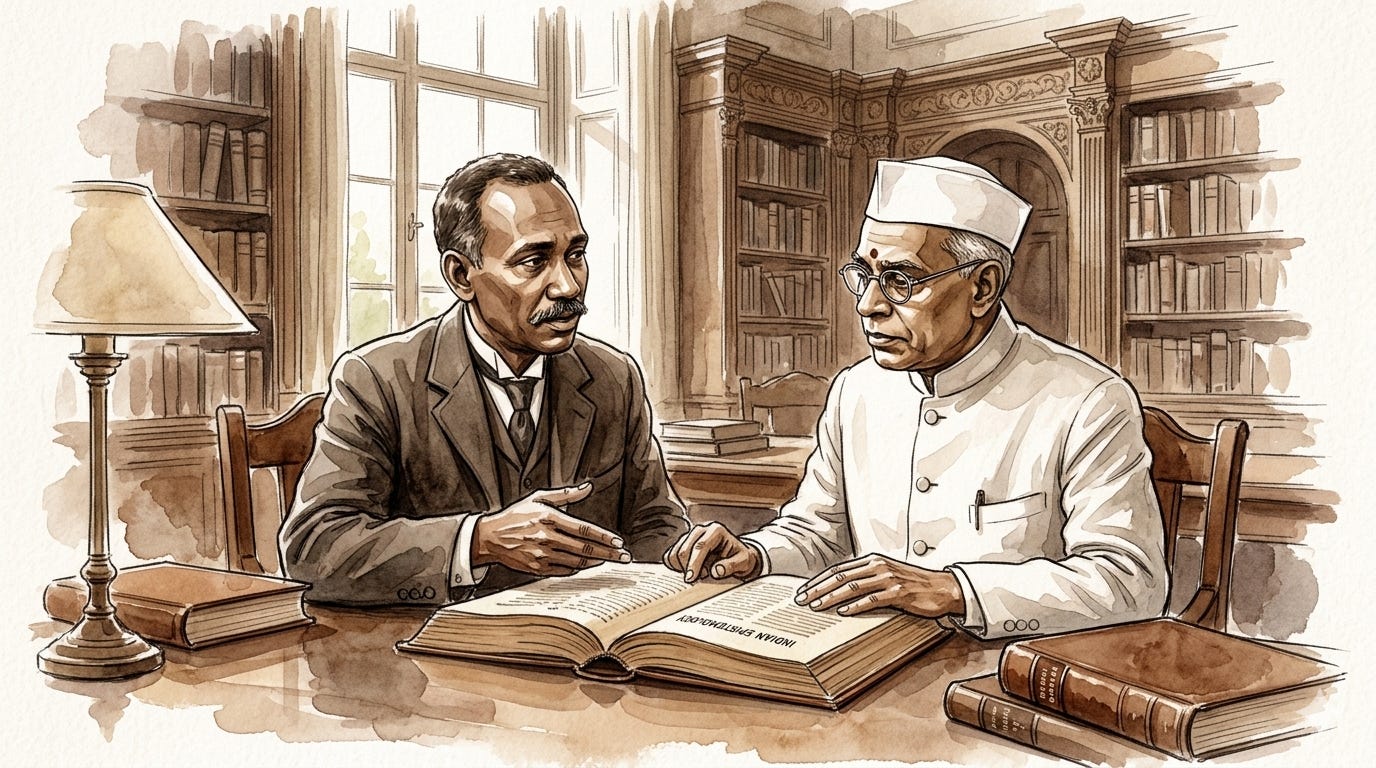
Among the lasting byproducts of this method-first orientation was Sarkar’s early interaction with Kallidaikurichi Aiyah Nilakanta Sastri (1892–1975), later the preeminent historian of South India. The episode offers a granular window into scholarly standards, the politics of language, and the institutional conditions of knowledge-making in colonial India.
In December 1915, Modern Review carried Sarkar’s reflective “Confessions of a History Teacher,” a carefully argued critique of the dearth of advanced historical works in Indian languages and a warning that English-only instruction often eroded student confidence. Editor Ramananda Chatterjee—himself a nation-shaping figure in public letters—invited responses from history teachers across provinces, transforming a single essay into a national conversation about pedagogy, language, and standards.
From distant Tirunelveli, a 23-year-old lecturer responded in favor of English as the medium for serious historical instruction. The letter, both candid and practical, read in part: “…so long as it is thought that history is… the cheapest to impart…[it] is bound to fall very short of the ideal… I cannot testify to better success with a vernacular medium, at least in my college and in this district… English serves me better as a medium of expression than Tamil — in handling historical subjects. Perhaps the vernacular is not so well off in this part of the country as it should be.” The writer was K.A. Nilakanta Sastri.
Subramania Bharati, the iconic Tamil poet, responded sharply in Swadesamitran, indicting the attitude, not the scholar, and invoking a civilizational appeal for linguistic dignity: “I must pity Sri Nilakanta Iyer. The wonder of persons who cannot speak their own language straight, teaching the sciences may be seen only in our country… The Japanese, the Chinese, the Norwegians, the Italians, the Dutch…used to think of us as people of inferior intelligence in the sciences and in the languages. Only now, some of us are making clear to the outside world that Indians are not savages or tailless apes; that we have our own languages…and poets. Therefore, we cannot but laugh when a few of us pronounce that the Tamils are inferior to the other sections of Indians.” The exchange crystallized a fundamental tension: English could be a powerful vehicle for interregional scholarly exchange, yet a neglect of Tamil (or any bhasha) threatened to sever students from their own textual inheritance.
Within four years, Sastri joined Sarkar as an assistant in the Department of History at the fledgling Banaras Hindu University. Though Sarkar’s stint at BHU was brief due to differences with the institution, the intellectual impression on Sastri endured. In the Jadunath Sarkar Commemoration Volume, Sastri recalled: “Our short association at Banaras…proved to be the beginning of an enduring friendship which to my great good fortune has lasted… to this day. I saw enough of the great man to profit by a study of his methods of work and by his advice which was… ungrudgingly given whenever I went to him with any… problem… To a promising junior scholar he is ever encouraging and generously helpful, but once he suspects sham, he quietly turns his back…”
Their methodological complementarities deepened the significance of that early “debate.” Sarkar’s craft rested on multilingual triangulation: cross-checking Persian chronicles (with their courtly idioms and rhetorical conventions) against Marathi bakhars, Rajasthani newsletters, revenue papers, and regional genealogies. He practiced both external and internal source criticism, testing provenance, bias, chronology, and material transmission. By contrast, Sastri built South Indian political and cultural history upon epigraphy and philology. He mined copper-plate charters, temple inscriptions in Tamil, Sanskrit, and Grantha, and the monumental series South Indian Inscriptions and Epigraphia Indica. With painstaking attention to paleography, regnal formulae, titulature, calendrical conversion, and prosopography, he reconstructed institutions of the Cholas and Pandyas—administration, taxation, irrigation, temple corporations, and maritime commerce—with a precision that set benchmarks for regional historiography.
Read together, their practices advance a multilingual, evidence-first vision of Indian Historiography. English can unify discourse across regions and facilitate comparative method; vernaculars, however, remain indispensable for direct engagement with primary archives and the civilizational vocabulary embedded in bhasha texts. The question, then and now, is not English versus Tamil (or Bengali, Sanskrit, Persian, Prakrit) but English and Tamil within a disciplined architecture of sources. This dual commitment prevents the “plausible simplifications” that Bloom warned against and that mass-produced summaries—whether in textbooks or through algorithmic tools—too easily promote.
Institutions and periodicals mattered as well. Modern Review, under Ramananda Chatterjee, functioned as a national, multilingual clearinghouse for serious thought, connecting Calcutta to Tirunelveli, Banaras to Madras. BHU’s early years exemplified another kind of infrastructure: an explicitly civilizational university where Sanskrit learning, historical method, and scientific training stood in productive dialogue. Such platforms modeled an academic citizenship that transcended region and language, and that remains relevant for a plural society.
For educators and researchers today, several technical lessons stand out. First, reconstructing complex pasts requires triangulation—placing chronicles, inscriptions, administrative papers, and material culture in mutual critique. Second, philology and epigraphy are not antiquarian luxuries; they are engines of verifiable narrative, anchoring chronology and institutional history. Third, pedagogy gains power when students move between English-language syntheses and the bhasha sources from which those syntheses draw, internalizing both method and inheritance. Finally, digital tools, including artificial intelligence, may assist discovery and organization but cannot replace judgment born of language competence, source criticism, and historical context.
The human dimension of this story is equally instructive. An earnest young lecturer from the Madras Presidency publicly differed with a senior historian from the Bengal Presidency; a celebrated poet defended the dignity of Tamil; and, within a few years, the two historians worked side by side and sustained a collegial relationship across decades. This arc—from disagreement to mentorship to enduring respect—offers a model of scholarly kinship that India’s intellectual culture can reclaim.
That model also advances a wider civilizational unity. The disciplines and methods on display—philology, epigraphy, comparative historiography—are shared resources for understanding the intertwined histories of Hindu, Buddhist, Jain, and Sikh traditions. When scholars work across languages and regions with humility before sources, they illuminate a common civilizational fabric, nourish interfaith understanding within the dharmic family, and strengthen the democratic conversation that binds contemporary India.
In the end, the first exchange between Jadunath Sarkar and K.A. Nilakanta Sastri underscored a principle as urgent now as it was in 1915: serious history begins where linguistic competence meets methodological rigor. Everything else—be it fashionable simplification or unexamined polemic—must yield to the patient labor of understanding. Their kinship invites present-day readers to aspire to that standard and to carry forward a multilingual, pan-Indian historiography worthy of Bharatavarsha.
Inspired by this post on Dharma Dispatch.