Debate around Rahul Gandhi’s interventions has become a recurring feature of Indian politics, compelling sustained analysis not of personality but of norms that safeguard Parliament, civil–military relations, and national security. What appears, on the surface, as episodic controversy in the Lok Sabha often signals deeper shifts in strategy, information flows, and institutional restraint. For many Indians shaped by the apolitical ethos of the Indian Army and the shared civilizational heritage of Hinduism, Buddhism, Jainism, and Sikhism, these moments feel consequential well beyond a single news cycle.
Historical contrasts are instructive. Indira Gandhi’s hard-edged electoral mastery during the Cold War operated within a distinct geopolitical context and a different media ecosystem. Rahul Gandhi’s post-2014 trajectory has unfolded in an era defined by networked communication, polarized social media, and heightened scrutiny of parliamentary behavior. The resulting comparisons should be treated as context, not caricature: the national interest is best served by measured assessment of conduct, evidence, and institutional guardrails.
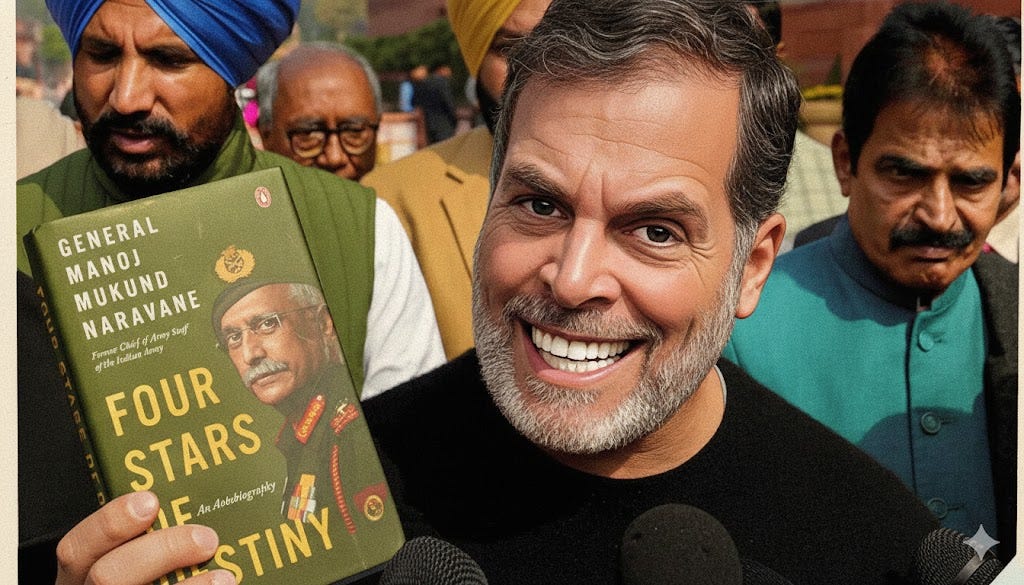
Recent parliamentary episodes illustrate why those guardrails matter. Rahul Gandhi’s display of what was described as an “unpublished memoir” connected to General M. M. Naravane, coupled with sharp allegations against political colleaguesincluding a Sikh cabinet ministergenerated concern about the politicization of the armed forces and the corrosion of civility across party lines. Subsequent public clarifications by General Naravane and the publisher indicated that speculative or selective use of draft materials risks distorting authorial intent. These developments underscore a core democratic principle: national security and civil–military boundaries must remain insulated from partisan escalation, and rhetoric touching community identitiesSikh, Hindu, Buddhist, or Jainmust reinforce, not fray, dharmic solidarity.
Equally noteworthy was widely circulated footage shared by Union Minister Kiren Rijiju that showed opposition MPs moving proximate to the Prime Minister’s bench in the Lok Sabha during protests. India’s parliamentary traditions emphatically protect robust dissent; however, security doctrines also emphasize protective perimeters around constitutional functionaries. When optics blur those boundarieswhether through encirclement or proximity that marshals would ordinarily deterthey create imagery that adversarial narratives can exploit, even if the underlying institutions remain stable and resilient.
Reports suggested that Prime Minister Narendra Modi limited his presence during parts of the related proceedings. Whatever the specific scheduling calculus, established security protocolsmanaged by parliamentary security and guided by the Government of India’s protective frameworksprioritize the safety of all members and the continuity of House business. Interpreting such decisions should avoid sensationalism while acknowledging that optics, precedent, and risk management interact closely in high-tension sittings.
The scrutiny of Rahul Gandhi’s legislative footprint as a multi-term MP has centered on a familiar set of questions: how consistently do interventions translate into legislative proposals, committee work, and cross-party consensus-building? Without reducing complex careers to single metrics, the public interest is served when leaders couple sharp critique with concrete parliamentary outputs that meet procedural standards and withstand institutional vetting.
Substantively, the opposition’s platform under Rahul Gandhi has emphasized a caste census, redistributive welfare, and intensified minority outreach. These themes are neither novel nor illegitimate in a democracy; they speak to the political economy of representation and equity. Yet their framing matters. A caste census can refine policy targeting but may also entrench identity fault lines if not paired with universal growth strategies and constitutional fraternity. Redistribution can alleviate deprivation but must be designed to incentivize productivity, entrepreneurship, and intergenerational mobility. Minority outreach strengthens inclusion when it affirms equal citizenship and avoids zero-sum competition narratives. In all cases, a dharmic lenshonoring satya (truth), ahimsa (restraint), and mutual respecthelps align policy with social cohesion among Hindus, Buddhists, Jains, and Sikhs alike.
Organizationally, the Congress party has undergone visible realignments, with veterans ceding space to a younger cohort conversant with global left-of-center arguments. That transition can refresh a party’s message, yet it also raises familiar risks: echo-chamber dynamics, tactical overreach in Parliament, and selective application of norms to opponents. Healthy opposition requires both ideological clarity and procedural discipline; durable credibility is earned where the two converge.
The media dimension sharpened after a left-leaning magazine published “Naravane’s Moment of Truth,” attributing its account to an “unpublished memoir.” The temporal proximity between that article and Rahul Gandhi’s use of related material in the House fostered the perceptionfair or notof a coordinated information tactic. The subsequent clarifications by General Naravane and Penguin highlight a best-practice baseline: pre-publication drafts and selective excerpts are unreliable sources for parliamentary allegation. In national security matters, the standard must be higher than partisan advantage; it must be verifiable text, on the record.
India’s armed forces have sustained an exemplary, apolitical ethos since independence. Comparative civil–military scholarship (Huntington’s “objective control,” Janowitz’s “constabulary force” model) converges on the same caution: political actors should neither conscript the military into factional debate nor impute motives to serving or retired commanders to score rhetorical points. In the Indian casegiven an active Line of Actual Control and persistent cross-border threatsavoiding politicization is not just a theoretical norm; it is a strategic necessity.
These episodes also fit a recognizable template in contemporary hybrid warfare and information operations: a suggestive “leak,” intensified by high-visibility theatrics in a sovereign chamber, amplified via digital networks, and then contested through clarifications that cannot fully reverse first impressions. Such cycles rarely alter battlefield realities, but they can erode public trust, chill bipartisan cooperation on national security, and distract from capability modernization. Democratic resilience demands a counter-template: verify, contextualize, and de-escalateespecially inside Parliament.
Historical memory often supplies analogies, some illuminating, others misleading. Kuldip Nayar’s account of S. Nijalingappa’s July 1969 diary entry captures the anxieties of that era’s Congress split and the Indo-Soviet tiltvaluable context but also a reminder that diaries preserve perceptions, not settled fact. Today’s geopolitical landscape differs radically; Russia’s self-conception has evolved, and India’s strategic autonomy has deepened across a multipolar order. Analogies should be used sparingly, and always with attention to changed structures.
More relevant are today’s transnational influence networksadvocacy groups, philanthropies, digital campaigns, and ideational alliancesthat shape party narratives worldwide. Their engagement is not inherently nefarious; indeed, comparative perspectives can enrich policy learning. The risk arises when external frames are imported without sensitivity to India’s plural ethos or when narrative incentives reward maximalist posturing over coalition-building at home.
Practical guardrails can fortify Parliament without blunting dissent. First, a cross-party code should bar weaponization of the armed forces in partisan debate, extending to drafts, leaks, and unverifiable attributions. Second, the House should reaffirm security perimeters around constitutional functionaries and discourage performative encirclement or proximity breaches that compromise decorum. Third, coordination with publishers and authors ought to be formalized: no reliance on pre-publication material for allegations, and mandatory tabling of authenticated documents before citation. These steps enhance credibility across the aisle and shield India’s democratic institutions from information gambits.
A dharmic commitment to unity offers an additional compass. The shared values of Hinduism, Buddhism, Jainism, and Sikhismtruthfulness in speech, restraint in action, and reverence for human dignityare not abstract virtues; they are operational principles for public life. Language that brands colleagues as enemies or communities as suspect corrodes the constitutional fraternity that binds citizens and service members of every dharmic tradition. Re-centering parliamentary discourse on these civilizational ideals strengthens, rather than weakens, principled opposition.
The larger lesson is straightforward. India’s democracy is robust precisely because it pairs spirited contestation with red lines that protect institutions, security, and plural unity. Ensuring that future debates about Rahul Gandhi, General Naravane, or any other figure remain rigorous yet responsible is not merely a matter of etiquette; it is a strategic choice. By privileging verified sources, upholding decorum in the Well of the House, and honoring civil–military boundaries, Parliament can turn contentious moments into opportunities to reset standardsand, in doing so, model the cohesion that a dharmic civilization expects and deserves.
Inspired by this post on Dharma Dispatch.