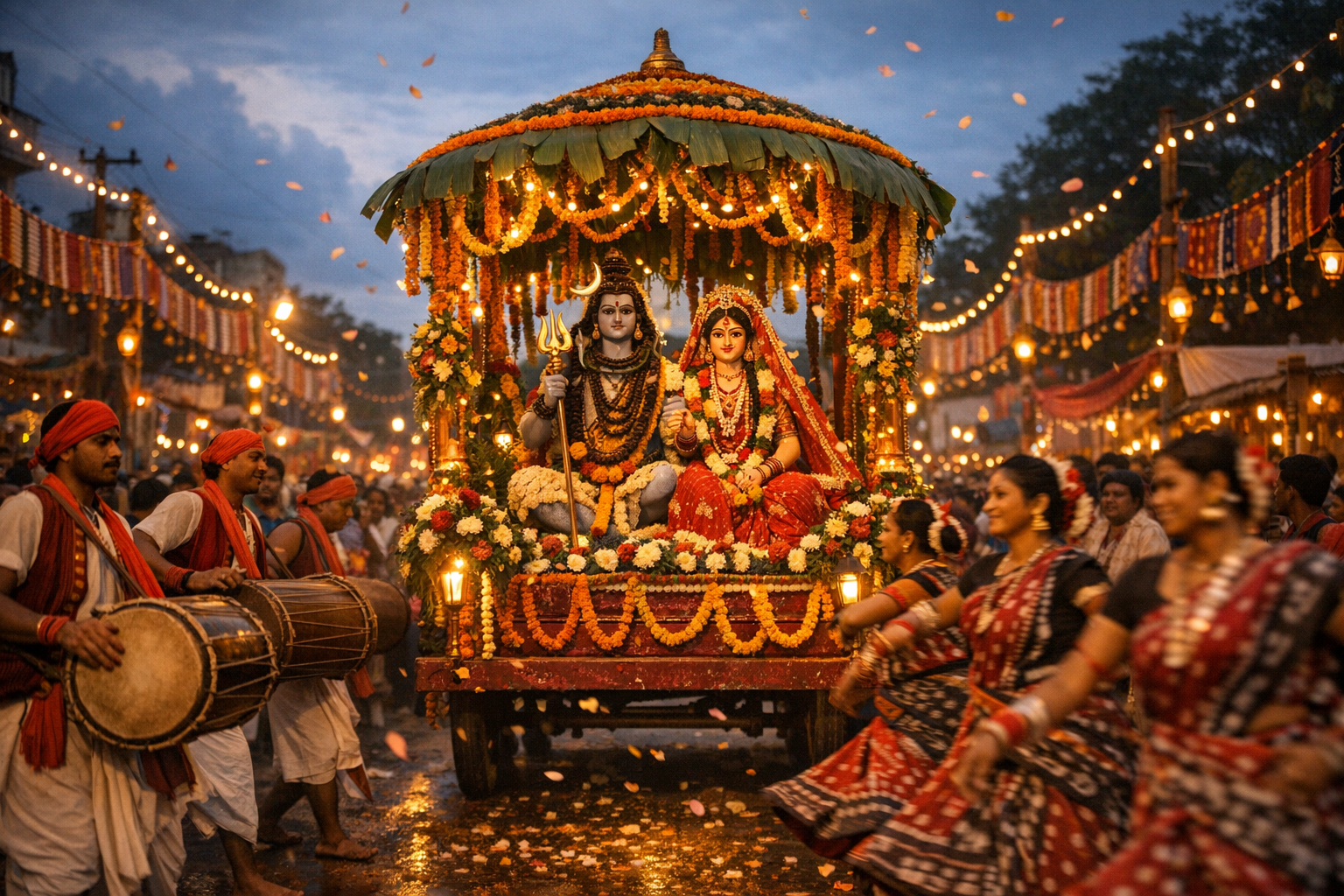
Sital Sasthi, the celebrated reenactment of the divine wedding (kalyana) of Lord Shiva and Goddess Parvati, stands as one of Odisha’s most evocative community festivals. In 2026, Sital Sasthi falls on 20 June, corresponding to Jyeshtha Shukla Sasthi in the lunar calendar. Centered in Sambalpur and echoed across western Odisha, this living tradition blends Vedic marriage rites with a citywide carnival, creating a unique confluence of devotion, folk culture, and public participation.
Calendrically, Sital Sasthi aligns with the sixth lunar day (Sasthi) of the bright fortnight (Shukla Paksha) in the month of Jyeshtha, a period that traditionally heralds relief from summer heat and the anticipation of the monsoon. The very term “Sital” (coolness) symbolizes the transition from searing heat to seasonal respite, mirroring the cooling, auspicious union of Shiva and Parvati. Local panchangs in Odisha determine the precise observances, processions, and vivaha-samskara timings, which are typically published by Sambalpur’s temple and akhada committees closer to the date.
Historically, Sital Sasthi in Sambalpur is documented for over four centuries. Oral histories and civic records indicate that merchant guilds, temple bodies, and neighborhood collectives (para committees) systematized the public celebration, gradually giving it a processional, carnival-like character. While the core is devotional and scripturalrooted in Shaiva-Puranic narrativesthe festival’s social architecture reflects a sophisticated urban ritual ecology: adoption ceremonies, inter-household coordination, and citywide cooperation.
A distinctive feature is the ritual “adoption” of Goddess Parvati by a local household, which assumes the role of the bride’s family. This adoptive family conducts the full spectrum of Hindu marriage rites: kanyadaan, invocation of Agni, mantras of consent, and saptapadi. Lord Shiva, received as the bridegroom, proceeds in a jubilant baraat led by drummers and dancers. The union is solemnized with scriptural fidelity, yet presented in a manner that is accessible and participatory for the wider public.
The famed Sital Sasthi Jatra transforms Sambalpur into a luminous corridor of floats and costumed retinues. Depictions of Shiva’s ganas, sages, devas, and scenes from Itihasa–Purana move through the city alongside folk troupes and akhada displays. Processions often continue late into the night, culminating in a communal darshan that merges temple liturgy with the vibrant energy of a civic carnival. For many visitors, this is where the spiritual pageant meets cultural spectacle.
Western Odisha’s folk arts command a central place in the celebrations. Sambalpuri music, Dalkhai performances, percussion ensembles, and regional narrative arts animate the streets. The city becomes a gallery of Sambalpuri ikat textilessaris, gamuchhas, and stolesshowcasing Odisha’s celebrated bandha weaving tradition. Local artisans, flower vendors, and food sellers form an ephemeral economy around the festival, sustaining crafts and livelihoods.
Socially, Sital Sasthi enacts belonging. Neighborhoods coordinate hospitality, route management, and cultural items, reinforcing bonds that extend well beyond the festival week. The ethos of sevaso integral to Dharmic traditionsmanifests through volunteerism, community kitchens, water stations, and crowd care. The festival’s leitmotif of sacred union and harmony resonates across Hinduism, Buddhism, Jainism, and Sikhism, emphasizing non-violence, compassion, and community welfare as shared civilizational values.
Ecologically, Sital Sasthi is aligned with the seasonal rhythm. The rite symbolizes the invitation of monsoon rains and celebrated coolness. Contemporary committees increasingly incorporate green practices: reduced single-use plastics, designated waste points, cloth banners, and post-procession cleanups. Visitors can support these efforts by carrying refillable water bottles, using public transport where possible, and following local waste-segregation norms.
While 20 June 2026 is the principal tithi, Sital Sasthi unfolds across multiple days. A typical sequence includes the adoptive-kanya ceremony, formal invitations (nimantrana), vrata and Sankalpa, the baraat of Shiva, the vivaha-samskara with Vedic mantras, and the extended jatra with public darshan. Each locality’s organization varies, and akhada committees publish detailed schedules, routes, and performance lineups as the date approaches.
Visiting Sambalpur for Sital Sasthi is both a devotional journey and a cultural immersion. The nearest major airport is Veer Surendra Sai Airport (Jharsuguda), with road and rail connectivity to Sambalpur Junction. Given summer conditions, light cotton attire, head covering, hydration planning, and comfortable footwear are strongly advised. Respectful photography (avoiding flash at close range during rituals), patience in dense crowds, and adherence to volunteer guidance ensure a safer, more meaningful experience.
Culinary and craft encounters enrich the itinerary. Local eateries serve staples such as pakhala bhata and dahi-bara aloo dum, while sweet shops offer chhena poda and rasabali. Handloom markets present opportunities to acquire authentic Sambalpuri textiles, directly supporting weaver communities. Such engagements allow visitors to experience Odisha’s cultural heritage beyond the ceremonial core.
From a ritual studies perspective, Sital Sasthi is an exemplary public performance of the Vedic vivaha template. Textual elementskanyadaan, panigrahan, saptapadiare transposed into a civic framework, inviting lay participation without diluting orthopraxy. The result is a rare ritual commons: scripture in motion, enlivened by regional idioms of music, dance, and dress.
Thematically, the festival’s emphasis on union and balance echoes across Dharmic thought: the harmonization of divine masculine and feminine, the restoration of ecological order with the arrival of rain, and the reintegration of community through vow and celebration. These shared motifsdharma, dayan (compassion), and sevaform a cultural grammar that connects Hindu, Buddhist, Jain, and Sikh sensibilities in a spirit of mutual dignity.
Comparatively, Sital Sasthi can be viewed alongside other kalyanam traditionssuch as the Meenakshi–Sundareswarar Thirukalyanamwhile remaining distinct in its western Odishan flavor. The Sambalpur model privileges neighborhood stewardship and performative folk expression, positioning it as both a regional heritage emblem and a contribution to India’s broader festival landscape.
Key planning note for 2026: 20 June is the anchor date for Jyeshtha Shukla Sasthi in Odisha. Temple authorities and local committees in Sambalpur typically announce procession routes, performance slots, and traffic advisories in advance; travelers are encouraged to consult local notices closer to the festival week. As with all tithi-based observances, minor variations may occur across panchang traditions.
In essence, Sital Sasthi 2026 in Sambalpur offers a rare synthesis: the sanctity of Shiva–Parvati’s wedding, the exuberance of a people’s carnival, and the quiet assurance that seasonal coolnessand social harmonywill return. It is devotion one can walk through, music one can see, and heritage one can participate in.
Inspired by this post on Hindu Pad.