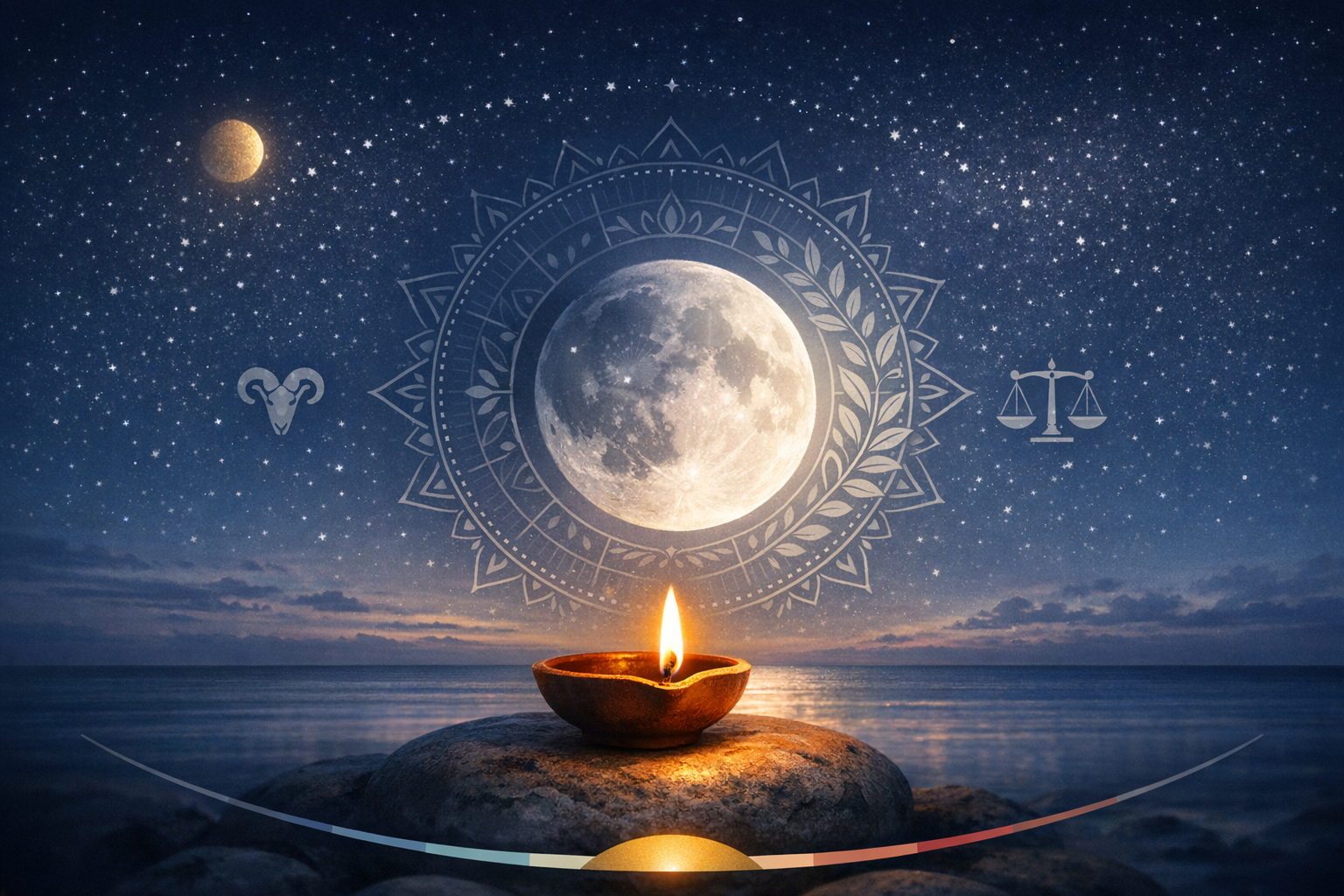
Thursday, April 30, 2026, in the Hindu calendar (Panchang) presents Shukla Paksha Chaturdashithe fourteenth lunar day of the waxing phaseprevailing until 8:17 PM. Thereafter, the lunar day transitions into Purnima (the full moon tithi) for the remainder of the night in most regions. This April 30 2026 Tithi overview supports planning for worship, study, and personal milestones with clarity and confidence.
Regional panchang computations may show slight variations because tithi boundaries depend on local longitude, latitude, and sunrise/sunset. The time 8:17 PM refers to the transition point as used in many regional almanacs; local panchang listings should be consulted to confirm city-specific details. Across India, the underlying sequenceShukla Paksha Chaturdashi transitioning into Purnimaremains the same even when exact clock times differ.
Technically, a tithi is defined by the longitudinal separation between the Moon and the Sun, with each tithi spanning 12 degrees of relative elongation. Shukla Paksha Chaturdashi concludes as that separation nears 168 degrees, and Purnima begins as it approaches 180 degrees. This astronomical basis ensures consistency in the Hindu calendar (Panchang) while allowing for precise local calculation.
Shukla Paksha Chaturdashi marks the luminous culmination of the waxing fortnight. It is traditionally regarded as an energetic window for focused japa, vrata observance, and disciplined study. Many households experience this period as a gentle crescendo of intention that ripens into the full clarity of Purnima later in the night.
With the onset of Purnima tithi after 8:17 PM, activities associated with fullness, completeness, and gratitude are emphasized. Purnima is classically auspicious for satvika pursuitsmeditation, daana (charity), svadhyaya (self-study), satsanga, and collective prayers. Devotees often experience renewed emotional balance under the full moon, finding it supportive for reconciliation, community bonding, and mindful decision-making.
The weekday context adds further nuance: Thursday (Guruvar) is aligned with Brihaspati (Jupiter), a planetary influence connected with wisdom, teachers, scripture, and ethical discernment. Consequently, April 30, 2026 favors guru-centric practices, scriptural reading (such as Bhagavad Gita or Upanishads), and seeking guidance that harmonizes material objectives with dharma.
Rashi considerations can be framed in the sidereal system widely used in India (e.g., Lahiri ayanamsa). Around this date the Sun is in Mesha Rashi (Aries), which emphasizes initiative and principled leadership. At Purnima, the Moon sits nearly opposite the Sun; therefore, the full moon tends to occur with the Moon in or near Tula Rashi (Libra), emphasizing harmony, equipoise, and just relations. This Aries–Libra polarity invites a balance between courageous action and fair, compassionate engagement.
For Nakshatra, the full-moon sector around Tula Rashi commonly spans the Swati–Vishakha zone. Depending on the exact local time of observation and the ayanamsa used, the Moon will be placed in one of these nakshatras during the transition window. Swati emphasizes independence and gentle adaptability, while Vishakha highlights determination and milestone-setting; both are compatible with refining intentions at the cusp of Purnima. Local panchang data should be used to confirm the precise Nakshatra at one’s location.
Good Time (Auspicious Muhurat) guidelines for the day can be refined without city-specific data by using well-established daily windows. Abhijit Muhuratcentered around local solar noonis widely considered favorable for undertakings that require steadiness and clarity. When exact start and end times are needed, they should be derived from the local sunrise-to-sunset span.
Brahma Muhurta, the pre-dawn period preceding sunrise, is particularly potent for meditation, pranayama, mantra, and subtle contemplative practices. Many practitioners across Hindu, Buddhist, Jain, and Sikh traditions find this quiet interval naturally supportive for inner stillness, metta/maitri (loving-kindness), samayika (equanimity practice), or Nitnem (daily recitation) to center the mind before the day unfolds.
Rahu Kalam, Yamaganda, and Gulika Kalam are inauspicious segments traditionally avoided for initiating new ventures. These intervals are calculated by dividing the daytime (sunrise to sunset) into eight equal parts. On Thursday, Yamaganda falls in the first segment, Gulika Kalam in the third segment, and Rahu Kalam in the sixth segment. As a practical reference, with a notional 6:00 AM–6:00 PM day, these map approximately to 6:00–7:30 AM (Yamaganda), 9:00–10:30 AM (Gulika), and 1:30–3:00 PM (Rahu Kalam). For accuracy, always adjust these spans proportionally to the actual local sunrise and sunset.
Pradosha Kalathe period around sunsetremains spiritually resonant even when a formal Pradosh vrata does not fall on the day. On Chaturdashi leading into Purnima, this twilight can be used for serene worship, lighting a lamp, brief meditation, or collective family prayer, fostering calm transition into the full-moon night.
Nishita Muhurta (centered around local midnight) is often recommended for advanced mantra sadhana and deep contemplation under the full moon. Many practitioners report that Purnima nights enhance emotional clarity and devotional depth, making even short meditative sessions feel grounded and restorative.
For householders, students, and professionals, a practical approach to April 30, 2026 might be: schedule high-precision decisions during Abhijit Muhurat or stable mid-morning windows, avoid initiating critical tasks during Rahu Kalam and Yamaganda, and reserve the evening transition for gratitude practices as Purnima sets in after 8:17 PM. Such a rhythm helps align daily responsibilities with the Panchang’s natural cadence.
From a unity-of-dharma perspective, this full-moon transition encourages shared values across Hinduism, Buddhism, Jainism, and Sikhism: compassion, non-violence, truthfulness, and self-restraint. A brief period of silence, collective reading of wisdom texts, or a simple act of charity can become a common bridge, honoring diverse practices while strengthening mutual respect.
Month naming around this Purnima may vary due to the purnimanta and amanta systems used by different regions. In north and west India, many follow the purnimanta system; in peninsular regions, the amanta system is more common. Despite differing month labels, the tithi sequence and spiritual tenor remain aligned, underscoring the Panchang’s integrative logic.
For those tracking Rashi and Nakshatra with precision, it is best to use a reliable local panchang or a trusted calculation tool that clearly specifies ayanamsa (e.g., Lahiri), time zone, daylight saving offset (if any), and geolocation. Accurate inputs ensure that tithi transitions, nakshatra boundaries, and weekday-sensitive intervals match one’s place of worship or residence.
In summary, April 30, 2026 offers a graceful arc from Shukla Paksha Chaturdashi to Purnima, weaving together the vigor of a nearly full waxing moon with the completeness of the full moon night. By observing auspicious windows (Abhijit, Brahma Muhurta), steering clear of inauspicious periods (Rahu Kalam, Yamaganda, Gulika), and embracing contemplative practices, the day can be lived with poise, devotion, and a spirit of unity across dharmic traditions.
Inspired by this post on Hindu Blog.