
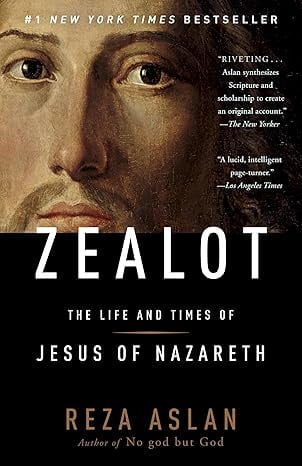
Zealot by Reza Aslan situates the figure of Jesus within the turbulent world of Second Temple Judaism, particularly the Jewish revolt against the Roman Empire (66–70 C.E.). The Roman occupation, garrisoned even near the Jerusalem Templethe singular center of Jewish worshipfueled an atmosphere of resistance. With the Temple’s destruction in 70 C.E., Jewish communal life and the early Jesus movement were profoundly reshaped. In this context, the earliest Gospels were composed, decades after the crucifixion, by communities seeking meaning in a devastated landscape.
Aslan argues that the Jesus presented in the Gospels diverges from the historical Yeshua. The Gospels are treated as theological testimonies written by believers for specific pastoral and missionary purposes rather than as dispassionate historical records. By turning to the social, political, and theological conditions of the era, the book reconstructs a portrait of Yeshua that emphasizes his Jewish identity and the charged milieu of Roman rule. In doing so, it also traces how the “modern Jesus” emerged through later interpretive layers.
Two anchor points ground Aslan’s historical reconstruction. First, Yeshua was a Jew who led or inspired a popular movement, consistent with other messianic and prophetic figures of the period. Second, he was crucified by the Romans, a penalty regularly imposed for sedition and treason. The analysis underscores that Yeshua likely worked as a craftsman and, like most Galilean peasants of the era, would have been illiterate. Claims of far-flung travels or advanced schooling in youth, including narratives of India or Tibet, are treated as later accretions without reliable historical support.
Following baptism by John the Baptist, Yeshua embarked on a ministry of preaching and healing, functioning in the mold of itinerant exorcists and charismatic teachers then common across Judea and Galilee. Aslan notes that unlike many contemporaries, Yeshua reportedly did not charge for such servicesa detail corroborated by both pagan and Jewish critics of early Christianity. His proclamation of the imminent “Kingdom of God” resonated in a time when many expected divine justice to break into history and reorder social, religious, and political life.
Aslan’s central thesis presents Jesus not as a purely otherworldly moralist but as a zealously committed, this-worldly reformer whose message had immediate political implications under imperial rule. Announcing a radically new order had consequences in Roman-occupied Judea. Crucifixionreserved for political dissidentsaccords with such a profile more than with accusations of purely religious blasphemy. The portrait that emerges is of a messianic claimant whose vision challenged entrenched structures and who suffered Rome’s most public form of execution.
Pontius Pilate’s record further contextualizes the crucifixion. Executions were not extraordinary in his tenure; they were, tragically, a routine instrument of control. The crucifixion of Yeshua, therefore, did not register as a singular political upheaval in the empire’s eyes. Later administrative changes affecting Pilate and temple leadership followed separate unrest, indicating that the crucifixion should be read within a broader continuum of Roman provincial governance rather than as an isolated turning point.
After the crucifixion, three intertwined developments took shape. First, Yeshua’s earliest companions in Jerusalem reframed their hopes through the proclamation of the resurrection and continued his teachings in the city. Second, Paul articulated a theological vision that elevated Jesus’ divinity and addressed urban, Greek-speaking audiences less concerned with messianic politics and Jewish ritual law. This created productive tensions between “Hebrew” followers rooted in agrarian Judea and “Hellenist” adherents in the diaspora. Third, the devastation of 70 C.E. accelerated the writing of the Gospels in various centersRome, Damascus, Antioch, Ephesusby authors who were not eyewitnesses and who preserved diverse traditions colored by local concerns.
In the post-70 C.E. environment, Gospel authors often placed less emphasis on direct Roman culpability and more on theological themes that could speak across the empire. Mark’s account, for example, presents Pilate with a complexly framed role and includes the well-known hand-washing motif in later traditionsa literary strategy that some readers have taken as minimizing Roman responsibility. Over time, certain misreadings contributed to anti-Jewish attitudes in later history. The Gospels, composed in Greek for largely gentile audiences, thus reflect the communicative needs and apologetic strategies of expanding communities, not an intent to foment prejudice. Contemporary interfaith scholarship emphasizes reading these texts with historical sensitivity to counter discrimination and foster mutual respect.
Aslan’s work stands in a long tradition of “Historical Jesus” research that employs history, literary criticism, and sociology to sift memory from theology. Comparable effortssuch as Thomas Sheehan’s analyseshave treated the canonical Gospels as complex, theologically shaped sources, acknowledging that canon formation involved political and ecclesial decisions. Unsurprisingly, methodological diversity has yielded portraits of Yeshua ranging from apocalyptic preacher to sage, social prophet, and charismatic healer. Engaging this plurality can enrich comparative religion and deepen appreciation for how communities preserve meaning after rupture.
Over centuries, the message associated with Jesus was reframed as it moved into Hellenistic settings, culminating in a richly theological Christology distinct from the historically situated Yeshua. Recognizing this evolution does not diminish devotion; rather, it illuminates how faith traditions adapt, translate, and endure. For many readers, this perspective evokes empathy for communities negotiating loss and hope after catastrophe and invites a more nuanced understanding of early Christianity within the Roman Empire.
This inquiry also offers a bridge for interfaith dialogue with dharmic traditionsHinduism, Buddhism, Jainism, and Sikhismwhere acceptance of multiple paths (Ishta) and plural modes of realization is foundational. Understanding how the Gospels and later theology emerged from specific historical needs encourages respectful engagement with difference, a core value in dharmic thought. Approached this way, Aslan’s analysis becomes more than historical reconstruction; it becomes a resource for unity, compassion, and comparative insight across living traditions.
Inspired by this post on Varnam.
