

The rejection of a proposed Hindu temple site in Northstowe, Cambridgeshire, has become a significant moment for the Hindu community in the United Kingdom. The issue is not merely about one parcel of land; it concerns religious access, minority representation, public decision-making, and the practical meaning of equality in a rapidly growing British town.
According to reports cited in the original coverage, South Cambridgeshire District Council awarded a 999-year lease on a 0.25-hectare plot in Northstowe to the Northstowe Church Network, also known as NCN. The arrangement is reported to involve a peppercorn rent, and the successful proposal is expected to include facilities not only for Christian worship but also for the local Muslim community.
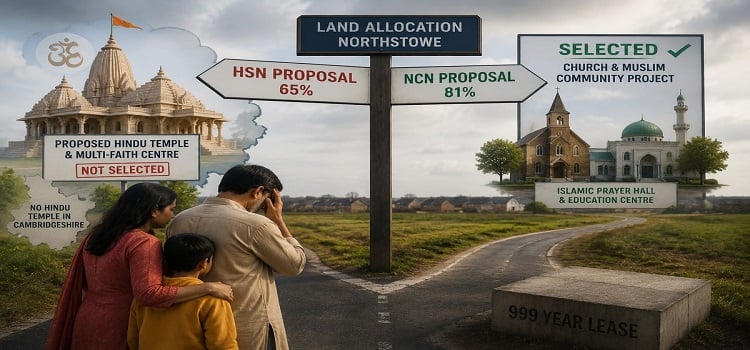
Hindu Samaj Northstowe, a Hindu charity established by local residents, had also applied for the same site. Its proposal reportedly sought to create Cambridgeshire’s first Hindu temple alongside an interfaith and well-being centre. For a community of roughly 150 Hindu families in and around the area, the proposal represented more than a building project. It represented a local spiritual home, a place for samskaras, festivals, community education, family worship, and cultural continuity.

The reported scoring process has intensified concern. Council officers are said to have awarded Hindu Samaj Northstowe’s proposal 65%, while the Northstowe Church Network proposal received 81%. On that basis, the site was allocated to the church-led project. In formal administrative terms, this appears to have been a bid assessment. In community terms, however, many Hindus will naturally experience it as a painful exclusion from a once-in-a-generation opportunity to establish a temple in a new town designed for future growth.

Northstowe is not an old settlement with an inherited religious infrastructure. It is a planned new town in Cambridgeshire, and its public and community assets will shape civic life for decades. When religious land is allocated in such a setting, the decision carries long-term consequences. A 999-year lease is not a temporary programming choice; it is an institutional decision with enduring social meaning.

For Hindu families, the absence of a local temple often means travelling to other towns and cities for worship, festivals, rites of passage, language classes, scriptural learning, and community support. This creates a practical burden that is easy to underestimate from the outside. A temple is not only a place where murtis are worshipped. It is also where children learn the sound of mantras, grandparents transmit memory, families gather during grief and celebration, and diaspora Hindus preserve a living connection to Sanatana Dharma.

The issue also raises a broader question about how minority faith communities are evaluated by public bodies. A Hindu temple proposal may not always resemble the institutional style of a church network or a large interfaith consortium. Hindu community life is often organised through family networks, volunteer charities, festival committees, sampradayas, and local associations. A fair assessment process should be capable of recognising these forms of organisation rather than privileging only those models that appear administratively familiar.

This does not require hostility toward Christian or Muslim residents. A dharmic response should avoid reducing entire communities to political blocs or civilisational enemies. Christians, Muslims, Hindus, Sikhs, Buddhists, Jains, Jews, and others all have legitimate needs in plural societies. The concern here is more precise: when a specific Hindu community lacks a local temple and presents a proposal for land designated for religious or community use, the reasons for rejection should be transparent, proportionate, and publicly intelligible.

In that sense, the most constructive path is not communal resentment but civic accountability. Hindu residents are entitled to ask how the scoring criteria were designed, whether cultural and religious needs were weighted adequately, how long-term demographic growth was considered, and whether the proposed Hindu temple’s social value was properly understood. These are legitimate questions in a democratic society.

The reported decision also invites reflection on the language of interfaith inclusion. Interfaith work is meaningful when it expands access and dignity for all communities. It becomes problematic when one minority community’s institutional needs are absorbed, delayed, or displaced in the name of a broader arrangement that does not actually provide that community with what it requires. Hindus do not merely need symbolic mention in a multi-faith vocabulary; they need functioning spaces where Hindu worship and Hindu community life can be carried out with autonomy and respect.

A temple has distinct requirements. It involves consecration, ritual purity, calendar-based worship, festival capacity, priestly access, educational programming, community kitchens, and space for devotional and cultural practices. These needs cannot always be satisfied by generic rooms in a shared civic building. The same principle applies across religious traditions: meaningful equality requires understanding the internal logic of each community’s practice.

The Hindu response in Northstowe therefore deserves recognition. Local Hindus stood publicly for their needs and articulated a civic claim rather than withdrawing into silence. In diaspora settings, this matters. Communities that do not explain their requirements to councils, planners, and public institutions are often misunderstood or overlooked. Advocacy, when conducted with dignity and clarity, becomes an essential part of religious freedom.

There is also an emotional dimension that formal reports cannot fully capture. A family that must drive long distances for every major festival experiences religious life differently from a family whose place of worship is embedded nearby. Children who grow up without a local temple may know Hindu identity as something occasional and distant rather than normal and rooted. Elders may feel cut off from the rhythms that sustained them for a lifetime. These are not abstract inconveniences; they affect belonging.
At the same time, this controversy should encourage a higher standard of dharmic solidarity. Hindus, Buddhists, Jains, and Sikhs in Britain share a need for fair treatment, accurate representation, and respect for sacred institutions. Their traditions are distinct, yet they often face similar challenges in public recognition, planning processes, education, and media narratives. The Northstowe case should therefore be read not only as a Hindu temple dispute but as part of a wider conversation about dharmic visibility in the United Kingdom.
Public authorities should recognise that equality is not achieved by assuming all religious communities have the same infrastructure, the same history of institutional access, or the same ability to compete in bureaucratic processes. In many British towns, churches possess long-established networks and social capital. Other communities, including Hindus, may be newer, smaller, or more dependent on volunteers. A neutral process must be attentive to these unequal starting points.
The reported Northstowe decision is therefore a test of process as much as outcome. If the council’s evaluation was fair, the reasoning should be made clear enough for residents to understand. If the assessment overlooked the Hindu community’s religious needs, then the decision deserves scrutiny and possible reconsideration through appropriate civic channels. Transparency is the minimum requirement when public land and long-term community rights are involved.
The language surrounding such disputes also matters. Inflammatory framing may express pain, but it can obscure the strongest argument: Hindu communities deserve equal dignity under public policy. The strongest case is factual, disciplined, and rights-based. It asks whether a growing Hindu population has been given a fair opportunity to establish a temple, whether the assessment criteria recognised Hindu religious life accurately, and whether public institutions are prepared to support genuine pluralism rather than symbolic diversity.
For British Hindus, the Northstowe case should become a reminder of the importance of institutional preparation. Temple proposals require strong governance, clear architectural planning, safeguarding policies, financial transparency, community consultation, legal advice, and public engagement. These elements do not replace devotion, but they help translate devotion into forms that councils and planning bodies can evaluate responsibly.
For councils and policymakers, the lesson is equally clear. A Hindu temple is not a cultural extra. It is a core religious institution for a community whose members contribute to local life, pay taxes, raise families, volunteer, and seek the same dignity afforded to others. If a new town is to be genuinely inclusive, its religious infrastructure must reflect the communities that live there.
The dispute over Cambridgeshire’s first Hindu temple site is therefore not over. Even if this particular land has been allocated, the underlying issue remains: Hindu families in the area still need a local temple. Their demand is reasonable, their disappointment is understandable, and their continued civic engagement will be essential. A mature plural society should be able to hear that claim without defensiveness and respond with fairness.
The most constructive conclusion is not division but resolve. Northstowe and South Cambridgeshire now have an opportunity to show that religious diversity includes dharmic traditions in practice, not only in public language. For the Hindu community, the path forward lies in disciplined advocacy, transparent engagement, and unity with other dharmic communities committed to dignity, religious freedom, and cultural continuity.
Inspired by this post on Hindu Human Rights Blog.







Leave a Reply
You must be logged in to post a comment.