
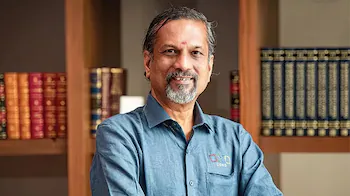
The recent public exchange involving Zoho founder Sridhar Vembu and historian Ramachandra Guha is more than a passing social-media controversy. It reflects a deeper tension within Indian public life: whether political criticism can remain intellectually serious when it begins from personal hostility rather than evidence, context, and proportion.
According to a June 2, 2026 report by Moneycontrol, Vembu responded sharply after Guha, during a discussion with veteran journalist Karan Thapar, said that “nobody hates Modi and Amit Shah’s BJP more than me.” The discussion reportedly took place in the context of Congress leader Rahul Gandhi’s eligibility and suitability for the office of Prime Minister. Vembu’s response on X framed the remark as an example of a broader pattern in elite discourse, where hostility toward Prime Minister Narendra Modi and Union Home Minister Amit Shah is often treated as a marker of intellectual seriousness.
Vembu’s central argument was that critics of the Modi-led Bharatiya Janata Party often understate, dismiss, or refuse to acknowledge the scale of India’s transformation since 2014. He pointed to improved governance, stronger security, infrastructure expansion, and the ability to discuss development in regions once dominated by disorder, insurgency, or administrative drift. Whether one agrees with his political conclusions or not, the intervention raised a serious question: can a democracy sustain meaningful debate if influential voices move from criticism of policies to a declared hatred of political actors and their supporters?
In a mature democracy, opposition is not merely legitimate; it is necessary. No government should be insulated from scrutiny, and no leader should be treated as beyond criticism. Yet criticism acquires credibility when it is disciplined by facts, historical memory, and an awareness of institutional complexity. Hatred, by contrast, narrows the field of vision. It encourages selective memory, rewards rhetorical intensity, and makes it harder to recognize progress even where progress is visible.
Vembu’s comments must be read in this context. He did not merely defend a political party; he challenged a style of public argument that has become familiar in Indian media and academic circles. The argument was that some sections of the intellectual class appear more invested in opposing Modi and Shah than in honestly evaluating India’s governance trajectory. This is a provocative claim, but it is not without public resonance, especially among those who have watched India’s development debates shift from scarcity and resignation toward infrastructure, digital capability, national security, and state capacity.
One of the most important parts of Vembu’s response was his insistence on historical comparison. India before 2014 was not a static paradise suddenly disturbed by ideological politics. It was a country facing serious internal security challenges, uneven development, corruption scandals, infrastructure bottlenecks, policy paralysis, and deep regional anxieties. Punjab, Jammu and Kashmir, Assam, central India, Bihar, Uttar Pradesh, and West Bengal each carried distinct governance burdens. Any serious political assessment must begin by remembering that baseline rather than judging the present against an imagined past.
This does not mean every claim made by the government or its supporters should be accepted uncritically. It means that political analysis must compare outcomes, not merely emotions. Infrastructure growth, digital public infrastructure, direct-benefit transfers, improved tax formalization, road and rail expansion, startup growth, defense modernization, welfare delivery, and a more assertive national-security posture are all part of the contemporary Indian story. So are debates over federalism, institutional independence, social harmony, media freedom, and minority concerns. Serious analysis must hold both sets of facts together.
The deeper issue, therefore, is not whether Guha has the right to oppose the BJP. He does. Nor is it whether Vembu has the right to defend Modi and Shah. He does. The deeper issue is the quality of Indian political discourse. When a prominent historian uses the language of hatred, and a prominent technology entrepreneur responds by attacking the intellectual culture that enables such language, the exchange reveals a widening gap between elite commentary and the lived political experience of many citizens.
For many Indians, the last decade has not been understood primarily through television debates or ideological essays. It has been experienced through highways, airports, digital payments, UPI transactions, rural electrification, sanitation drives, welfare transfers, vaccination logistics, border-security debates, temple restoration, cultural confidence, and a renewed vocabulary of civilisational identity. These experiences may be uneven across class and region, but they cannot be dismissed as propaganda simply because they do not fit older frameworks of political analysis.
Vembu’s own public persona gives his intervention added significance. As the founder of Zoho, he is associated with Indian technology, rural entrepreneurship, self-reliance, and a critique of hyper-centralized urban corporate culture. His political comments therefore do not come from a conventional party spokesperson. They come from a business leader who has repeatedly emphasized indigenous capability, local talent, and the need to build institutions outside elite metropolitan assumptions. That background helps explain why his criticism of “intellectuals” found a receptive audience among those who see India’s transformation as practical, ground-level, and civilisational rather than merely electoral.
The exchange also highlights a long-running tension in Indian public life: the relationship between academia, media, and democratic legitimacy. India’s academic and media elites have often performed an important role in questioning power. At their best, they preserve institutional memory, expose abuse, and prevent majoritarian complacency. At their weakest, however, they can become socially insulated, ideologically predictable, and dismissive of voters whose priorities differ from their own. Vembu’s response should be understood as a critique of that second tendency.
There is an important distinction between dissent and derision. Dissent strengthens democracy when it challenges policies, asks hard questions, and insists on accountability. Derision weakens democracy when it treats voters as morally inferior for making choices that intellectual elites dislike. The health of Indian democracy depends on preserving dissent while resisting the temptation to convert political disagreement into cultural contempt.
This distinction is especially important for a civilisational society such as India, where political identity is often intertwined with language, region, caste, faith, family memory, and cultural aspiration. The blog’s broader commitment to unity among Dharmic traditions — Hinduism, Buddhism, Jainism, and Sikhism — requires a disciplined public vocabulary. Political criticism should not become a license for social fragmentation. Nor should cultural confidence become a license for arrogance. A Dharmic public ethic would encourage debate with firmness, but also with restraint, self-knowledge, and respect for the dignity of opponents.
Seen through that lens, the controversy offers a useful lesson. A society cannot build unity by suppressing disagreement, but it also cannot build unity by normalizing hatred as a badge of sophistication. The Indian tradition has long made room for debate, commentary, philosophical disagreement, and competing schools of thought. The existence of multiple darshanas, sampradayas, monastic traditions, reform movements, and regional expressions of devotion shows that disagreement need not become civilisational rupture. The challenge is to carry that inheritance into modern political life.
The Modi era has intensified this challenge because it has altered India’s political vocabulary. For supporters, it represents a period of national reconstruction, cultural recovery, and administrative assertiveness. For critics, it raises concerns about centralization, ideological dominance, and the treatment of dissent. Both perspectives exist in the public domain, but neither is strengthened by emotional absolutism. The question is not whether one must admire or reject Modi and Shah; the question is whether public debate can remain anchored in reality rather than reflex.
Vembu’s emphasis on development and security deserves careful examination because these are measurable areas of governance. India’s expansion of digital public infrastructure, especially UPI and Aadhaar-linked service delivery, has changed the relationship between citizen and state. Roads, ports, airports, railway modernization, and logistics reforms have become central to economic policy. Welfare delivery has increasingly relied on direct transfers and digital verification. These shifts are not merely campaign claims; they are structural changes that shape everyday life.
At the same time, development cannot be treated as a complete answer to every political concern. Economic growth must be accompanied by institutional trust, social peace, legal fairness, and space for legitimate disagreement. A confident society should be able to acknowledge both achievement and unfinished work. The strongest defense of India’s transformation is not denial of criticism; it is the willingness to evaluate criticism honestly while refusing to let ideological hostility erase visible progress.
The media dimension is equally important. News platforms, interviews, and televised debates often reward sharp lines, memorable confrontations, and polarizing statements. A sentence built around hatred travels faster than a paragraph built around nuance. This creates incentives for public figures to speak in ways that mobilize their own side rather than persuade the undecided. The Vembu-Guha exchange became news precisely because it dramatized this broader media pattern.
For readers trying to understand the controversy, the most responsible approach is not to reduce it to a personality clash. It should be read as a case study in contemporary Indian political communication. Guha’s statement represented one form of elite opposition: morally intense, openly adversarial, and centered on distrust of the BJP’s leadership. Vembu’s response represented another form of public intervention: nationalist, developmental, impatient with elite condescension, and focused on historical comparison. The clash between these two modes is now a defining feature of Indian politics.
The most useful outcome would be a higher standard of debate. Critics of the BJP should be able to question the government without relying on hatred as a public credential. Supporters of the BJP should be able to defend the government without dismissing every concern as bad faith. Intellectuals should be judged by evidence, consistency, and humility, not by their opposition to a particular leader. Entrepreneurs and public figures should also recognize that political speech carries social responsibility, especially when it influences large audiences.
India’s democratic future will not be secured by uniformity of opinion. It will be secured by the capacity to argue fiercely without losing proportion. Vembu’s intervention matters because it reminds readers that development, security, and governance outcomes must remain central to political judgment. Guha’s remark matters because it shows how easily opposition can become personalized in a polarized age. Together, the episode reveals the urgent need for a public culture that is factual, historically grounded, and civilisationally mature.
The lesson is clear: India deserves criticism that improves governance, not hatred that hardens camps. It deserves intellectual life rooted in truth-seeking, not status signaling. It deserves political confidence that can defend national achievement while remaining open to correction. In that balance lies the possibility of a stronger Bharat — democratic, Dharmic in temperament, technologically ambitious, culturally rooted, and capable of debating its future without forgetting its shared civilisational inheritance.
Inspired by this post on Hindu Post.







Leave a Reply
You must be logged in to post a comment.