

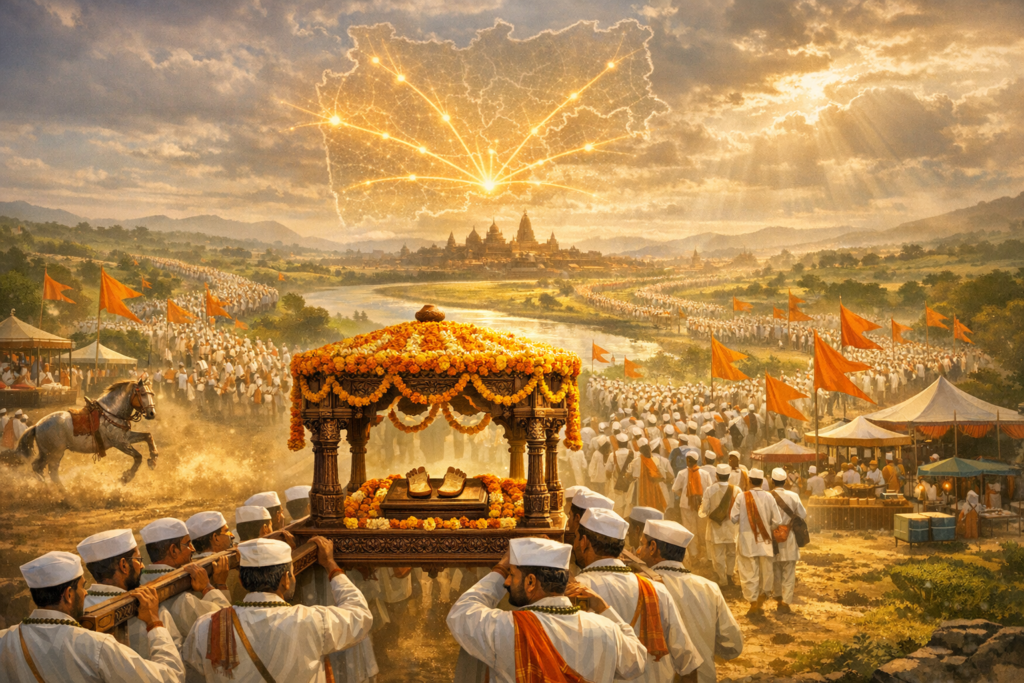
In South India’s sacred geography, Adi Sesha—the primordial, infinite serpent (also called Ananta)—is understood to repose across a triad of living temples: Tirupati (Tirumala), Ahobilam, and Srisailam. Within this devotional cartography, each shrine embodies a segment of the cosmic serpent’s form, binding landscape, theology, and pilgrimage into a single contemplative axis.
This interpretive mapping of divinity onto landforms is not an incidental flourish of mythology but a sustained tradition that informs practice, itinerary, and identity. In textual memory and oral lore, Tirupati anchors the Seshachalam Hills, Ahobilam unfolds across the rugged Nallamala forest as the seat of the Nava-Narasimha shrines, and Srisailam crowns the same Nallamala range on a promontory of the Krishna River. The three sites together are frequently described as a “divine triangle,” a configuration that conveys both theological unity and geographic coherence.
Philologically, “Sesha” connotes “that which remains” after cosmic dissolution, while “Ananta” signals the limitless substratum of being. Puranic narratives portray Adi Sesha as the devotee and support of Vishnu—both the couch of the Lord in the Ksheerabdi and the sustaining principle of terrestrial stability. The superimposition of this cosmology onto the Eastern Ghats gives the pilgrim a way to see landscape as liturgy and topography as theology.
Geographically, the Seshachalam and Nallamala hill systems of the Eastern Ghats provide the ecological and cartographic substrate of this belief. Tirumala occupies the Seshachalam range near present-day Tirupati; Ahobilam lies deeper within the Nallamala, amidst dense deciduous forest and sandstone-ridged gorges; Srisailam rises on the Nallamala plateau above the Krishna’s cutbanks. The triangle they form is not perfectly equilateral by road, but in sacred geometry it reads as equidistant nodes of a single narrative arc.
Regional sthala-purāṇas differ on precise correspondences—some traditions place Srisailam at the hood or head of Adi Sesha, Ahobilam at the heart or navel, and Tirumala at the tail or feet; others invert these attributions. The divergence is not an error but a hermeneutic gesture: each center asserts intimacy with the serpent’s life-force, thereby affirming the inseparability of the three sites. The shared message is unmistakable—devotion travels a single spine even as it bows before many forms.
Tirupati (Tirumala), oriented to Sri Venkateswara, is ensconced on seven hills long identified with the coils or hoods of Adi Sesha. Traditional enumeration recognizes Seshadri, Neeladri, Garudadri, Anjanadri, Vrishabhadri, Narayanadri, and Venkatadri, with the main temple on Venkatadri. The Venkatachala Mahatmya section associated with the Skanda Purana extols this massif as a parvata consecrated by Vishnu’s presence, a scriptural echo of the living devotion one witnesses daily.
Ritually, the day at Tirumala opens with Suprabhātam, proceeds through Archana, Arjita Sevas such as Kalyānotsavam, and cycles through extensive naivedya and harati. The temple economy and administration under Tirumala Tirupati Devasthanam (TTD) orchestrate these offerings with remarkable precision, but the heart of the experience remains an intimate darśana—pilgrims frequently describe a quickening stillness that outpaces the great flow of queues and logistics.
Architecturally, Tirumala’s complex synthesizes Chola, Pandya, and Vijayanagara layers: towering gopurams, a granite-lined prakāra, the garbhagṛha with the famed saligrama-like murti, and a deeply codified ritual choreography. Even as the temple burgeoned historically, its core continues to read as a high Drāviḍa plan animated by Vaishnava iconography and soundscapes of Veda pāraẏana and divya prabandham.
Ahobilam, situated in today’s Nandyal district, is the dramatic Vaishnava counterpoint on the Nallamala. Here the storyworld of Narasimha crystallizes into nine distinct shrines—the Nava-Narasimha kshetras—each articulating a theological mood and a terrain feature. The core cluster comprises Ahobila, Jwala, Malola, Kroda (Krodakara), Karanja, Bhargava, Yogananda, Chatravata, and Pavana Narasimha, distributed between lower and upper Ahobilam.
Pilgrims encounter sharp ravines, seasonal cascades, and the vertical outcrop revered as the Ugra Stambha—a lithic memory of the pillar from which Narasimha emerged for Prahlada. The landscape here is not a backdrop; it is a protagonist. Traversing the circuit, many report a tangible oscillation between awe and solace: Jwala’s fiery aspect challenging complacency; Malola’s tender saumya mood consoling the heart; Chatravata’s grove-like quiet inviting contemplative stillness.
Srisailam completes the triad with a rare confluence: Sri Mallikarjuna Swamy is venerated as a Jyotirlinga, while Sri Bhramaramba is honored as a Shakti Peetha. The temple’s placement over the Krishna’s scarp is both strategic and sacral, its precincts configured through spacious prakaras, pillared mandapas, and layered gateways reflecting Kakatiya and Vijayanagara patronage with later refurbishments. In living practice, Shaiva and Shakta currents are braided here into a single daily liturgy.
Festivals highlight each node of the triangle: Tirumala’s Brahmotsavam and the devotional swell of Kartika Masam; Ahobilam’s vibrant utsavas for the Nava-Narasimha with treks that become collective vows; Srisailam’s Mahā Shivaratri and continuous alankaras to Bhramaramba. Observed together, they draft a liturgical calendar that keeps the “sacred spine” attentive across the year.
Theologically, the triangle exemplifies unity-in-diversity central to dharmic thought. Vaishnava devotion to Venkateswara and Narasimha, Shaiva reverence for Mallikarjuna, and Shakta worship of Bhramaramba co-exist without contradiction. Rather than contesting supremacy, these kshetras demonstrate complementarity: protection, compassion, and awakening flow along a single devotional current understood as Adi Sesha’s life-line through the hills.
Cross-tradition resonances deepen this unity. In Buddhism, the Naga Mucalinda shelters the meditating Buddha; in Jainism, Parshvanatha is iconographically protected by a serpent hood; in the Sikh tradition, the imperative toward reverence, service, and interfaith respect cultivates a shared ethic of harmony. The serpent, far from a narrow emblem, becomes a pan-dharmic symbol of guardianship and cosmic order.
Underlying the lore are textual threads—especially the Venkatachala Mahatmya associated with the Skanda Purana for Tirumala and the local sthala-purāṇas for Ahobilam and Srisailam—that tie topography to theology. These narratives are not mere etiologies; they are interpretive keys that instruct how to walk, see, and serve—how to turn distance into devotion and terrain into teaching.
The landscape sciences add a complementary lens. The Seshachalam Hills, designated a Biosphere Reserve in 2010, and the contiguous Nallamala forests comprise critical tiger habitat, quartzite and sandstone formations, and rich endemic flora such as red sanders (Pterocarpus santalinus). When tradition names these ranges as Adi Sesha’s coils, it folds ecological stewardship into spiritual responsibility. Pilgrimage, in this telling, is also conservation.
Reading the triangle through sacred geometry clarifies why devotees speak of energy “nodes.” Temples function as capacitors of memory—ritual sound, movement, and offering structure attention. Whether one begins at Srisailam (head), passes via Ahobilam (heart), and culminates at Tirumala (tail/feet), or reverses the sequence to travel from surrender at the feet toward the head’s clarity, the itinerary is a contemplative pedagogy.
From a historical vantage, epigraphic and stylistic layers reveal exchange rather than isolation. Chola and Pandya endowments touch Tirumala; Kakatiya and Vijayanagara patronage shapes Srisailam; medieval Vaishnava orders, including the Sri Vaishnava lineage, animate Ahobilam’s priestly and musical life. The triangle thus maps not a single dynasty’s will but a civilizational weave of gifts, schools, and songs.
For many visitors, embodied experience confirms the texts. In Tirumala, the ascent through seven hills trains the breath into steadiness before darśana; in Ahobilam, the forest’s hush interrupts inner noise and reattunes attention; in Srisailam, the Krishna’s vast sweep asserts a quiet strength that often lingers long after departure. Pilgrims frequently report a sense that the three stops complete a single sentence.
Seasonality matters. Kartika Masam amplifies the glow at Tirumala and Srisailam; post-monsoon months reward Ahobilam’s treks with safe trails and clear streams. Summer heat intensifies the ascents, and monsoon downpours, while beautiful, can complicate ghat-road travel and upper-shrine approaches. When planning, aligning festival desire with climatic prudence results in both safer and more immersive journeys.
Practical connectivity supports the circuit. Tirupati offers rail and air links to major metros; Ahobilam is approached from Nandyal or Kurnool with final stretches by road; Srisailam connects by forest highways from Hyderabad, Kurnool, and Nandyal. Even logistics can be devotional when framed as service: choosing off-peak hours, respecting line discipline, and adopting low-impact travel benefit both fellow pilgrims and the hills they traverse.
Ritual grammar provides a final interpretive note. At Tirumala, Vaishnava seva patterns orient the devotee to surrender (śaraṇāgati); at Ahobilam, the nine forms of Narasimha cultivate courage, discernment, and compassion as complementary virtues; at Srisailam, Shaiva and Shakta upāsanā insist that power and tenderness belong together. The three, read as a syllabus, tutor the heart to be both strong and soft.
Importantly, this triangle has never required sectarian boundary-marking to maintain its force. The unity of dharmic traditions—Hinduism, Buddhism, Jainism, and Sikhism—finds here a natural stage for mutual recognition. Each tradition contributes a vocabulary of reverence and responsibility; none needs to negate another to sustain its own flame. The serpent’s spine, in this light, is a metaphor for shared support.
In sum, the “Sacred Spine of Adi Sesha” is a multilayered synthesis: Puranic imagination and epigraphic history, geomorphology and sacred geometry, ritual cycles and ecological care, personal transformation and civilizational continuity. For those who walk it thoughtfully, the triangle does more than connect three destinations; it teaches how to stand upright in a world that constantly bends—rooted like a mountain, supple like a serpent, and luminous like a shrine.
Inspired by this post on Hindu Blog.






Leave a Reply
You must be logged in to post a comment.