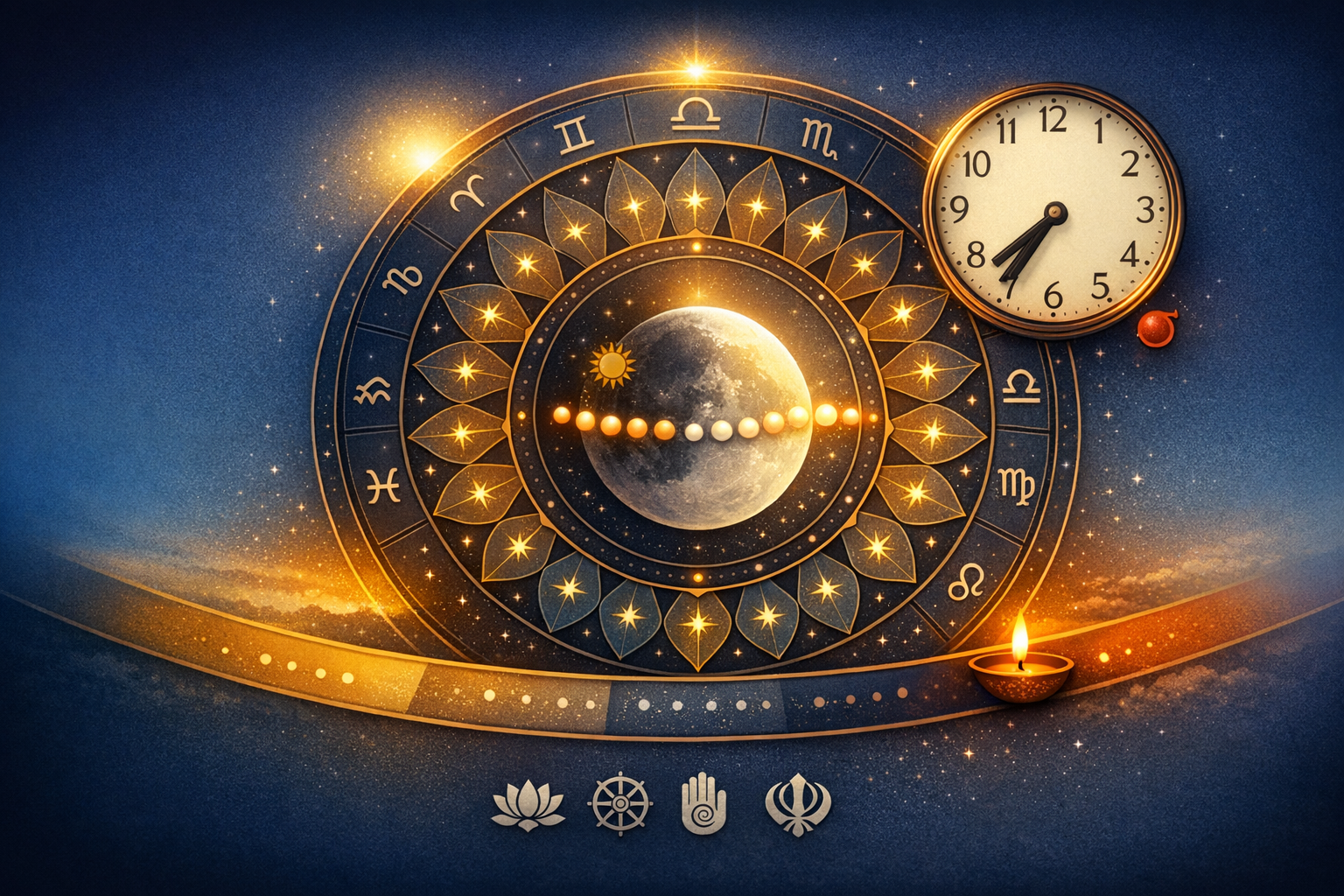
Tuesday, May 26, 2026 in the Hindu calendar (Panchang) begins with Shukla Paksha Dashami (the 10th lunar day of the waxing phase) and transitions to Shukla Paksha Ekadashi (the 11th lunar day) at approximately 07:40 IST in most Indian regions. This tithi change has practical implications for daily worship, vrata planning, and the selection of auspicious timings (Shubh Muhurat) across diverse dharmic traditions.
Tithi denotes the angular separation between the Moon and the Sun measured in 12° increments; each increment constitutes one lunar day. Because the Moon’s motion is not uniform relative to the Sun, a tithi can be shorter or longer than a civil day, and its transition may occur at any clock time. On this date, Shukla Paksha Dashami prevails until 07:40 IST, after which Shukla Paksha Ekadashi governs the rest of the day. Local sunrise times and longitude/latitude can cause small regional shifts, so practitioners should verify with a reliable regional Panchang if exactness is essential for observance.
In practical terms, daily morning worship and routine undertakings happening before 07:40 IST fall under the influence of Dashami, whereas activities thereafter occur under Ekadashi. Many households find it helpful to plan significant devotional practices and dietary disciplines according to the prevailing tithi, especially when Ekadashi vrata is intended.
Shukla Paksha Dashami is generally considered neutral to moderately auspicious for regular duties, intellectual work, and steady progress. It supports tasks that benefit from methodical effort rather than sudden leaps. While major life-initiating ceremonies are often aligned with more powerfully auspicious combinations, Dashami is suitable for maintenance, learning, community service, and temple visits that deepen continuity in spiritual life.
Shukla Paksha Ekadashi is one of the most observed vrata days in the Hindu calendar, revered especially in the Vaishnava tradition, and respectfully acknowledged in broader Sanatana Dharma practice. The vrata emphasizes upavasa (mindful restraint and simplicity), japa, dhyana, and seva. A widely used rule is that Ekadashi fast is typically observed on the civil day when Ekadashi prevails at sunrise. Because on May 26, 2026 sunrise in many Indian locations will occur before 07:40 IST (while Dashami is still running), many almanacs may designate the fasting day as the following civil date when Ekadashi is present at sunrise. Parana (vrata completion) is performed on Dwadashi, after Hari Vasara (the first quarter of Dwadashi) has elapsed. Local Smarta/Vaishnava traditions and regional Panchang guidance should be followed for precise fasting and parana windows.
Dharmic unity is naturally reflected in this lunar rhythm. Buddhists in several lineages emphasize Uposatha on defined lunar phases for intensified mindfulness and ethical reflection; Jains observe periodic fasting and pratikraman synchronized with lunar dates; Sikh families that follow the Nanakshahi solar reckoning often join the spirit of Ekadashi by choosing the day for introspection, simran, seva, and restraint. The shared ethos across Hinduism, Buddhism, Jainism, and Sikhisminner purification, compassion, and disciplinefinds resonance in these lunar observances, strengthening inter-tradition harmony.
Nakshatra identifies the Moon’s placement within one of 27 lunar mansions, and Rashi denotes the Moon’s sign backdrop. Both refine daily assessments for travel, learning, contracts, or healing practices. Because Nakshatra and Rashi shift with lunar motion and differ by location and time, practitioners should consult a regional Panchang or a trusted jyotisha resource for their precise locality. Pairing the prevailing Nakshatra qualities with the day’s tithi helps in making nuanced choicesfor instance, aligning study, pilgrimage planning, or charitable giving with supportive lunar traits.
Good Time (Shubh Muhurat) selection commonly considers universal windows and local calculations. Brahma Muhurtaapproximately 1.5 hours before local sunrisesupports meditation, pranayama, and scriptural study. Abhijit Muhurta centers around local solar noon and is often treated as a balanced, practical window for time-sensitive tasks. Evening sandhya and the Godhuli period naturally suit devotional reflection. For region-specific selections, Choghadiya (popular in western India) classifies rotating day/night segments as Amrit, Shubh, and Labh (favorable), Char (neutral), and Udveg, Kal, Rog (avoid). Choosing Amrit–Shubh–Labh windows enhances the day’s outcomes.
Equally important are avoidance windows: Rahu Kalam, Gulika Kalam, and Yamaganda. These are computed by dividing the daylight interval (sunrise to sunset) into eight equal parts and mapping weekday-specific segments. For Tuesday, Rahu Kalam corresponds to the 7th segment, Yamaganda to the 3rd, and Gulika Kalam to the 5th segment. Exact clock times depend on local sunrise and sunset; practitioners can compute them quickly by noting sunrise, subtracting sunset to get total daylight, dividing by eight, and then applying the Tuesday segment mapping.
Because Mars (Mangal) rules Tuesday, the day’s temperament favors disciplined action, courage tempered by ethics, and careful channeling of energy into constructive service. Aligning this martial steadiness with the sattvic emphasis of Ekadashi (post 07:40 IST) yields a balanced spiritual practicefirm in resolve yet gentle in approach. Many families find that dedicating time to annadana, study of the Bhagavad Gita or other dharmic texts, and quiet meditation harmonizes the day’s energetic profile.
For those observing Ekadashi, practical guidelines include simplifying diet (traditions vary on grains and beans), increasing japa and svadhyaya, and cultivating maitri (friendliness) toward all beings. Hydration and health considerations are integral; elders, expectant mothers, those with medical conditions, and children should observe according to capacity and with guidance. The vrata’s essence is inner clarity and compassion, not austerity for its own sake.
To personalize this Panchang guidance: identify local sunrise, verify the tithi at sunrise, and note the Dashami–Ekadashi transition at 07:40 IST as a general India-wide reference. Then select Shubh Muhurat windows using Abhijit Muhurta and Choghadiya, avoid Tuesday’s Rahu Kalam/Yamaganda/Gulika segments by local computation, and align the day’s devotional intent with the Ekadashi spirit that prevails after the morning transition. This method preserves scriptural accuracy while remaining practical for householders and renunciants alike.
In summary, May 26, 2026 carries a clear lunar arc: Shukla Paksha Dashami until 07:40 IST, then Shukla Paksha Ekadashi for the remainder of the day. Thoughtful timing, compassionate conduct, and shared dharmic values transform this calendar datum into a living practiceone that unites communities across Hindu, Buddhist, Jain, and Sikh traditions through common aspirations for inner steadiness, wisdom, and service.
Inspired by this post on Hindu Blog.