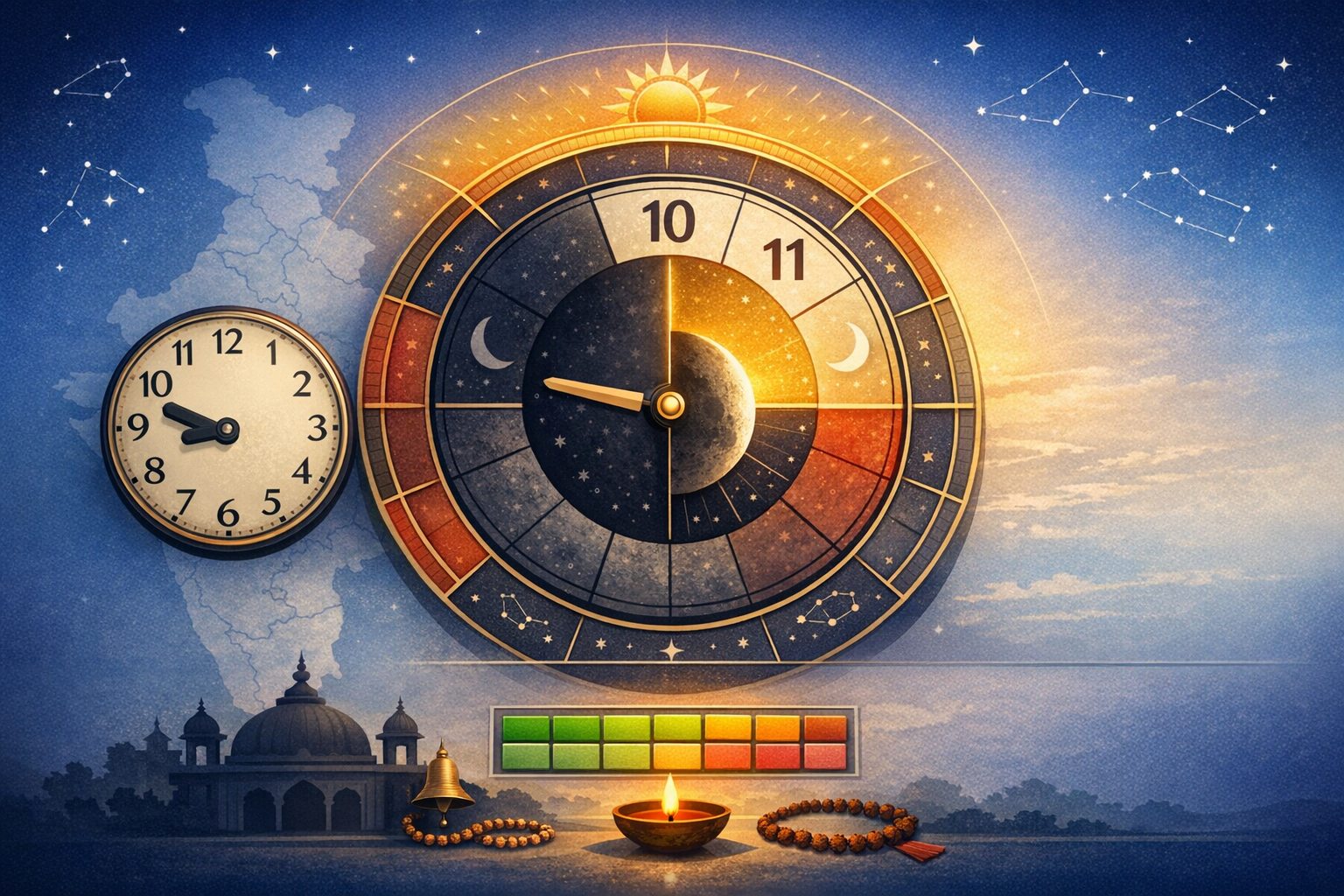
On Tuesday, May 12, 2026, the Hindu calendar (Panchang) in most regions marks Krishna Paksha Dashami, the tenth lunar day in the waning fortnight. Krishna Paksha Dashami tithi remains in effect until 9:47 AM on May 12, after which Krishna Paksha Ekadashi tithi begins and continues for the rest of the day. This Dashami–Ekadashi transition is significant for daily observances, fasting plans, and temple rituals, and it is best aligned to local Panchang timings for precision.
A tithi in the Panchang is defined astronomically by the relative longitudinal angle between the Moon and the Sun. Each tithi spans a 12-degree increment in this angular separation, so the boundary of a tithi shifts from place to place and day to day due to lunar velocity, solar longitude, and local time zone. Because of this, the recorded end of Dashami at 9:47 AM and the onset of Ekadashi thereafter may show minor regional variations, which is why traditional almanacs and temple schedules advise checking locale-specific data.
Calendar systems across India follow two principal lunar month conventionsAmanta (month ends with Amavasya, common in southern and western India) and Purnimanta (month ends with Purnima, common in northern and eastern India). Although month names may differ by convention (for example, a Krishna Paksha Ekadashi in late spring may be associated with Vaishakh or Jyeshtha depending on the system), the operative tithi itself and its dharmic significance remain the same. This shared astronomical basis underscores the unity of practice across regional traditions.
Krishna Paksha Dashami is traditionally viewed as a preparatory day ahead of Ekadashi. Many households adopt sattvic routines, reduce heavy foods, and conclude the day with light, easily digestible meals to support the discipline of the next day. Devotional reading (parayana), japa, and quiet evening meditation are widely recommended. In many Vaiṣṇava lineages, this Dashami evening is used to settle routine tasks and cultivate mental steadiness, so the Ekadashi vrata can be observed with focus and serenity.
With the onset of Krishna Paksha Ekadashi at 9:47 AM, the devotional emphasis intensifies. In numerous traditions, Ekadashi fasting is observed on the day when Ekadashi prevails at sunrise (Udaya tithi). If Ekadashi does not prevail at sunrise, local Panchang rules determine whether fasting shifts to the next sunrise; Smarta and Vaiṣṇava calendars sometimes differ on this point to avoid viddha (overlap) considerations. The breaking of the fast (parana) is performed on Dwadashi after sunrise while respecting the Hari Vasara window, which should have elapsed. Because these determinations are technical and region-specific, practitioners are advised to follow their community’s established Panchang or temple bulletin for the precise fasting date and parana timing.
Beyond fasting, Ekadashi is honored for its inner discipline: cultivating compassion, offering dana, practicing mindful speech, and devoting uninterrupted time to prayer or kirtan. Many find that light silence in the late afternoon or early evening deepens concentration. Households often report that even a partial dietary restraintpaired with sincere remembranceelevates clarity, steadiness, and a quiet joy that carries into Dwadashi.
Auspicious-period guidance complements tithi observance. Abhijit Muhurta, a well-known midday auspicious span, is centered on local solar noon and typically extends about 1/15th of the daylight duration. To approximate it, determine sunrise and sunset, compute the daytime length (dinman), divide it into 15 equal parts, and identify the central portion around solar noon. This window is traditionally favored for tasks demanding precision, oaths, and focused prayers when other timings are uncertain.
Routine cautionary periods are also part of daily Panchang practice. On Tuesdays, Rahu Kaal falls in the 7th division of the daytime (often late afternoon when the day is divided into eight equal parts), Yamaganda falls in the 3rd division, and Gulika Kaal in the 5th. To compute these exactly for a given location, divide the sunrise-to-sunset interval into eight equal parts and map the segments accordingly. Activities such as initiating new financial commitments or ceremonial beginnings are typically deferred outside these spans.
Many regions additionally consult the Choghadiya system, which divides day and night into eight time-blocks each, cycling through auspicious (e.g., Amrit, Shubh, Labh) and inauspicious (e.g., Rog, Kaal) segments. For accuracy, calculate each choghadiya as approximately 1.5 hours adjusted by the precise day or night length. Choosing Amrit, Shubh, or Labh choghadiyas can refine planning when paired with tithi and Abhijit Muhurta.
Nakshatra and Chandra Rashi further nuance the day’s quality by describing the Moon’s stellar backdrop and zodiacal sign. Because these can change within the day, specifics for May 12, 2026 depend on the locality and exact time. When selecting times for sankalpa, travel, or contract signing, practitioners often blend tithi with Nakshatra and Rashi considerations to align personal undertakings with the sky’s rhythm.
These lunar observances reflect a deeper harmony shared across Dharmic traditions. While Panchang practice is rooted in Hindu customs, lunar mindfulness is also meaningful in Buddhism (for example, Vesak around the Vaishakh full moon), Jainism (regular fasting on Agyaras/Ekadashi and other tithis), and Sikh heritage that honors seasonal and celestial cycles within a distinct calendrical framework. This shared attentiveness to time as sacred nurtures unity in diversityinviting reflection, ethical living, and compassion as common commitments.
Practical observance on May 12, 2026 may therefore follow a simple arc: keep the morning steady under Krishna Paksha Dashami; after 9:47 AM, deepen focus as Ekadashi prevails; prefer Abhijit Muhurta for precise tasks if needed; and avoid Tuesday’s Rahu Kaal, Yamaganda, and Gulika Kaal divisions for fresh commencements. Pair these with quiet japa, mindful meals, considerate speech, and a generous heart. Such integrative practice anchors the day in clarity and purpose.
Because Panchang data are sensitive to longitude, latitude, and local horizon phenomena, final decisionsespecially for fasting, parana, temple visits, and ceremonial beginningsshould follow an authoritative local almanac or the schedule posted by the nearest temple. Within that fidelity to place, the Dashami–Ekadashi passage on May 12, 2026 offers a balanced template for discipline and devotion, reflecting the enduring guidance of the Hindu calendar and its kinship with the wider Dharmic family.
Inspired by this post on Hindu Blog.