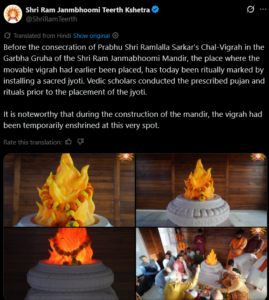
Reports circulating on social media alleging the use of a made-in-China plastic lamp at the Shri Ram Janmabhoomi Mandir triggered an intense debate about ritual propriety, symbolism, and heritage stewardship. For many devotees, the suggestion that an artificial light might replace the living, ghee-fed Akhand Jyoti raised immediate concerns about ritual continuity and the philosophical meaning of Agni in Sanatana Dharma. At the same time, the episode highlights a practical question facing all major temples: how to uphold time-honoured rites in a high-traffic, highly regulated environment without compromising safety, conservation, or clarity of communication.
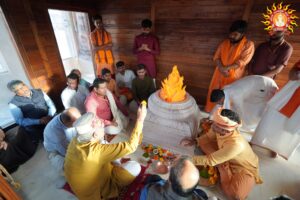
“Before the consecration of Prabhu Shri Ramlalla Sarkar’s Chal-Vigrah in the Garbha Gruha of the Shri Ram Janmabhoomi Mandir, the place where the movable vigrah had earlier been placed, has today been ritually marked by installing a sacred jyoti. Vedic scholars conducted the prescribed pujan and rituals prior to the placement of the jyoti. It is noteworthy that during the construction of the mandir, the vigrah had been temporarily enshrined at this very spot” – Shri Ram Janmbhoomi Teerth Kshetra
The statement above affirms the ritual installation of a sacred jyoti and underscores that Vedic pujan was conducted as prescribed. The ensuing public conversation, however, reflected wider anxieties: whether any decorative electric lamps might be misconstrued as substitutes for the Akhand Jyoti; whether procurement choices (including imported items) align with cultural expectations; and how institutional communication can reduce confusion around core rites in the Garbha Gruha.

In the Vedic and Agamic understanding, Agni is not mere illumination but a Devatawitness, messenger, and purifier. An unbroken, ghee-fed flame (Akhand Jyoti) carries layered meanings: satatata (continuity), pavitrata (purity), and sakshyatkara (divine presence as witness). Smriti and Agama traditions consistently treat the sacrificial and consecrational fire as ritually efficacious in ways that electric lighthowever useful for visibility and ambiencecannot replicate. This distinction explains why devotees feel a visceral, emotional bond with the living flame and why even the aroma of ghee smoke evokes darshan memories from childhood temple visits.
This reverence for the sacred flame resonates across dharmic traditions. In Buddhist monasteries across the Himalaya, butter lamps symbolize wisdom dispelling avidya; in Jain practice, the lamp of knowledge marks inner illumination and vrata; in Sikh parampara, while Akhand Paath rather than an akhand flame is central, the language of jotlight as the transmission of sabdaretains profound metaphorical force. The shared symbolism of the sacred light can therefore be a bridge for unity among Hindus, Buddhists, Jains, and Sikhs, reinforcing a civilizational ethic that honours both diversity of expression and a common quest for transcendence.
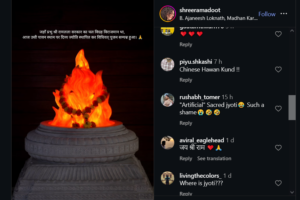
Against this background, two categories of lighting must be clearly differentiated: (1) the ritual Akhand Jyoti in the Garbha Gruha whose continuity, fuel, and handling are governed by shastra and established temple paddhati; and (2) auxiliary lighting (including electric lamps or LED diyas) for décor, safety, or crowd guidance elsewhere in the mandir complex. Conflating the two invites misunderstanding. The former is a living sacrament; the latter are pragmatic aids that can be valuable when judiciously deployed without intruding upon or symbolically replacing the jyoti.
Modern temples also operate within stringent safety and conservation frameworks. India’s National Building Code (NBC 2016, Part 4: Fire and Life Safety) and state fire department rules require risk assessments, flame management, and emergency response planning in high-occupancy venues. Continuous open flames demand compliant containment, spillage control, trained personnel, and monitoring. These are not obstacles to tradition; correctly implemented, they are enablers that protect devotees, the Deity’s abode, and the heritage fabric of the shrine.

Conservation science further recommends proactive soot management. Ghee-fired lamps can deposit carbon on stone, metal, and painted surfaces in confined sancta. Thoughtful lamp placement, high-quality ghee, optimized wick geometry, and micro-ventilation all reduce soot load. Periodic, minimally invasive cleaning using conservation-grade methods protects murtis, shringar, and the Garbha Gruha’s fabric while preserving the tactile realitieslight, fragrance, and warmththat devotees associate with darshan.
A practical, temple-ready protocol can reconcile ritual integrity with modern safeguards. A dedicated deepa assemblyheavy-gauge brass or panchaloha, with a stable wide basecan sit in a shallow, metal-lined containment plinth to capture any overflow. A clear, high-temperature glass shield (not symbolic of enclosure but functional as a draft buffer) reduces accidental wick flare while keeping the flame visibly “alive.” Oxygen ingress should be adequate to prevent incomplete combustion. Trained sevaks perform a rota for topping ghee, trimming wicks, and documenting continuity. Nearby, discreet aspirating smoke detection and a non-water clean-agent extinguisher reduce collateral risk without exposing the sanctum to corrosive residues.
Ritual purity and public safety are complementary when processes are transparent. Publishing a succinct, periodically updated notewhat constitutes the Akhand Jyoti, where it resides, who maintains it, and how safety is assuredhelps devotees distinguish the sacred flame from decorative lamps elsewhere in the complex. Such clarity curbs speculation, aligns public expectations, and strengthens trust in temple governance.
Procurement choices also carry cultural and economic symbolism. Where electric or decorative lamps are used for non-ritual functions, prioritizing high-quality, locally made fixtures honors both swadeshi sensibilities and practical maintainability. India’s artisan ecosystemsfrom Moradabad’s metalwork to southern sthapati traditionscan meet exacting specifications for ritual and auxiliary lighting. Clear vendor standards (materials, heat tolerance, absence of toxic plastics, repairability) serve sustainability and reduce waste.
Finally, the conversation points to a broader institutional aspiration: integrated training for temple personnel that blends Agama, dharmashastra, heritage conservation, public safety, and crowd logistics. Such multidisciplinary capabilitywelcoming sevaks and professionals from all communities within the dharmic familystrengthens ritual excellence, visitor experience, and long-term preservation. It also models unity in diversity by demonstrating how shared values translate into shared skills and responsibilities.
Preserving the sanctity of the Akhand Jyoti at Ayodhyaand in every sacred spaceneed not conflict with modern norms. When the living flame remains central, protected, and continuously served according to shastra, and when auxiliary lighting is transparently identified as decorative or functional rather than sacramental, tradition and technology reinforce rather than undermine each other. In that synthesis lies a civilizational promise: to keep the sacred light of Dharma burning clearlyrooted in wisdom, safeguarded with prudence, and shared across the dharmic traditions that together illumine the Bharatiya spirit.
Inspired by this post on Hindu Human Rights Blog.