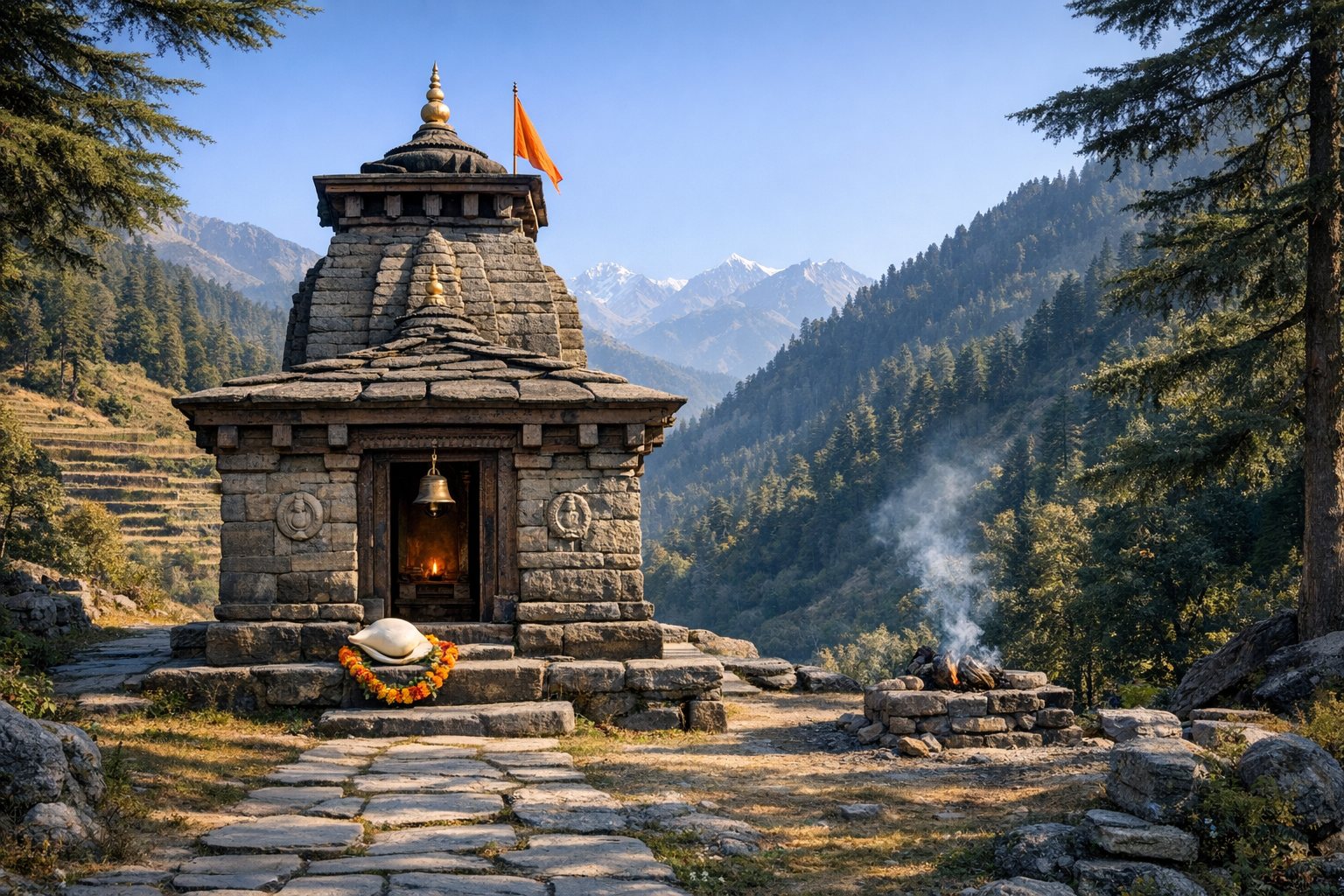
Dhyan Badri Temple, set quietly in the Urgam Valley of Chamoli district, Uttarakhand, is venerated as a contemplative sanctuary within the Sapta Badri pilgrimage circuit. At approximately 2,135 meters above sea level, the shrine honors Lord Vishnu in an ambience that foregrounds meditation (dhyana) as both practice and principle. The temple’s narrative, its geocultural setting in the Garhwal Himalaya, and its enduring ritual life together present an instructive portrait of Himalayan Vaishnavism harmonized with the region’s broader sacred geography.
Geographically, Dhyan Badri lies near Kalpeshwar, a noted site of the Panch Kedar tradition, in the Urgam Valley accessed from the Helang junction on the Rishikesh–Badrinath highway. Terraced fields, deodar and pine stands, and the valley’s gentle gradients shape a landscape that is comparatively approachable by Garhwal standards, while still retaining the quietude that pilgrims often associate with contemplative practice. Seasonal conditions in the valleyclear post-monsoon skies and crisp, breathable air in late autumnreinforce the aura of stillness evoked by the temple’s very name.
The name “Dhyan Badri” encapsulates a dual meaning central to Uttarakhand’s Vishnu shrines. “Dhyana” references the classical yogic state of steady, one-pointed awareness; “Badri” recalls the ancient “Badrikashrama,” the woodland of badari (jujube) trees associated with Vishnu’s tapas in Himalayan lore. Together they signal a form of darshana in which vision arises not from spectacle, but from inner quietudean interpretive key that visitors consistently find borne out by the site’s understated architecture and devotional rhythm.
Local oral tradition preserves a story of Urvarishi, a steadfast seeker whose austerities in the Urgam Valley culminated in a divine vision (darshan) of Lord Vishnu at this very spot. While textual attributions vary across districts and gazetteer records, the narrative’s thematic coreundaunted sadhana rewarded by a moment of luminous clarityaccords with the meditative ethos of the shrine. In local recitations, Urvarishi personifies the pilgrim’s interior journey: deliberate, patient, and receptive to grace when mind and landscape align.
Dhyan Badri is generally enumerated among the Sapta Badriseven Himalayan shrines dedicated to Vishnu that include the preeminent Badrinath along with Adi Badri, Bhavishya Badri, Vriddha Badri, Yogadhyan Badri, Ardha Badri, and Dhyan Badri (with local variants sometimes substituting Narsingh for one of these). The circuit’s structure reflects how sacred presence disperses across valleys and elevations, inviting pilgrims to experience the deity’s many modalitiescosmic, kingly, pastoral, and contemplativewithin a single region.
Crucially, Dhyan Badri stands near Kalpeshwar (Panch Kedar), underscoring a living dialogue between Vaishnava and Shaiva pilgrimage in Garhwal. This adjacency is emblematic rather than accidental: it illustrates a Himalayan culture in which devotion to Vishnu and Shiva is not a zero-sum preference but a complementary set of practices, often woven together within the same family or village. Such spatial convergence offers a model of dharmic unity that resonates with wider Indic traditions.
Historically, the Badri shrines show layered development across the early to late medieval periods, with periodic renewals of worship during subsequent centuries. The broader Badrikashrama tradition is remembered in Puranic literature, and the renaissance of Himalayan pilgrimage in the last millenniumencouraged by ascetic lineages and monastic custodianshelped consolidate local temples like Dhyan Badri. While precise epigraphic dates for the shrine remain limited in public sources, architectural idiom and village genealogies point to a heritage carried by community custodianship rather than royal monumentalism.
Architecturally, Dhyan Badri follows the understated Garhwali hill-temple vocabulary: a compact stone sanctum crowned by a modest shikhara, a simple mandapa space, and wooden lintels that buffer the mountain climate. The material restraint is intentional; it directs attention away from structural display toward the sanctum’s interior quiet. The immediate temple precincts often display local stonework, a small dhuni, and votive offerings that testify to an unbroken, village-anchored devotional economy.
The presiding murti of Vishnu aligns with the contemplative accent of the Badri tradition. In regional retellings, the deity is understood in a meditative or yogic modeconsistent with the iconographic emphasis seen at Yogadhyan Badrithereby inviting mental steadiness rather than sensory opulence. Even when specific iconographic details vary by local record, the ritual conversations led by priests and residents underscore a central point: the darshan here is meant to quiet the mind, not overwhelm it.
Liturgical life follows the Vaishnava calendar, with heightened devotional intensity during Kartika and on Ekadashi observances, including Vaikunta Ekadashi. Seasonal flow governs attendanceafter thaw and before heavy snowsbut the essential rites remain rooted in nitya-seva frameworks that the Garhwal region shares widely. Regional coordination, where relevant, aligns informally with practices familiar from Badrinath and other Vishnu kshetras stewarded in the orbit of the Badrinath Kedarnath Temple Committee (BKTC), even as Dhyan Badri itself retains its village-centered identity.
For many visitors, the temple functions as a living primer on classical dhyana. In practical terms, the site lends itself to simple, time-honored methods: a brief pranayama to settle the breath; pratyahara by softening attention to the five senses; a few rounds of silent japa with a chosen nama of Vishnu; and finally, quiet sitting facing the sanctum, maintaining a gentle, steady gaze. This practice architecture reflects the Yogasutra’s progression without sectarian exclusivity.
The contemplative signature of Dhyan Badri resonates across dharmic traditions. Hinduism, Buddhism, Jainism, and Sikhism all accord primacy to disciplined attentiondhyana, bhavana, samayik, simranas a means to ethical clarity and insight. Within this shared grammar of practice, the temple emerges not as an exclusivist emblem but as a local articulation of a civilizational commitment to inner transformation, compassion, and responsible living.
Visitors frequently remark on the sensory ecology of the precinct: conch notes modulated by alpine wind, the low, even cadence of priestly recitation, the muted colors of terraced fields, and the tactile coolness of mountain stone. Such details matter; they support a mode of seeing in which darshan is less a single instant and more a sustained disposition. The experience coheres with the Urvarishi memory: devotion ripens into vision when attention turns patient and whole.
Access typically proceeds from Rishikesh or Dehradun toward Joshimath on NH-7, turning at Helang for the Urgam road. From Urgam village, Dhyan Badri is reached by a short, well-trodden local path, often combined with a visit to Kalpeshwar. Public transport and shared jeeps serve the Helang–Urgam segment seasonally; homestays and small eateries, where available, reflect the valley’s modest but hospitable infrastructure.
Optimal travel months are late April to June and September to November, with the monsoon window requiring caution due to potential landslides. Given the moderate altitude (~2,135 m), gradual ascent, hydration, and weather-appropriate layering are advisable. During winter, snow can curtail local mobility; checking road conditions and temple timings in advance with village contacts or district bulletins improves planning fidelity.
Conservation in the Urgam Valley relies on low-impact pilgrimage. Responsible visitation includes minimizing plastic, engaging local guides, respecting photography guidelines in and around the sanctum, and supporting community-based services. Such practices sustain both the ecological balance of the Garhwal Himalaya and the intangible cultural heritage that keeps temples like Dhyan Badri vibrantly local.
For pilgrims mapping broader itineraries, Dhyan Badri integrates well with the Sapta Badri cluster and the Char Dham corridor. A measured sequenceVriddha Badri and Yogadhyan Badri near Pandukeshwar, Dhyan Badri in Urgam, Adi Badri near Karnaprayag, Bhavishya Badri in Subhain, and Badrinathyields a comparative encounter with Vishnu’s many forms. Interleaving Kalpeshwar (Panch Kedar) underscores the Himalayan practice of honoring Shiva and Vishnu in complementary rhythms.
From a research perspective, Dhyan Badri exemplifies how village-temple ecologies preserve doctrinal nuance through lived practice rather than elaborate textualization. Puranic references to Badrikashrama, British-era surveys of Garhwal, and contemporary ethnographies converge on a shared conclusion: the Himalaya’s sacred map is best read on the ground, with attention to local custodians, oral memory, and seasonal ritual patterns.
Ultimately, Dhyan Badri’s distinctiveness lies in its refusal of spectacle. The temple does not overwhelm; it clarifies. Set in a valley that encourages slow looking and slow breathing, the shrine manifests a core intuition of the dharmic world: when practice steadies and mind grows quiet, visiona darshan like that remembered of Urvarishiarises naturally. In this sense, Dhyan Badri remains not just a destination within the Sapta Badri, but an enduring school of inner seeing for the Garhwal Himalaya and beyond.
Inspired by this post on Hindu Blog.