On Saturday, March 28, 2026, according to the Hindu calendar (Panchang) observed in most regions, the day begins with Shukla Paksha Dashami tithithe tenth lunar day of the waxing phaseuntil 10:06 AM. From 10:06 AM onward, it transitions to Shukla Paksha Ekadashi tithi, the eleventh lunar day associated with heightened spiritual discipline and devotional practices. Timings may vary by locality and calculation school; where a default is assumed without explicit mention, Indian Standard Time (IST) is typically used, and local Panchang references should be consulted for precision.
In the classical framework, a tithi is defined by the elongation (angular difference) between the Moon and the Sun. Each tithi spans 12 degrees of this lunar–solar separation: when the Moon’s geocentric sidereal longitude exceeds the Sun’s by n×12°, tithi n (1–30) begins. Mathematically, tithi number = floor[(Moon longitude − Sun longitude)/12] + 1. The change noted at 10:06 AM indicates the moment the elongation crosses a multiple of 12°, shifting from Dashami (n = 10) to Ekadashi (n = 11). This astronomically grounded approach underlies modern Drik calculations widely used in contemporary Panchangs.
Shukla Paksha Dashami is generally regarded as supportive of steady growth-oriented undertakings and the consolidation of ongoing efforts. In many households, the morning window before the tithi change is preferred for routine responsibilities, studies, and charitable intentions. While Dashami does not carry the ritual weight of Purnima or Amavasya, its placement in the waxing fortnight corresponds to a symbolic movement toward light, clarity, and expansiona theme that practitioners often align with tasks requiring focus and follow-through.
Shukla Paksha Ekadashi (from 10:06 AM onward) is particularly revered across diverse Hindu sampradayas for vrata (vows), upavasa (fasting, in varied forms), and intensified japa and dhyana. Many observe partial or full fasting, prefer sattvic foods, engage in reading of Bhagavad-Gita and Bhagavata Purana, and devote time to seva (service). The following day’s parana (fast breaking) customarily occurs in Dwadashi within the appropriate window, avoiding the period known as Hari Vasara. As with all ritual timings, local Panchang guidance ensures correct observance.
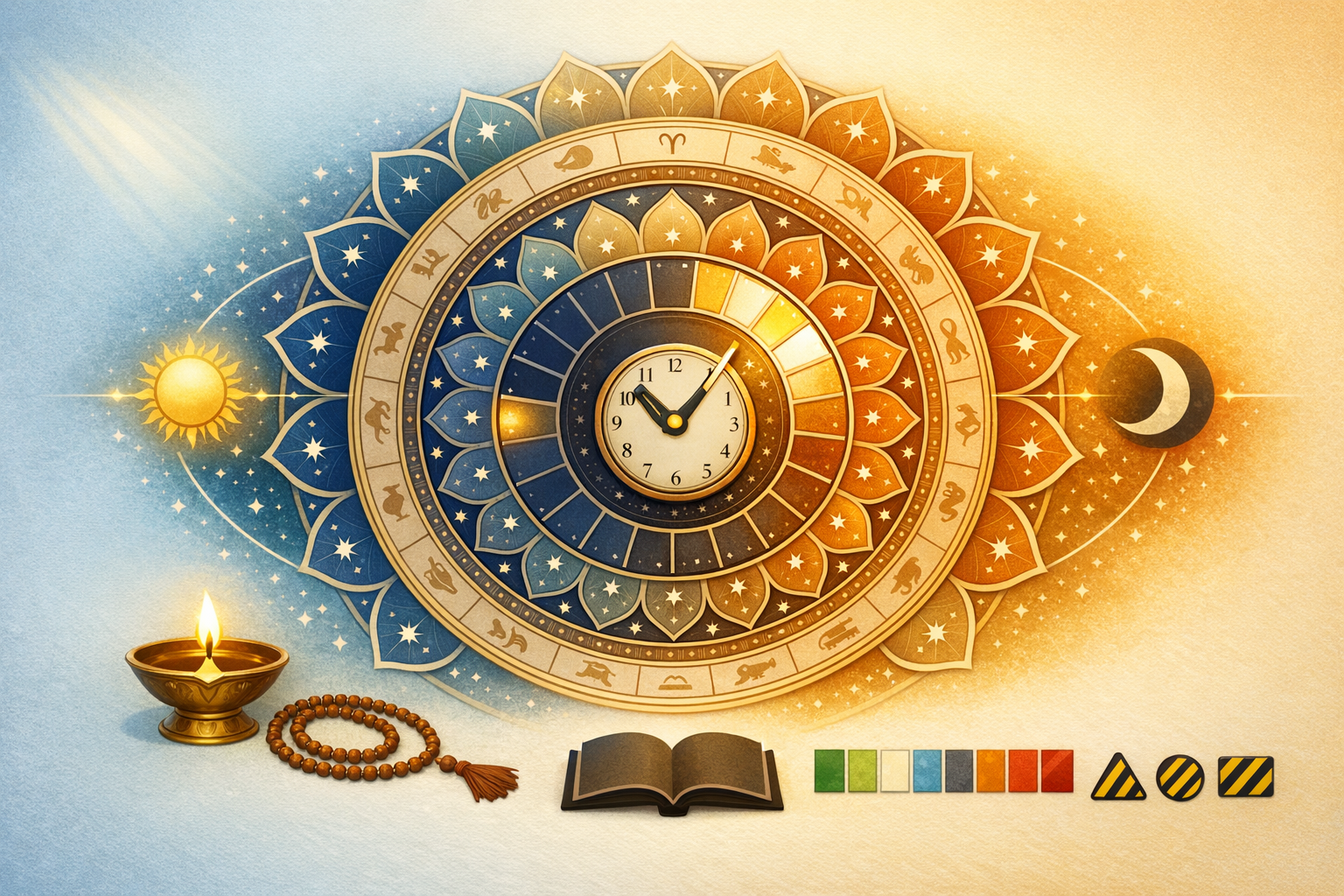
For those seeking a practical orientation to “good time” (Shubh Muhurta) on this date, two time-tested approaches are widely referenced: Abhijit Muhurta and Choghadiya (along with routine avoidance of periods such as Rahu Kalam, Yamaganda, and Gulika Kala). Because these depend on local sunrise and sunset, practitioners should compute them for their specific coordinates and date.
Abhijit Muhurta is a universal-purpose, generally auspicious interval centered on local solar noon. It is often approximated as roughly 24 minutes before and 24 minutes after the true midday point (which itself is calculated from local sunrise and sunset, not clock noon). Abhijit Muhurta is traditionally recommended for activities that require broad auspicious support when a specialized muhurta is not available, especially for sattvic or neutral objectives.
Choghadiya divides daytime (sunrise to sunset) and nighttime (sunset to sunrise) into eight equal segments each. On most regional Panchangs, the segments categorized as Amrit, Shubh, and Labh are considered favorable, while Kaal, Udveg, and Rog are avoided for new undertakings. Chal is typically neutral to mildly favorable. Because each segment’s actual clock time depends on day length, consulting a location-specific Panchang or a reliable Choghadiya calculator is essential for March 28, 2026.
Routine avoidance windowsRahu Kalam, Yamaganda, and Gulika Kalaare also sunrise-derived and vary by the day of the week. These intervals are customarily set aside for non-initiatory tasks and are not preferred for starting travel, inaugurations, or financially consequential decisions. Given their variability, local computations are recommended rather than relying on fixed clock tables.
Nakshatra and Rashi (particularly the Moon’s Chandra Rashi) add another layer of daily Panchang interpretation. The lunar mansion (Nakshatra)one of 27 (with occasional mention of Abhijit as a 28th)is determined by the Moon’s sidereal longitude and is central to selecting rites, travel decisions, and certain personal undertakings. The Moon’s sign (Rashi) offers a complementary view of the day’s emotional tone and receptivity. Since their names and change times on March 28, 2026 depend on precise ephemerides and the local horizon, authoritative regional Panchangs or Drik-based tools should be used to determine the operative Nakshatra and Moon sign for a given place and time.
Variations between Panchangs arise from methodological differencesDrik (observational/astronomical) vs. Vākya (traditional tabular) systemsand from the choice of ayanamsha (e.g., Lahiri). These technical factors influence the computed onset and end of a tithi or the entry of the Moon into a Nakshatra or Rashi. The 10:06 AM tithi change provided here reflects the standard note for “most regions,” yet local results can legitimately differ by a few minutes (or, in some cases, more), especially across time zones outside India.
Symbolically, the movement from Shukla Paksha Dashami to Shukla Paksha Ekadashi on the same civil date enables a blended observance: steady, worldly responsibilities in the earlier Dashami window and heightened devotional focus as Ekadashi begins. Many families find this natural rhythm helpfulcompleting errands and secular tasks before the transition and reserving post-transition hours for upavasa, japa, and reflective study.
This calendrical sensitivity to lunar phases resonates across India’s broader dharmic family. In Buddhism, Uposatha days aligned with lunar phases are dedicated to reflection and ethical renewal; in Jainism, Poshadha and other fasts emphasize non-violence, self-restraint, and inner clarity in consonance with the lunar cycle; Sikh practice, while following the Nanaksahi solar calendar and daily Nitnem, shares the Indic emphasis on disciplined remembrance (simran) and moral living. This shared orientation toward periodic reflection and ethical practice underscores a living unity among Hindu, Buddhist, Jain, and Sikh traditions, even where calendrical systems differ in technical detail.
Practically speaking for March 28, 2026: those prioritizing secular or logistical tasks may use the morning Dashami window, while those observing Ekadashi vrata can align their fasting and devotional activities with the post-10:06 AM period. For initiations or sensitive commitments, identify an auspicious window via Abhijit Muhurta or favorable Choghadiya segments, while steering clear of location-specific Rahu Kalam and similar intervals. When in doubt, defer to a trusted local Panchang or an experienced priest for fine-grained muhurta advice.
Finally, a note on context: March typically intersects with Chaitra in many regional calendars, the opening of a new cycle in several traditions. Whether the aim is spiritual renewal through Ekadashi, community-centered observance, or simply aligning the day’s responsibilities with supportive cosmic rhythms, careful use of the Panchang on March 28, 2026 brings both clarity and cohesionhonoring India’s civilizational ethos of plurality, shared wisdom, and mutual respect across dharmic paths.
Inspired by this post on Hindu Blog.