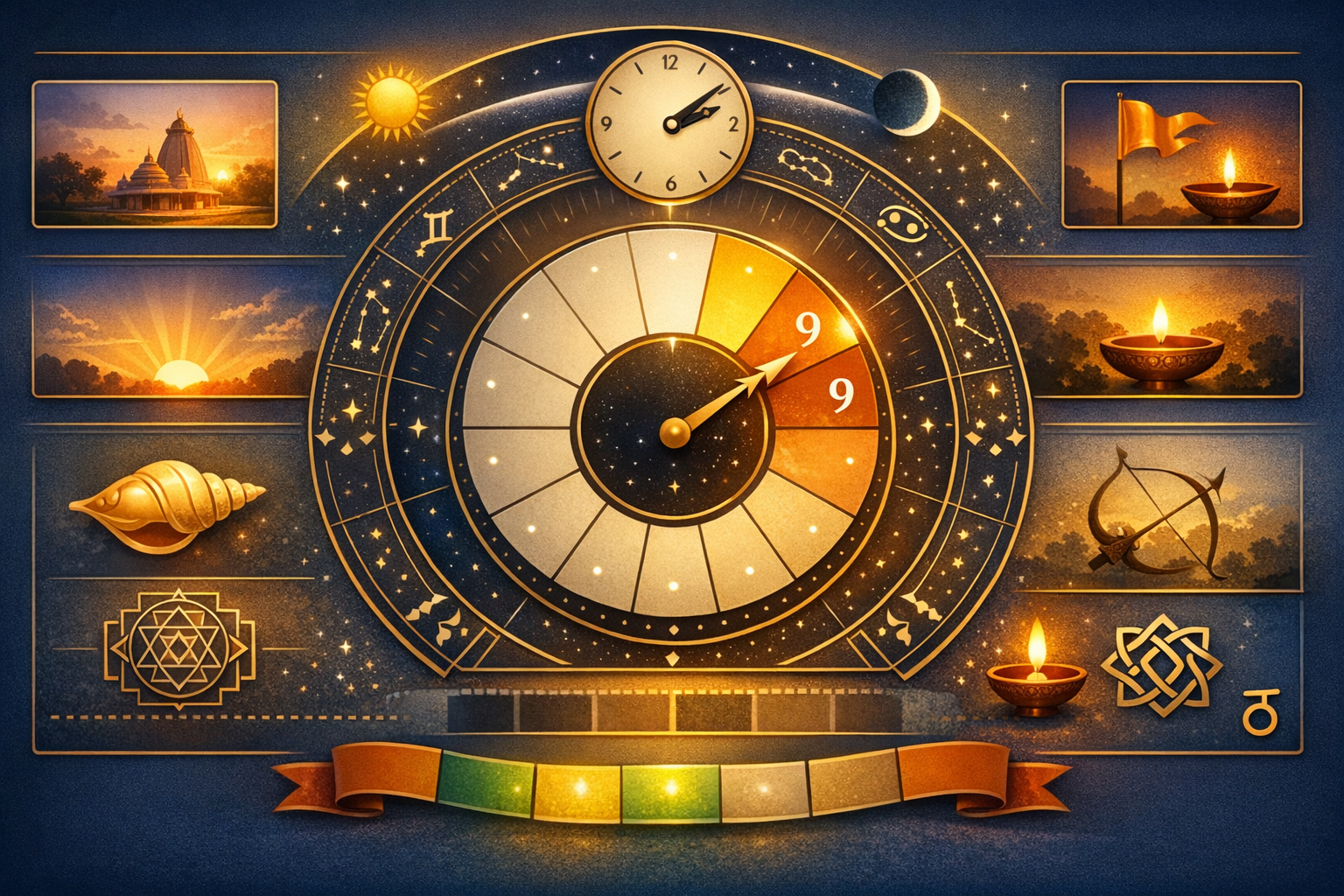
Thursday, March 26, 2026 in the Hindu calendar (Panchang) marks Shukla Paksha Ashtamithe eighth lunar day of the waxing phasein most regions. Ashtami prevails until approximately 2:11 PM (14:11), after which it transitions to Shukla Paksha Navami, the ninth lunar day. Owing to regional almanac conventions, observance windows may vary slightly by location, yet this Ashtami-to-Navami sequence is consistent across the majority of Indian Panchangs.
In technical terms, a tithi is defined by the longitudinal separation between the Moon and the Sun. Each tithi spans 12 degrees of this separation: Ashtami corresponds to an angular difference greater than 84° and up to 96°, and it becomes Navami once the separation exceeds 96°. This astronomical underpinning anchors the Panchang’s daily guidance for ritual observances, muhurta selection, and spiritual discipline.
Falling on a Thursday (Guruvara), the day is traditionally associated with Brihaspati (Jupiter) and is often chosen for Guru upasana, Vishnu worship, study, offerings, and charitable acts aligned with wisdom and expansion. Many households experience a deliberate, calm rhythm on Guruvara, selecting the day for learning, vows, and steady beginnings that benefit from Jupiter’s sattvic influence.
The post-2:11 PM arrival of Shukla Paksha Navami is especially significant this fortnight. Ram Navamiwhich is observed when Navami prevails during Madhyahna (midday period)is likely to be observed in most regions on the following civil day, subject to local sunrise and the Navami prevalence during the midday window. As such, March 26, 2026 functions as the devotional bridge from Chaitra Shukla Ashtami to the spiritually resonant Navami phase.
Those seeking “good time” (shubh muhurta) on this day can rely on the Panchang’s time-tested anchors that are independent of locale yet must be adjusted to local sunrise. The most widely used are: (1) Brahma Muhurta, a pre-dawn window ideal for japa, meditation, svadhyaya; (2) Abhijit Muhurta, centered on local midday and spanning roughly 48 minutes, favoring initiatives that demand clarity and resolve; (3) Vijaya Muhurta in the later afternoon for undertakings that aim at overcoming obstacles; and (4) Godhuli (around sunset), gently auspicious for prayers and home rituals. These are complemented by the avoidance of inauspicious segments such as Rahu Kalam, Yamaganda, and Gulikai Kalam.
To compute these windows accurately, begin with local sunrise and sunset times. Divide the daylight into equal parts as needed: Abhijit Muhurta centers on the local solar noon; Brahma Muhurta falls roughly 1 hour 36 minutes before sunrise and extends for about 48 minutes; Vijaya Muhurta is typically the 1.5 ghati period (about 36 minutes) occurring in the later portion of the afternoon; Godhuli is proximate to sunset and used for soft devotions rather than critical life events. These canonical definitions allow precise muhurta identification for any latitude/longitude without guesswork.
For inauspicious segments on Thursday, the conventional segment mapping relative to local sunrise is as follows: Rahu Kalam occupies the sixth daytime segment (approximately the 1.5-hour block beginning around early afternoon in a 12-hour day), Yamaganda occupies the first segment (immediately after sunrise), and Gulikai Kalam occupies the third segment of the day. Since these are proportional to local daylight length, exact clock times should always be derived from the day’s sunrise. Initiations and first-time ventures are best scheduled outside these intervals, while routine or remedial spiritual acts can still be performed with appropriate sankalpa.
Nakshatra and Moon’s Rashi (sign) are vital Panchang layers for March 26, 2026, and they should be verified for the observer’s location and time, especially near a mid-day tithi change. Nakshatra describes the Moon’s placement among the 27 lunar mansions, each offering a distinct flavor to undertaking selection (e.g., Dhruva-type nakshatras indicate stability, Ugra-type indicate intensity). Moon’s Rashi (sidereal sign) further refines emotional tone and suitability for activities like education, travel, business contracts, or domestic ceremonies. Around Shukla Ashtami–Navami of Chaitra, many almanacs frequently place the Moon in late Mithuna or Karka; however, specific nakshatra and Rashi boundaries should be confirmed using a reliable location-based Panchang.
Two more technical pillarsYoga and Karanacomplete the fivefold Panchang lens (Vara, Tithi, Nakshatra, Yoga, Karana). Yoga is computed from the sum of the Sun’s and Moon’s longitudes and cycles through 27 categories (e.g., Siddha, Shubha, Variyan), each subtly shaping the day’s undertone. Karanas (half-tithis) rotate more frequently (e.g., Bava, Balava, Kaulava, Taitila, Garaja, Vanija, Vishti), with Vishti (Bhadra) typically avoided for core auspicious starts. As with tithi, these should be read against local time for accuracy on March 26, 2026.
For practical planning, many also consult Choghadiyaan eightfold division of the day and night used in western and northern India for travel, trade, and quick muhurta checks. The favorable Choghadiyas are Amrit, Shubh, and Labh; Chara is neutral and useful for movement or errands; Kaal, Rog, and Udveg are avoided for fresh starts. Since day-length changes seasonally, the most reliable approach is to derive each of the eight daytime segments from the actual sunrise-to-sunset span and map the weekday-specific sequence accordingly for Thursday.
Spiritually, Shukla Paksha Ashtami of Chaitra is embraced by many as part of Chaitra Navratri, with Devi upasana, Kanya Puja (observed on Ashtami or Navami regionally), and home recitations honoring the Divine Feminine. As Navami commences after 2:11 PM, households commonly prepare for the following day’s Ram Navami observancesplanning Madhyahna puja, devotional kirtan, and family readings of the Ramayana. The day’s rhythm, therefore, naturally transitions from a devotional Ashtami focus to a Navami readiness that supports clarity and heartfelt celebration.
From a broader Dharmic perspective, this lunisolar discipline fosters unity across traditions. Buddhism structures Uposatha around lunar days; Jain communities often observe fasts and pratikraman tied to tithis such as Ashtami and Chaturdashi; Sikh familiesthough following the Nanakshahi solar calendar in contemporary practiceshare ancestral familiarity with lunar observances embedded in the subcontinent’s lived heritage. Recognizing these shared time-reckoning frameworks nurtures respect, learning, and harmony among Hindu, Buddhist, Jain, and Sikh communities.
For those organizing samskaras, journeys, or business steps on March 26, 2026, a reliable plan is straightforward: (1) confirm local sunrise/sunset; (2) note the tithi change (Ashtami to Navami) at approximately 2:11 PM; (3) select windows such as Brahma Muhurta, Abhijit, or afternoon Vijaya Muhurta; (4) avoid the Thursday-specific Rahu Kalam, Yamaganda, and Gulikai segments; (5) verify Nakshatra, Moon Rashi, Yoga, and Karana to align the action with the day’s finer energies; and (6) use Choghadiya as a quick secondary check if desired.
Regional almanac traditionsAmanta (month ending at Amavasya) and Purnimanta (month ending at Purnima)and longitudinal differences can produce minor variations in published Panchang data. Where local temple calendars or community panchangs provide refined timings, those should take precedence for rituals and public observances. The 2:11 PM transition to Navami presented here aligns with most Indian Panchangs and serves as a reliable baseline reference.
In sum, March 26, 2026 is a spiritually textured Thursday that begins with the contemplative depth of Shukla Paksha Ashtami and moves into the luminous promise of Shukla Paksha Navami. With thoughtful muhurta selection and attention to tithi, Nakshatra, Rashi, Yoga, and Karana, the day supports learning, devotion, family well-being, and preparation for the vibrant celebration of Ram Navami that follows in most regions.
Inspired by this post on Hindu Blog.