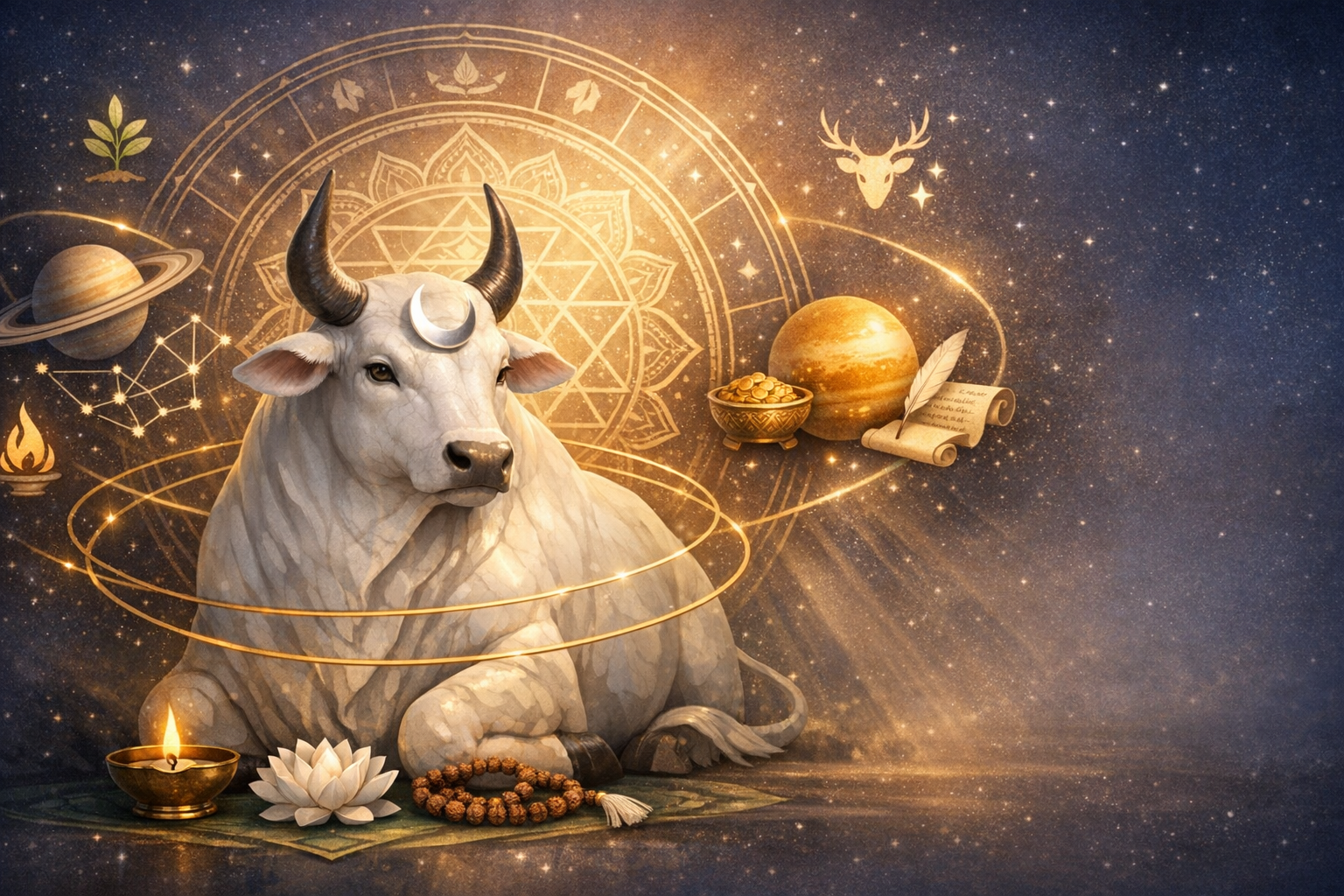
Vrishabha Rashi 2026-2027 Predictions, Taurus Moon Sign 2026-2027 Vedic Astrology Predictions, Vrishabha Rasi Palan, Vrishabha Rashi Rashifal for 2026-2027 are presented here in a rigorous, practical, and culturally rooted manner. Vrishabha Rasi (Taurus moon sign or Taurus zodiac sign) is the second among the 12 Rashi systems of Hindu Astrology, representing stability, value-building, patient progress, and a grounded relationship with resources, relationships, and the arts.
By constellation, Vrishabha spans Krittika and Rohini into Mrigasira. Classical siddhanta places Vrishabha across Krittika Nakshatram 2–3–4 padas, Rohini Nakshatram all padas, and Mrigasira Nakshatram 1–2 padas. In popular listings, this is sometimes shorthanded as “Krittika Nakshatram 1, 2, 3 padas or charans, Rohini Nakshatram all padas, Mrigasira Nakshatram 1, 2 padas.” This guide integrates both traditional delineations and contemporary practice to offer a precise yet accessible forecast for 2026–2027.
Methodologically, the analysis emphasizes gochara (planetary transits) of the slower-moving grahasShani and Gurubecause these establish the annual frame, complemented by qualitative cues from Rahu–Ketu shifts and fast-moving grahas for shorter windows. Standard Vedic ephemerides for the sidereal zodiac indicate Shani’s continued emphasis on the gains-and-networks sector for much of this cycle, while Guru transitions from resources-and-family toward communication, skills, and short-distance travel. Results vary with individual dasha–bhukti, ashtakavarga strength, and divisional charts (especially D-9), so the following should be read as a reliable Rashi-based map to be refined with one’s personal horoscope.
Shani’s influence during 2026–2027 is broadly aligned with the 11th from Vrishabha, a configuration that elevates the importance of sangha, professional circles, long-term goals, association leadership, and measured, sustainable gains. Under this pattern, outcomes tend to reward consistency, ethical collaboration, and realistic timelines; speculative shortcuts or imprudent alliances are less forgiving. Many Taurus Moon natives will perceive a sober but empowering nudge to formalize commitments, document agreements, and keep the cadence of steady delivery.
Guru’s movement sketches two distinct phases. The first part of the period favors the 2nd from Vrishabha, classically strengthening savings, family cohesion, voice, and knowledge assets; the later phase activates the 3rd, emphasizing upskilling, certifications, communication pipelines, content and code, and short-distance travel. In practical terms, this often correlates with a year that begins with consolidation and wise accumulation, then pivots into learning sprints, brand-building, and dissemination.
Rahu–Ketu dynamics through 2026–2027 amplify the career–home and visibility–privacy axes for many, accelerating change where stagnation has lingered and inviting dharmic clarity around purpose. This is supportive for bold but ethical career moves, provided due diligence is honored and family/inner stability is not neglected. Transparency and documentation remain the best guardrails against the shadow sides of the nodesoverreach, assumption, or misplaced trust.
Career and work: With Shani energizing the sphere of networks and long-term aspirations, Vrishabha natives benefit from consistent project governance, stakeholder mapping, and metrics-led delivery. The 2nd-house Guru phase supports articulate negotiation and resource access; the 3rd-house phase benefits those who publish, design, code, teach, or sell. Domains ruled or enhanced by Shukradesign, luxury goods, fragrances, hospitality, dairy and food sciences, farming inputs, jewelry, real estate staging, textiles, performing artsare well placed to convert steady effort into measurable wins.
Entrepreneurs and independent professionals can expect greater traction through systemization: standard operating procedures, client onboarding funnels, brand voice guides, and content calendars. During the skill-forward phase, small-format thought leadership (white papers, webinars, micro-courses) and channel partnerships often outperform large, high-risk launches. Where Rahu opens new professional doors, Ketu quietly tests stability; due diligence, references, and phased contracts are best practice.
Finance and assets: The anticipated Guru-in-2nd segment is classically auspicious for rebuilding buffers, clearing inefficient liabilities, and increasing the quality of assets rather than the mere count. As the year pivots toward the 3rd, expenditures tied to certifications, tools, travel, and implementation teams may rise. Maintaining a clear “core capital” policywhat never gets touchedstabilizes the journey and helps resist lifestyle creep.
Aaya Vyaya 2026-2027 planning is central for Vrishabha Rasi Palan. A practical baseline for many households this year is to target an Aaya:Vyaya ratio near 60:40 in the consolidation phase and at least 55:45 during the skill-and-outreach phase. Where irregular income cycles exist, tranche savings and sinking funds are recommended for taxes, travel, and learning investments. A calm Shukra-style cadencerefinement over excesskeeps the ledger elegant and sustainable.
Investments: The ethos of this cycle favors quality, dividends, and utility over hype, aligning with Shani’s preference for endurance and verifiability. Land and tangible upgrades that improve usability and yield can be prioritized, but title diligence, zoning, and cost-of-carry assessments must be meticulous. Where Rahu tempts with outsized promise, set objective guardrails: thesis, timelines, and exit criteria.
Home and property: Nodes can animate the home–work polarity; when the 3rd is active, short-term relocations for projects or study are common. Property deals reward documentation-first mindsets: encumbrance checks, structural audits, and compliance certificates. Minimalism in possessions and maximalism in order free bandwidth for skill-building and execution.
Relationships and family life: Guru’s presence in the 2nd elevates family conversations, lineage values, and mealtime harmony; later emphasis on the 3rd strengthens sibling ties and the everyday rituals that keep affection aliveshared walks, study sessions, and creative collaborations. Under nodal stimulation, honest boundaries, shared calendars, and non-reactive listening are the simple dharmic technologies that prevent minor frictions from becoming major.
Marriage and partnerships: For those contemplating formal commitments, the consolidation phase is primed for candid discussions on finances, shared duties, and life goals. During the more mobile 3rd-house phase, couples benefit from micro-rituals of connection to offset busy schedules. Contractspersonal or professionalmust be written, reviewed, and revisited.
Health and well-being: Vrishabha governs the throat, voice, lower jaw, cervical spine, and thyroid region; it is also linked to food habits and sugar balance. Stable routines for sleep, movement, and nutrition outperform sporadic intensity. Vocal hygiene, ergonomic upgrades, and moderated sweets are pragmatic. Where stress concentrates in the neck and shoulders, a daily breath–movement protocol is a high-yield intervention.
Ayurveda and Yoga integration: Gentle but consistent asana emphasizing the neck and shoulders (e.g., supported matsyasana, bhujangasana variations), combined with pranayama such as ujjayi, anuloma–viloma, and bhramari, supports the Vrishabha constitution. A sattvic emphasis in diet, mindful of heaviness and excess sweetness, aligns with Shukra’s refined nature. As always, medical conditions require professional care; yogic and Ayurvedic routines are complementary.
Education and skills: The skills-forward phase favors certifications in analytics, design systems, product management, supply chain, agritech, food technology, luxury retail, and financial planning. Communication excellencewriting, presenting, storytellingbecomes the carrier wave for expertise. Learners who embrace structured curricula and peer review cycles accelerate outcomes.
Students: The year supports bridging theory and practice. Study groups, spaced repetition for memorization, and weekly mock assessments align with Shani’s rhythm of steady, demonstrable mastery. During exam windows, breath-led focus routines and digital minimalism safeguard attention.
Travel and mobility: Short, purposeful trips that produce relationships, skills, or revenue are auspicious. Where long-haul travel is necessary, planning around Chandrabalam and Tarabalam increases comfort and success. Each journey should have a written purpose statement; this simple ritual prevents dispersion.
Remedial framework (upāya): The ethos across dharmic traditionsHindu, Buddhist, Jain, Sikhhonors inner steadiness, truthful speech, compassionate action, and seva. Vrishabha natives benefit from Friday observances to harmonize Shukra, Thursday reflections for Guru’s guidance, and Saturday disciplines that align with Shani’s integrity. Dana (charity) to education, food, and health causes integrates karma with community uplift.
Krittika Nakshatram padas within Vrishabha: The Agni principle refines, purifies, and forges character. Leadership opportunities increase under the gains-focused Shani pattern; the work is to temper decisiveness with tenderness. Sūryopāsanā on Sundays and lighting a deepa with gratitude supports clarity.
Rohini Nakshatram all padas: Creativity, fertility, and aesthetics flourish. During the Guru-in-2nd segment, family harmonics, voice training, and culinary or artistic ventures are poised for success. Emotional steadiness during nodal surges is cultivated through lunar observances on Mondays, quiet japa, and mindful meals.
Mrigasira (Mrigasira Nakshatram 1, 2 padas) within Vrishabha: Curiosity and iteration define growth here. The skills-centric phase of the year distinctly favors research, prototypes, and rapid feedback cycles. Grounding practiceswalks at the same hour daily, journaling checklistsconvert restlessness into research momentum.
Dasha-sensitive guidance: In Shukra mahadasha, prioritize refinement, relationships, and brand value; in Budha mahadasha, scale systems, documentation, and multi-channel communication; in Shani mahadasha, execute long horizons with audit-ready governance. Antardasha timing will regulate when the year’s larger potentials crystallize; align big milestones with your active dasha lord’s strengths.
Muhurta, Chandrabalam, and Tarabalam: For launches, relocations, and high-stakes negotiations, favor dates where the Moon is strong for Vrishabha and Tarabalam counts are supportive from the native’s birth star. When bespoke muhurta is not feasible, Choghadiya can still optimize daily windows; Shubh, Labh, and Amrit periods are generally constructive, while Kal and Rog are to be avoided for initiations.
Dharmic unity and practice: Jyotisha, when engaged in the spirit of dharmic unity, becomes a shared mirror for self-knowledge rather than a doctrine of fear. Meditation, japa, seva, and satya in speech are universal practices across Hinduism, Buddhism, Jainism, and Sikhism, and they reliably anchor Vrishabha’s patient, value-centered nature. Where life accelerates, these common wells of wisdom restore rhythm and meaning.
Year summary for Vrishabha Rashi 2026–2027: Expect a measured but meaningful climb in ambitions and networks, a first-half bias toward consolidation and voice, and a second-half emphasis on skills, communication, and mobility. Prudent risk, ethical alliances, and disciplined learning convert this cycle’s promise into tangible gains. When in doubt, choose steadiness over spectacle, documentation over assumption, and service over self-display.
Important note: These Vrishabha Rashi 2026–2027 predictions reflect Rashi-based tendencies under commonly accepted sidereal ephemerides. Individual outcomes depend on birth-time accuracy, dasha–bhukti, and specific yogas. For medical, legal, or financial decisions, professional counsel is essential; use astrology as a complementary, reflective tool that aligns action with dharma.
Inspired by this post on Hindu Pad.