-
Tata Ethical Fund Decoded: Sharia-compliant investing, facts vs myths, risks, and dharmic ethics

The ‘Tata Ethical Fund’ has invested for nearly three decades using a Sharia-compliant equity screen within India’s SEBI-regulated framework. This article explains—in clear, technical terms—what Sharia-compliant investing entails, how it differs from the colloquial idea of “halal certification,” and why such screens are neither extra-legal nor limited to any one community. It outlines the portfolio…
-
Kolhapur Protests over Shivaji’s Legacy: Calls to Ban ‘Shivaji Kon Hota?’ Spark Legal Debate

Protests erupted at Shivaji Chowk in Kolhapur demanding a ban on Comrade Govind Pansare’s ‘Shivaji Kon Hota?’. Demonstrators allege the book distorts the legacy of Chhatrapati Shivaji Maharaj and hurts religious sentiments, and they submitted a memorandum seeking prohibition and legal action. This analysis explains why Shivaji’s image carries deep emotional weight across Hindu, Buddhist,…
-
Saras Baug Protest Ahead of Bakri Eid: Smart Crowd Controls to Protect Peace in Pune

A spontaneous protest at Pune’s Saras Baug—branded “Hindu Rashtra Jagruti Andolan”—called for restrictive orders ahead of Bakri Eid on May 27, underscoring concerns about crowd management after heavy Ramadan footfall. This analysis explains the constitutional and legal contours governing peaceful assembly and religious freedom, clarifies what narrowly tailored Section 144 orders can achieve, and outlines…
-
Saleem Wastik arrest in 1995 kidnap–murder sparks debate: due process, calm, and unity

Reports indicate that YouTuber Saleem Wastik, who identifies as “Ex-Muslim,” was arrested in connection with a 1995 kidnapping–murder case, prompting public debate and legal scrutiny. This analysis explains how India’s CrPC and IPC govern late-stage arrests, remand, and bail in serious offences, emphasizing the presumption of innocence and evidentiary rigor. It outlines why there is…
-
Karna’s Elephant-Chain Banner: Fate, Dharma, and the Unyielding Spirit of Kurukshetra

The Mahabharata’s standards were a battlefield lexicon, distilling each warrior’s identity and philosophy into potent symbols. Within this system, tradition associates Karna with an elephant-chain emblem, a motif that fuses material realism—control of war elephants—with moral allegory—power managed by duty. While not uniformly attested across all recensions, the emblem appears in parts of the textual…
-
Honoring HG Saudamini Devi Dasi ACBSP: Legacy of Bhakti, Seva, and Grace in Mayapur

Her Grace Saudamani Devi Dasi (ACBSP), wife of Ravindra Svarupa Prabhu, departed in Sri Mayapur Dhama after a brief decline, leaving a legacy of devotion, steadiness, and seva in ISKCON. This tribute situates her life within Gaudiya Vaishnavism’s theological framework—sambandha, abhidheya, and prayojana—while explaining the devotional meaning of “leaving the body.” It highlights the spiritual…
-
Ananya Sharan Bhaava Explained: Fearless Single‑Minded Devotion Beyond Spiritual Shopping

Ananya Sharan Bhaava (single-minded devotion) is not acquired from outside; it is an innate capacity uncovered by simplifying attention and practicing consistently. Dharmic sources—from the Bhagavad Gita and Narada Bhakti Sutra to Buddhist refuge, Jain sāmāyika, and Sikh Nām Simran—converge on the same principle: refuge becomes single-minded when remembrance is continuous and ethics are integrated.…
-
Krishna as Paramananda: Unlocking the Highest Pleasure and Enduring Inner Bliss

The proposition that ‘Krishna means the highest pleasure’ is a technical statement of Vedic philosophy that distinguishes fleeting stimulation from enduring bliss (ānanda). Drawing on the Upanishads and the Bhagavad Gita, it locates true happiness in alignment with the Infinite and explains why inner joy is ‘beyond the senses’ yet discernible by a refined intellect.…
-
May 2026 Sacred Festivals at Tirupati Sri Kodandarama Swamy Temple: Timings, Rituals, Processions

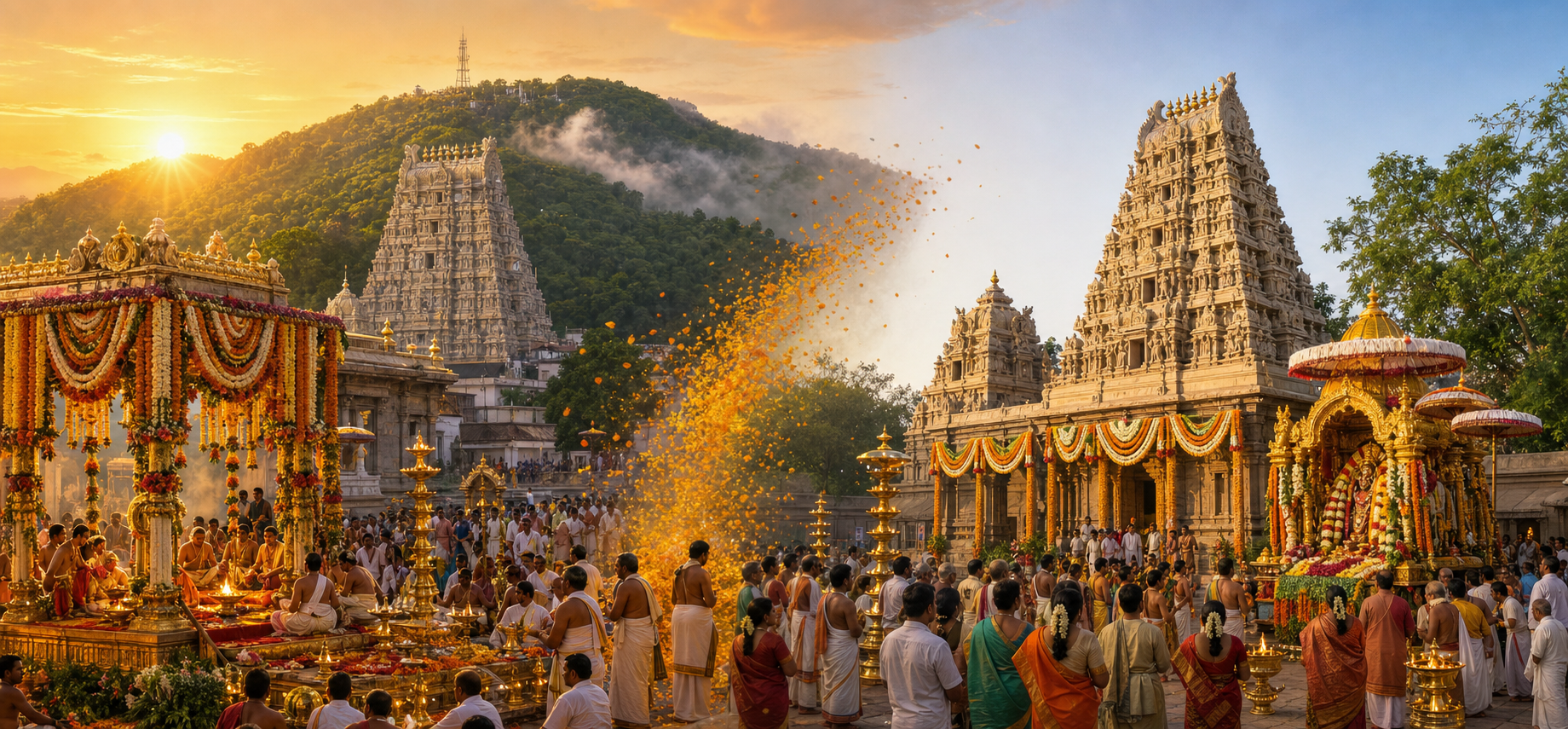
Sri Kodandarama Swamy Temple in Tirupati will observe two Poornima festivals in May 2026—on May 1 and May 31—with the Ashtottara Shatakalasabhishekam at 9:30 AM and an evening procession at 5:30 PM. The 108-kalasha abhishekam honors Sri Kodandarama Swamy with Sita and Lakshmana, echoing classical symbolism tied to the number 108. The Mada-street procession extends…
-
Panchamrita Abhisheka: Sacred Science, Symbolism, and Temple Tradition of the Five Nectars

Panchamrita Abhisheka—the bathing of deities with milk, curd, ghee, honey, and sugar/jaggery—unites sacred symbolism, Ayurveda, and practical icon care. Sri Sri Ravishankar’s observation that these five are “like nectar” echoes Agamic and Puranic guidance and explains why they endure in temple ritual. Each substance contributes uniquely: milk cools and nourishes, curd clarifies, ghee protects, honey…
-
Narada Jayanti 2026: Date, Tithi, Puja Vidhi and Devarshi Narada’s Timeless Legacy

Narada Jayanti 2026, the birth anniversary of Devarshi Narada, falls on May 2 and is observed on Vaishakha bahula Pratipada/Jyeshta Krishna Paksha Pratipada. Grounded in the tithi system of Hindu astronomy, the date can vary by time zone, making a local Panchang essential. The day honors Narada’s multidimensional legacy—as Brahma Manasa Putra, master of sacred…
-
Decoding ‘Om krato smara kritam smara’: karma, memory, and the art of conscious dying

“Om krato smara kritam smara” from the Īśāvāsya Upaniṣad condenses the Upanishadic path into one imperative: let the sovereign will remember what has been done. The mantra sits at a pivotal moment in the text (Vājasaneyi Saṁhitā 40.17), pairing ethical clarity with the acknowledgement of impermanence. A brief philological reading clarifies ‘krato’ (will/intellect), ‘smara’ (remember),…
-
Parashurama Dwadashi 2026: Auspicious Date, Puja Vidhi, Fasting Rules, and Profound Significance

Parashurama Dwadashi 2026 falls on April 28, the Dwadashi tithi following Mohini Ekadashi in Vaishakh Shukla Paksha. This guide explains the date’s calendrical basis, clarifies how it differs from Parashurama Jayanti, and provides a careful, step-by-step Puja Vidhi suitable for home observance. Readers will find clear fasting and parana guidance aligned with traditional practice, along…
-
18 Research-Backed Facts about Ganesha: Iconography, Mantras, Festivals, and Global Legacy

This comprehensive, research-grounded guide presents 18 essential facts about Ganesha—his Puranic origins, rich iconography, mantras, and threshold role as Prathama Pujya. Readers will learn how symbols such as the goad, noose, modaka, and the mouse vahana communicate psychological discipline and ethical intent. The overview explains the eight incarnations (Mudgala Purana), monthly observances like Sankatahara Chaturthi,…
-
Veerabrahmendra Swami Jayanti 2026: Sacred Date, Legacy, Rituals, and Pilgrim Guide

Sri Veerabrahmendra Swami Jayanti 2026 will be observed on April 26, honoring Pothuluri Veerabrahmendra Swami—Brahmamgaru, Kalagnani—with devotion and service. Centered at Sri Veerabrahmendra Swami Matham, Kandimallayapalle (Kadapa, Andhra Pradesh), the Jayanti Utsavalu typically feature special pujas, collective chanting, and community seva. The article explains how regional panchangam variations work, how to align household puja-vidhi with…
-
Basava Purana Unveiled: Palkuriki Somanatha’s Epic of Basaveshwara, Devotion and Equality

Basava Purana, composed in Telugu by Palkuriki Somanatha in the 13th century, is a seminal hagiographic epic on Basaveshwara (Basavanna Deva) that unites narrative, doctrine, and ethics. Sacred to the Lingayat community yet influential far beyond, it advances kayaka (work as worship), dasoha (sharing), and ishtalinga (direct devotion) as practical pathways to inner realization and…
-
Jyotiba of Maharashtra’s Sacred Hills: Radiant Warrior-Protector, Fusion of Shiva and Surya

Jyotiba, the radiant warrior-protector of Maharashtra’s sacred hills, is revered across the Deccan as a powerful fusion of Shiva’s transformative force and Surya’s life-giving radiance. Set on Wadi-Ratnagiri near Kolhapur, the temple anchors a sacred geography that interlinks with the famed Mahalakshmi shrine, illustrating how local ecology and pan-Indic theology cohere. The Chaitra Purnima yatra,…