
If you have opened Nyayamrita and become lost among arguments about maya, avidya, and difference, do not begin by memorizing the conclusions. Start with one question: what must be real for knowing, speaking, worshipping, and correcting an error to work at all?
That question brings Vyasatirtha’s method into focus. He does not defend Dvaita merely by repeating that God, souls, and the world are distinct. He asks whether a philosophy can deny those distinctions at the ultimate level without borrowing them whenever it makes a claim. Once you see that strategy, the difficult terminology becomes a set of problems you can examine rather than a wall you must climb.
Begin with the question Dvaita is trying to answer
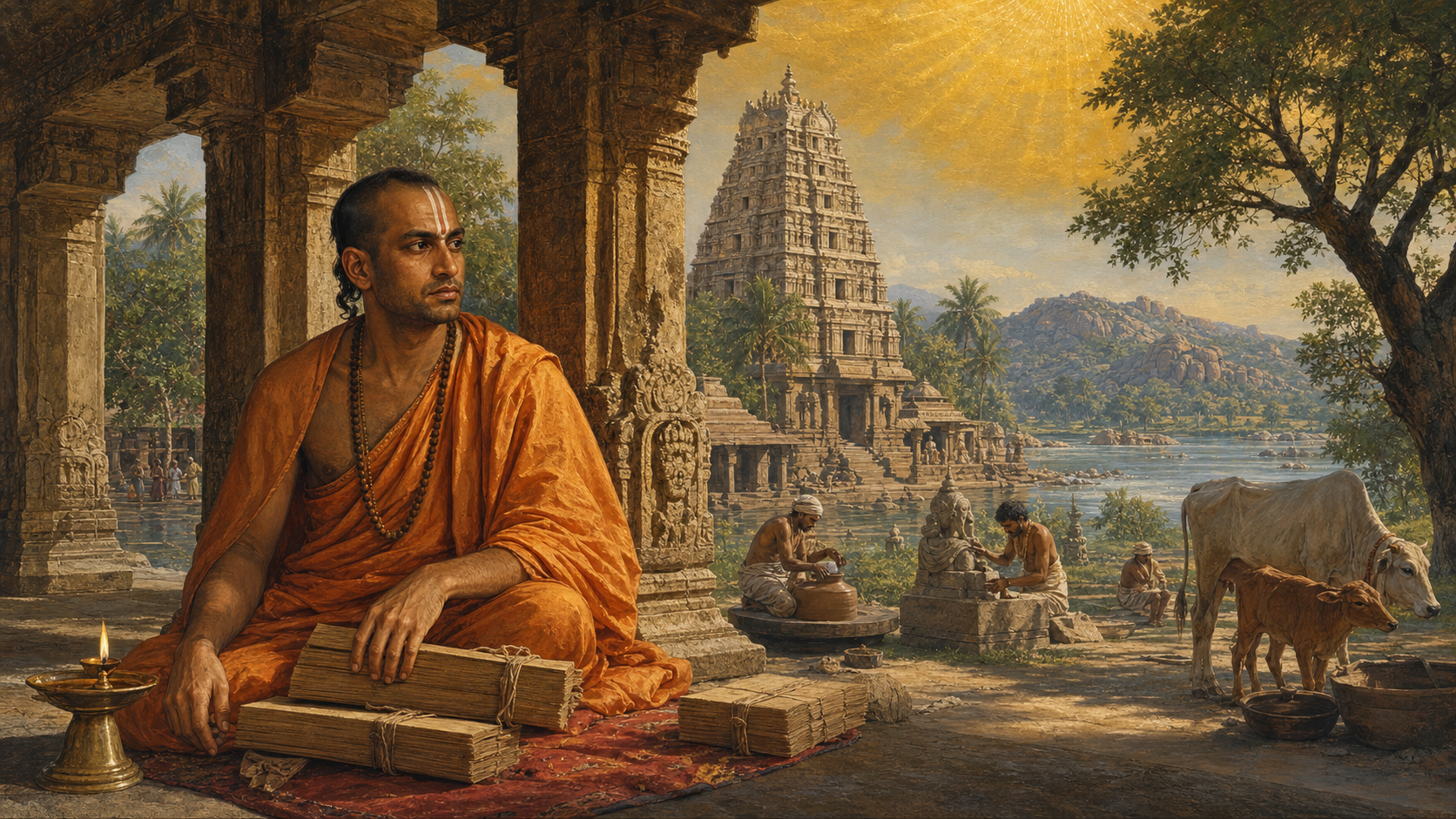
Vyasatirtha, also known as Vyasaraya, lived from 1478 to 1539 CE in the Vijayanagara intellectual world. Tradition associates him with Krishnadevaraya and with the devotional culture of the Haridasa movement. That setting matters: rigorous reasoning, temple learning, scriptural interpretation, music, and bhakti did not occupy separate civilizational compartments. A philosopher could test the logic of a metaphysical claim and still treat devotion as the purpose toward which clarity should lead.
Vyasatirtha uses Nyayamrita to defend Madhvacharya’s Dvaita Vedanta, especially against Advaita Vedanta. Both schools work within a shared scriptural inheritance that includes the Upanishads, the Brahma Sutra, and the Bhagavad-Gita. Their disagreement concerns how statements about unity, difference, divine qualities, the world, and liberation should be interpreted. You will misunderstand the debate if you reduce it to belief versus disbelief or devotion versus philosophy.
Dvaita begins from robust realism. Vishnu is supreme; individual selves, or jivas, are enduringly real; prakriti is real; and differences among God, selves, and material things are not temporary defects in perception. Vyasatirtha then asks whether experience, language, and scripture support that account more coherently than an ontology in which plurality is ultimately overcome.
His reasoning draws on three principal means of knowledge: perception, or pratyaksha; inference, or anumana; and trustworthy verbal testimony, or shabda. He also uses the analytical habits of Nyaya and the increasingly fine distinctions associated with Navya-Nyaya. This produces a useful discipline for your own reading: never evaluate a metaphysical conclusion in isolation from the means by which someone claims to know it.
For each major argument, make a four-line note:
- Claim: What exactly is being asserted about God, the jiva, matter, ignorance, or liberation?
- Pramana: Does the case appeal to perception, inference, scripture, or a combination?
- Presupposition: Which distinctions must already be functioning for the claim to be stated and understood?
- Consequence: What changes for bhakti, moral agency, or moksha if the claim is accepted?
This simple worksheet prevents two common mistakes. The first is treating Vedanta as a collection of detached quotations. The second is treating logical criticism as if it had no spiritual consequence.
Use the five differences as a map of the real
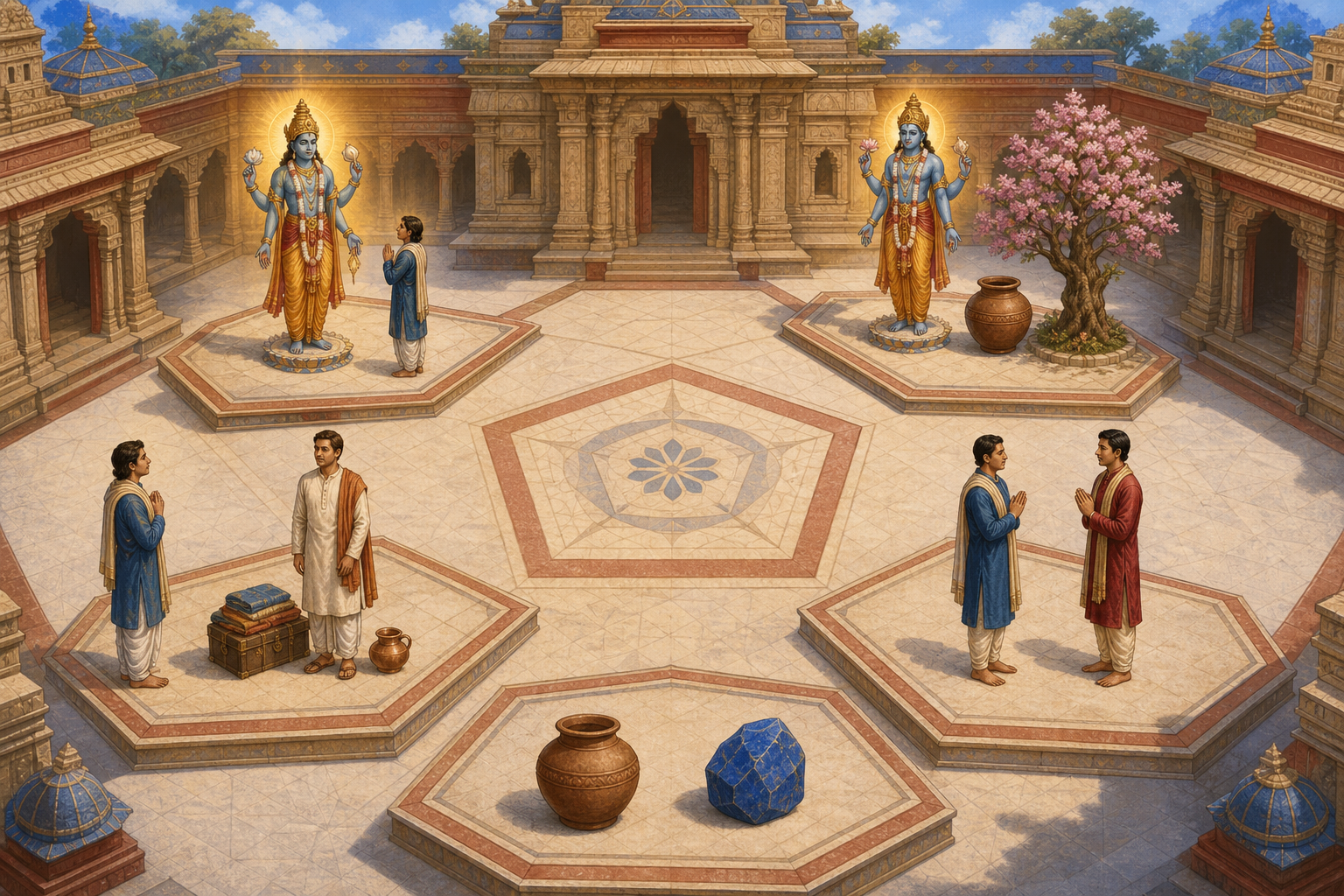
Madhvacharya’s panchabheda, or fivefold difference, gives you the clearest map of Dvaita ontology. Difference does not mean that reality has fallen into unrelated pieces. It means that a relationship does not erase the identities of the beings or things related. Dependence upon Vishnu is therefore compatible with the real existence of the dependent jiva and world.
| Difference | What Dvaita preserves | Question to ask while reading |
|---|---|---|
| Vishnu and the jiva | The distinction between the supreme Lord and the individual self | Does liberation unite the jiva with God by participation, or erase the jiva’s identity? |
| Vishnu and prakriti | The distinction between the supreme Lord and material reality | Is the world a real object of divine governance, or only an ultimately superseded appearance? |
| One jiva and another jiva | The plurality of individual knowers | What makes responsibility, memory, devotion, and personal liberation belong to a particular self? |
| One material entity and another | Stable identities and distinctions within the world | How could recognition and successful action occur if object boundaries were wholly projected? |
| The jiva and prakriti | The distinction between the conscious knower and material objects | What separates the one who experiences from what is experienced? |
These are not five unrelated doctrines. Together they protect the structure of cognition: a knower encounters something known through a real cognitive act. They also protect the structure of devotion: a worshipper directs love, knowledge, and service toward a Lord who is not a temporary image of the worshipper’s own self.
Try applying the map to the sentence, I worship Vishnu. Dvaita takes the worshipper, the act of worship, and Vishnu as genuinely meaningful. The worshipper depends upon Vishnu but does not become identical to him simply because the relationship is intimate. If you remove every distinction as ultimately unreal, you inherit the burden of explaining why this devotional grammar conveys truth rather than merely preparing the mind for its own eventual cancellation.
Panchabheda also keeps Dvaita from being mistaken for a crude picture of two equal realities facing each other. Its ontology includes real plurality together with hierarchy, or taratamya, and the supremacy of Vishnu. When someone describes Dvaita as nothing more than an absolute separation between God and creation, check whether that description accounts for dependence, relation, devotion, and ordered plurality. Usually it does not.
Apply three stress tests to maya, avidya, and nirguna Brahman
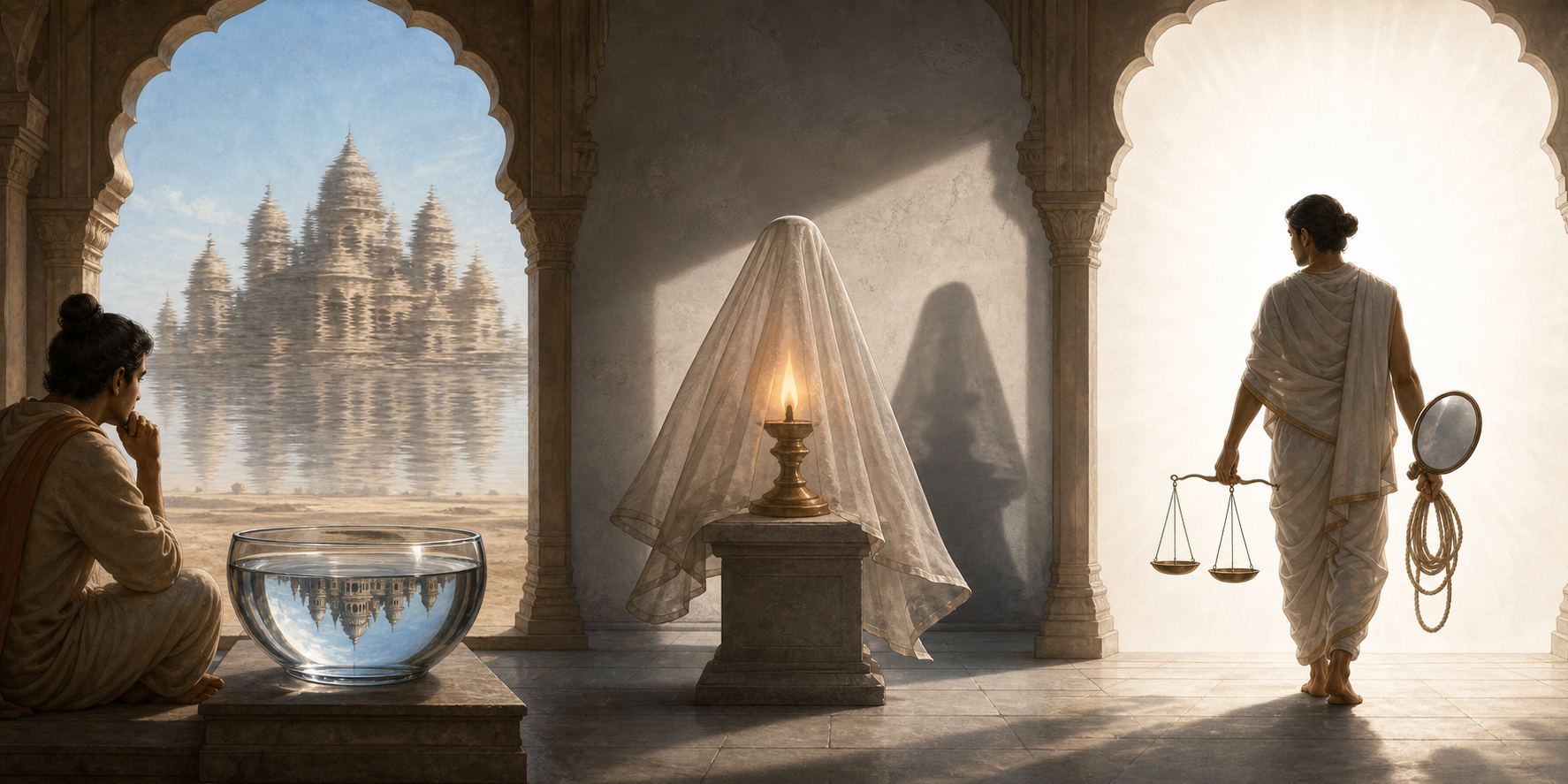
Vyasatirtha’s best-known criticisms do not amount to a casual assertion that ordinary experience must be correct in every case. Dvaita accepts that error occurs. The sharper question is whether error can be explained without relying on a real knower, a real basis for the mistake, and a later cognition capable of correcting it.
Can a local illusion explain the entire experienced world?
Consider the familiar case of mistaking a rope for a snake. The first cognition is erroneous, but correction becomes possible because there is a real rope, a misperception, and a later cognition that discloses what is present. Vyasatirtha presses the Advaita account of maya at this point. If the world is characterized as neither real nor unreal, or anirvachaniya, the account must still explain why the cognition establishing that status should be trusted.
The practical distinction is between a bounded illusion and a global theory of appearance. A bounded illusion relies on a wider field of reliable cognition: you recognize the rope, revise your belief, and act differently. A global theory cannot simply cite ordinary illusions and assume that the same explanation scales to the whole world. It must show what plays the role of the real substratum, who undergoes the error, and why the corrective knowledge escapes the problem attributed to earlier knowledge.
When you encounter an appeal to illusion, ask three questions: What is misperceived? Who misperceives it? What makes the correction valid? These questions do not, by themselves, prove every Dvaita conclusion. They identify an explanatory burden that a non-dual account must meet.
Where does avidya reside?
Avidya creates a second pressure point. If ignorance resides in Brahman, Brahman’s purity and perfection appear compromised. If it resides in the jiva, then the jiva must be sufficiently distinct from Brahman to possess ignorance that Brahman does not possess. Vyasatirtha uses this dilemma to argue that Dvaita can acknowledge limited knowers without placing limitation in the supreme reality.
Do not turn the dilemma into a slogan. Write the alternatives down and ask what each school means by locus, jiva, Brahman, and ignorance. A successful Advaita response must explain how avidya can be discussed without converting provisional individuality into ultimate difference. A successful Dvaita argument must show that its own account of finite cognition remains consistent with Vishnu’s supremacy and the jiva’s dependence.
The historical exchange did not stop with Vyasatirtha. Madhusudana Saraswati later answered through Advaita-siddhi, and Dvaita thinkers produced further rejoinders and sub-commentaries. That continuation should discipline your judgment. The objection generated a sustained Vedantic exchange; it did not make careful engagement with Advaita unnecessary.
Are divine qualities eternally true or provisionally attributed?
The nirguna-saguna distinction carries immediate consequences for worship. If nirguna Brahman is interpreted as strictly without qualities, scriptural descriptions of omniscience, compassion, and other auspicious attributes require an account of why they are affirmed. Dvaita treats such divine attributes as intrinsically and eternally real, not as projections that disappear with liberating knowledge.
When comparing interpretations, do not begin with an unexamined English gloss of nirguna. Ask what the school denies and what it affirms. Then examine whether its reading can preserve the force of scriptural names, predicates, and devotional address. Vyasatirtha generally favors direct meaning where it is contextually adequate and resists invoking figurative meaning merely to neutralize passages that affirm real divine qualities or difference.
See why realism changes bhakti and moksha
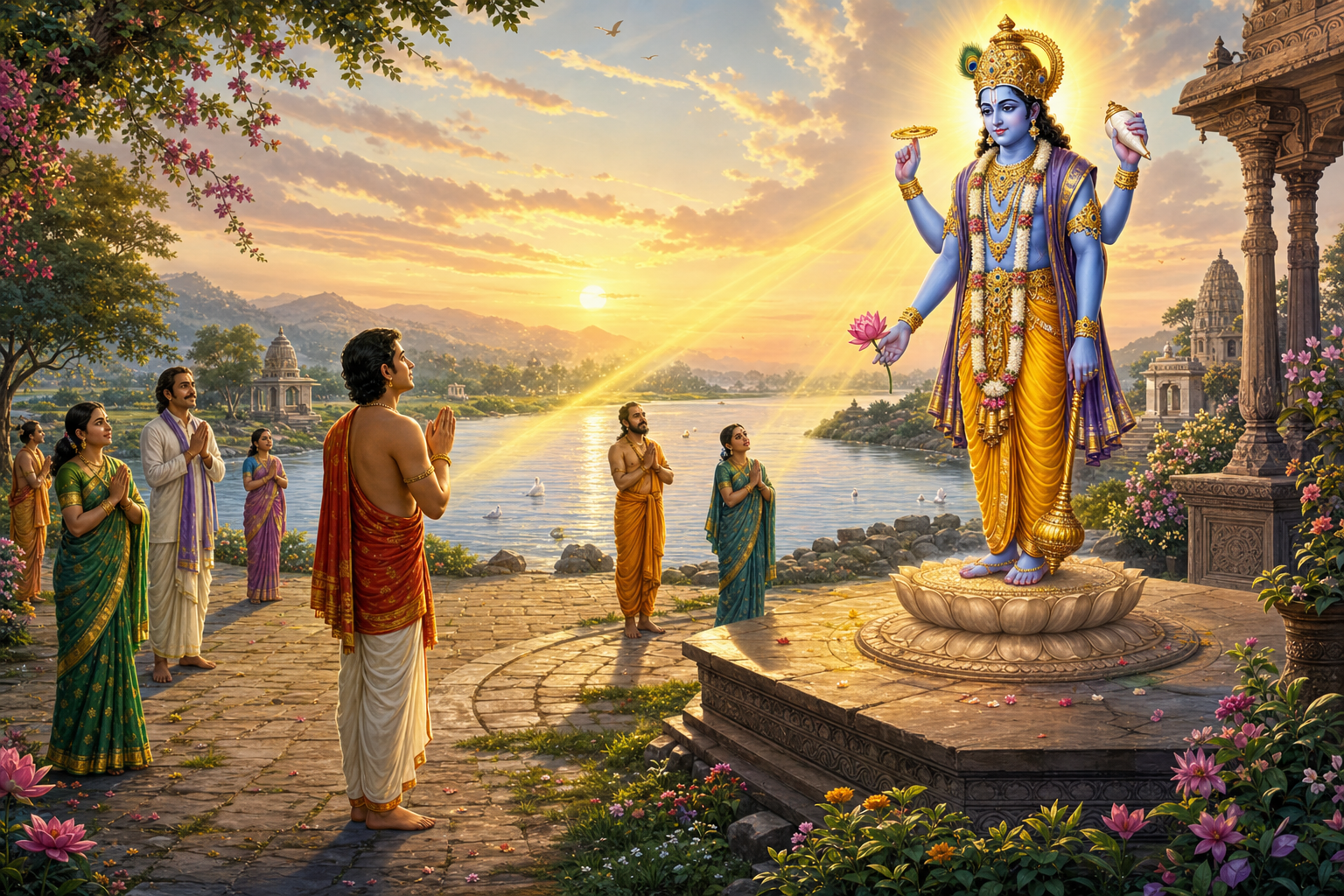
The debate matters because a metaphysics of difference produces a particular account of spiritual life. Under Dvaita, bhakti is not a provisional exercise directed toward a personal form that is ultimately left behind. A real jiva knows, loves, and depends upon a real supreme Lord whose auspicious qualities are eternally real.
Liberation therefore does not mean that the jiva discovers it was never distinct. Moksha is God-realization in which the jiva retains its identity and participates in divine bliss. Knowledge, devotion, ethical discipline, worship, and divine grace belong to one soteriological path rather than to disconnected stages with opposed truth-values.
You can test the practical force of this position through four questions:
- Prayer: Is the one addressed eternally real as a personal supreme being?
- Responsibility: Does the individual who acts remain a real moral agent rather than a temporary appearance?
- Grace: Is anugraha a real relation between Vishnu and the jiva, or language whose ultimate referents disappear?
- Liberation: Does freedom perfect the jiva’s relation with God, or dissolve the distinction that made devotion possible?
These questions reveal why Vyasatirtha spends so much effort on semantics and cognition. If distinctions among words, meanings, speakers, and referents were wholly unreal, successful communication and scriptural instruction would become difficult to explain. If correction is possible, some cognitions must disclose objects more adequately than others. If a command to worship carries truth, the identity of the worshipper and the reality of the worshipped cannot be dismissed without further argument.
This is also where philosophical disagreement should remain precise. Advaita, Vishishtadvaita, and Dvaita share sacred texts and the pursuit of moksha, but they do not mean the same thing by unity, difference, or liberation. Respect does not require pretending those distinctions are minor. A genuinely plural Dharmic culture can let each school state its strongest case while refusing hostility toward the people who reason differently.
Read Nyayamrita with discipline rather than sectarian slogans
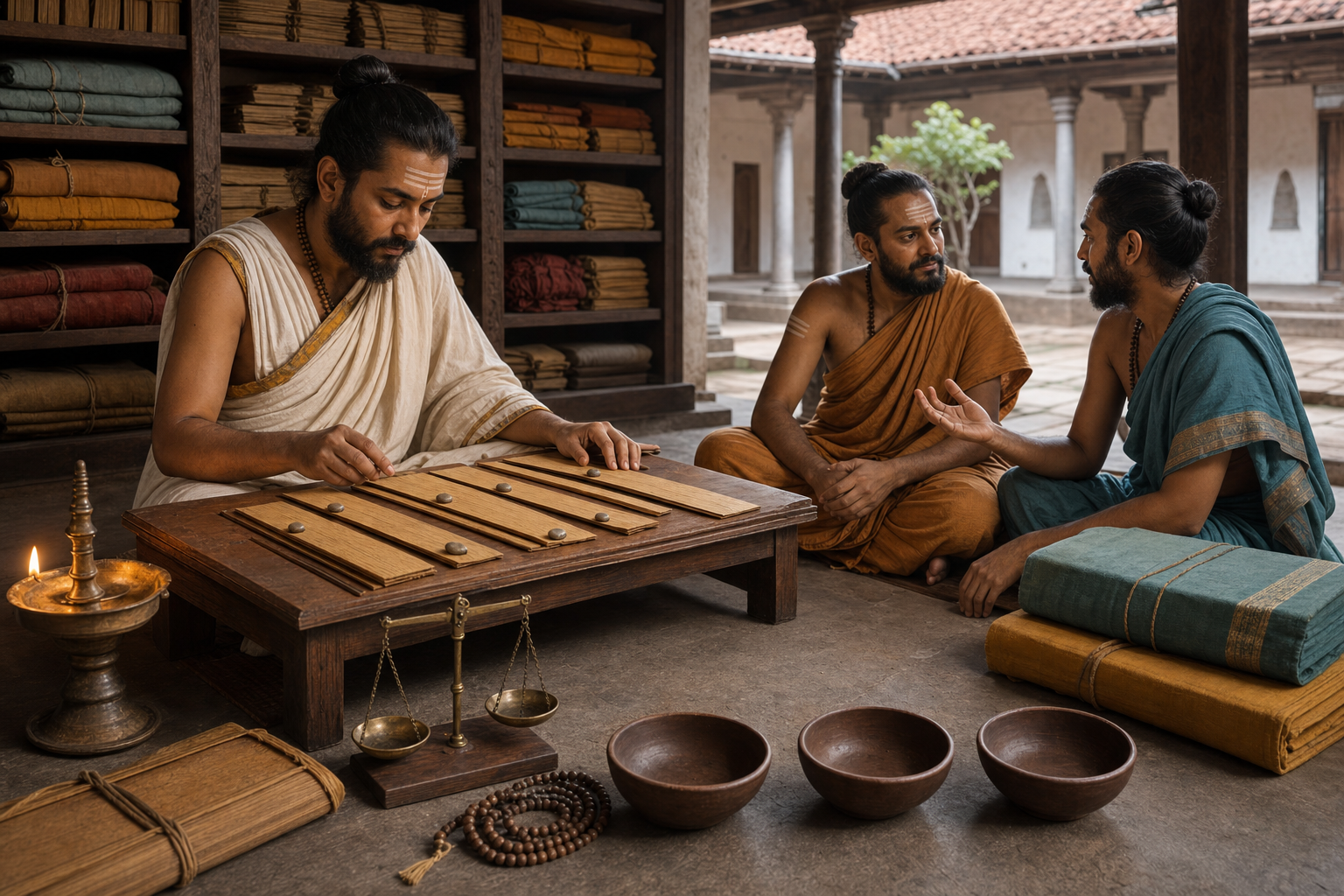
You do not need advanced Navya-Nyaya training before beginning, but you do need a method. Use the following sequence for one argument at a time.
- Define the disputed terms by school. Make separate entries for Dvaita and Advaita uses of bheda, maya, avidya, nirguna, jiva, and moksha. Do not assume that a shared Sanskrit word carries an identical metaphysical commitment.
- Identify the means of knowledge. Mark whether a premise comes from perception, inference, or scripture. If several pramanas are used, note how they are meant to support one another.
- Reconstruct the opposing position fairly. State it in a form that an informed adherent could recognize. If the position already contains a distinction between conventional and ultimate truth, include it before evaluating the criticism.
- Check for borrowed distinctions. Ask whether the argument denies difference while relying on a difference between ignorance and knowledge, appearance and reality, teacher and student, or bondage and liberation.
- Trace the spiritual consequence. Record what the conclusion means for worship, grace, ethical agency, scriptural authority, and the identity of the liberated jiva.
- Leave room for the reply. Separate Vyasatirtha’s objection, the Advaita response, and any Dvaita rejoinder. Do not compress a centuries-long debate into a declaration that one sentence ended it.
This procedure reflects the strongest civilizational lesson in Vyasatirtha’s work. Dharmic disagreement need not be vague to remain respectful. Precision can protect pluralism because it allows you to criticize a proposition without caricaturing a tradition or treating its adherents as enemies.
Key takeaways
- Dvaita treats difference as a real structure of existence, knowledge, language, devotion, and liberation.
- Panchabheda distinguishes Vishnu from jivas and prakriti, jivas from one another, material entities from one another, and jivas from matter.
- The illusion argument asks whether error and its correction already presuppose a real substratum and dependable cognition.
- The avidya problem asks where ignorance can reside without compromising Brahman or confirming a real difference between Brahman and the jiva.
- Dvaita understands divine qualities, bhakti, grace, and the liberated jiva’s identity as eternally meaningful.
- A careful reader should test pramanas, definitions, presuppositions, and soteriological consequences before choosing sides.
On your next reading, choose only one objection and complete the four-line claim, pramana, presupposition, and consequence worksheet. If you can then state both Vyasatirtha’s challenge and the strongest possible reply without blurring their differences, you have begun to read Nyayamrita in the spirit of disciplined Dharmic dialogue.