

You may be considering a promise to chant 16 rounds, or you may already be finishing your last rounds late at night with more anxiety than attention. The decisive question is not whether you felt sincere when you made the commitment. It is whether your ordinary life has a protected place for it.
A japa vow gives remembrance of Sri Krishna a fixed place when enthusiasm rises, falls, or disappears. Used well, the count steadies your practice without turning bhakti into a scorecard. This is how to assess your readiness, build a workable daily rhythm, chant with attention, and respond honestly when the rhythm breaks.
Understand what the vow is meant to accomplish
Sixteen rounds means 16 cycles of 108 mantra repetitions, or 1,728 repetitions of the Hare Krishna maha-mantra each day. Attentive completion commonly requires about 90 to 120 minutes. That number matters before you promise anything: you are not adding a vague spiritual intention to the day but reserving a substantial part of it for hearing Krishna’s names.
The count is a container, not the final measure of realization. It prevents the mind from quietly renegotiating the practice whenever work becomes demanding, sleep feels more attractive, or devotional taste is absent. Within that container, you learn to bring speech, hearing, posture, attention, and intention into the same act.
This is why a vow should be understood as pedagogical rather than merely juridical. It trains you. Sri Rupa Gosvami describes pure bhakti as favorable cultivation for Krishna, unobscured by competing ambitions. A daily vow translates that orientation into conduct: Krishna is not remembered only when the day happens to leave room.
The classical Gaudiya progression runs from sraddha, or faith, through sadhu-sanga and established practice, then through the clearing of impediments toward steadiness, taste, attachment, bhava, and prema. The vow does especially important work between anartha-nivritti and nistha. At that stage, inconsistency is not proof that the practice has failed. Inconsistency is one of the conditions the practice is training you to overcome.
Do not wait for ruci, spontaneous taste, before becoming steady. Nor should you pretend that steadiness automatically equals taste. Your immediate responsibility is simpler: make the daily encounter dependable enough that deeper attraction has somewhere to grow.
Key takeaways
- A vow protects japa on days when motivation cannot be trusted.
- Sixteen rounds require a real daily allocation of roughly 90 to 120 minutes.
- The fixed count is the minimum container for practice, not proof of spiritual attainment.
- Readiness means consistency during ordinary work, study, family, and travel conditions.
- If the practice breaks, honest repair is more useful than concealment or dramatic self-punishment.
Test your readiness on ordinary days, not exceptional ones

A retreat, festival, temple stay, or unusually peaceful week can show you what concentrated practice feels like. It cannot by itself show that you are ready for a lifelong vow. Readiness appears on the crowded weekday, the morning after poor planning, and the day when chanting feels dry.
Before making a formal commitment, keep a plain record of when you begin, when you finish, and what repeatedly interferes. You do not need an elaborate application. You need an honest picture of whether the proposed practice fits your real life. If most rounds are continually pushed into the least alert part of the night, the problem is not solved merely because the numerical total is sometimes reached.
Use these questions as a readiness audit:
- Can you reserve the time? Your calendar should contain an actual 90-to-120-minute plan, whether in one block or predetermined parts.
- Can the practice survive a normal week? Include employment, study, caregiving, commuting, household duties, and your usual need for sleep.
- Do you know your recurring obstacles? Name them precisely: late bedtime, phone use, unplanned morning tasks, travel, social commitments, or postponement after the first block.
- Are the four regulative principles already reflected in your conduct? A promise to abstain from meat-eating, intoxication, illicit sexual activity, and gambling should describe an established direction of life, not a hope concealed behind ceremonial language.
- Can you report difficulty without managing your image? Initiation requires transparency as well as enthusiasm. If you can discuss completed rounds but hide recurring failures, accountability has not yet become functional.
- Can you state your sankalpa in one sentence? Write why you want this vow in terms of remembrance, service, purification, or fidelity to guru and Krishna. A reason based mainly on status or social pressure will not support you for long.
The four regulative principles and the japa vow are one discipline, not five unrelated requirements. Abstaining from meat supports ahimsa and compassion. Sobriety protects clarity. Responsible sexual conduct supports purity and self-command. Abstaining from gambling protects truthfulness and steadiness from the appetite for chance, gain, and agitation. Together, these guardrails reduce the turbulence that you would otherwise carry directly into japa.
This pattern belongs to a wider dharmic understanding of vows. Buddhist precepts, Jain anuvratas, and Sikh disciplines also connect contemplation with non-harming, truthfulness, restraint, and sobriety. The forms differ by lineage, but the practical insight is shared: the mind cannot be trained for remembrance while the rest of life is organized around heedlessness.
If you are preparing for initiation, do not make yourself the sole judge of readiness. The guru-sisya relationship is reciprocal: the guru provides mantra, method, and correction, while the disciple offers practice, service, and truthful self-assessment. In many Gaudiya communities, harinama initiation may later be followed, where appropriate, by mantra or brahminical initiation. Each stage brings responsibilities that should be understood before they are accepted.
Modern household, educational, and professional responsibilities may change how you arrange the practice, but they do not make an unsustainable promise more spiritual. Bring your actual schedule to a trusted guru or authorized mentor. Ask where the proposed rhythm is weak before the vow makes those weaknesses costly.
Build a japa schedule that can survive your real life

The phrase chant in the morning is too imprecise to protect a vow. A workable plan identifies a start point, a location, the number of rounds in each block, and a fallback for foreseeable disruption. If any of those remains undecided, the decision will return when your attention and willpower are already under pressure.
Build the schedule in this order:
- Choose the quietest repeatable window. For many practitioners this is early morning, before messages, work, and household demands begin. The best window is not merely quiet once; it is available with reasonable consistency.
- Reserve the full amount of time. Put 90 to 120 minutes into the day rather than assuming the rounds will fit into unused fragments. Include enough margin that a slightly slower pace does not immediately create panic.
- Decide whether you need one block or a planned split. A single block reduces the risk that unfinished rounds will follow you through the day. If your duties make that impractical, assign exact rounds to two dependable windows, such as a larger morning block and a smaller block before a fixed later commitment.
- Create a fallback before disruption arrives. Know what you will do on travel days, early workdays, or mornings dominated by family needs. A fallback is a specific rearrangement of the same commitment, not permission to leave the remaining rounds to chance.
- Prepare the physical setting. Keep your beads, bead bag, seat, and any simple tracking aid in the same accessible place. Remove the need to search, charge, install, or decide before you begin.
- Move the phone out of the field of attention. Silent notifications can still pull the mind toward anticipated messages. If you use the phone only as a counter or timer, disable interruptions and avoid opening unrelated applications between rounds.
- Record each round promptly. Reliable bead or counter tracking prevents uncertainty near the end of a long session. It also stops the mind from turning counting itself into the main object of meditation.
A split schedule is useful only when both parts are protected. Morning rounds plus whatever remains later is not yet a plan. Name the later start point and place it before an existing obligation rather than after an open-ended evening. Otherwise every delay in the day will be transferred to japa.
If the morning slot repeatedly fails because you sleep too late, the repair belongs partly to the preceding evening. Prepare the beads, settle avoidable tasks, and protect the bedtime that makes attentive chanting possible. A morning vow cannot be maintained entirely by decisions made after waking.
Temple life once supplied many practitioners with an immersive ecology of kirtan, deity service, study, prasadam, and constant association. A householder or student may need to construct smaller versions of those supports deliberately. A fixed weekly gathering, a dependable study time, and regular contact with a mentor can keep solitary japa connected to a living community of practice.
Protect hearing without turning attention into another score
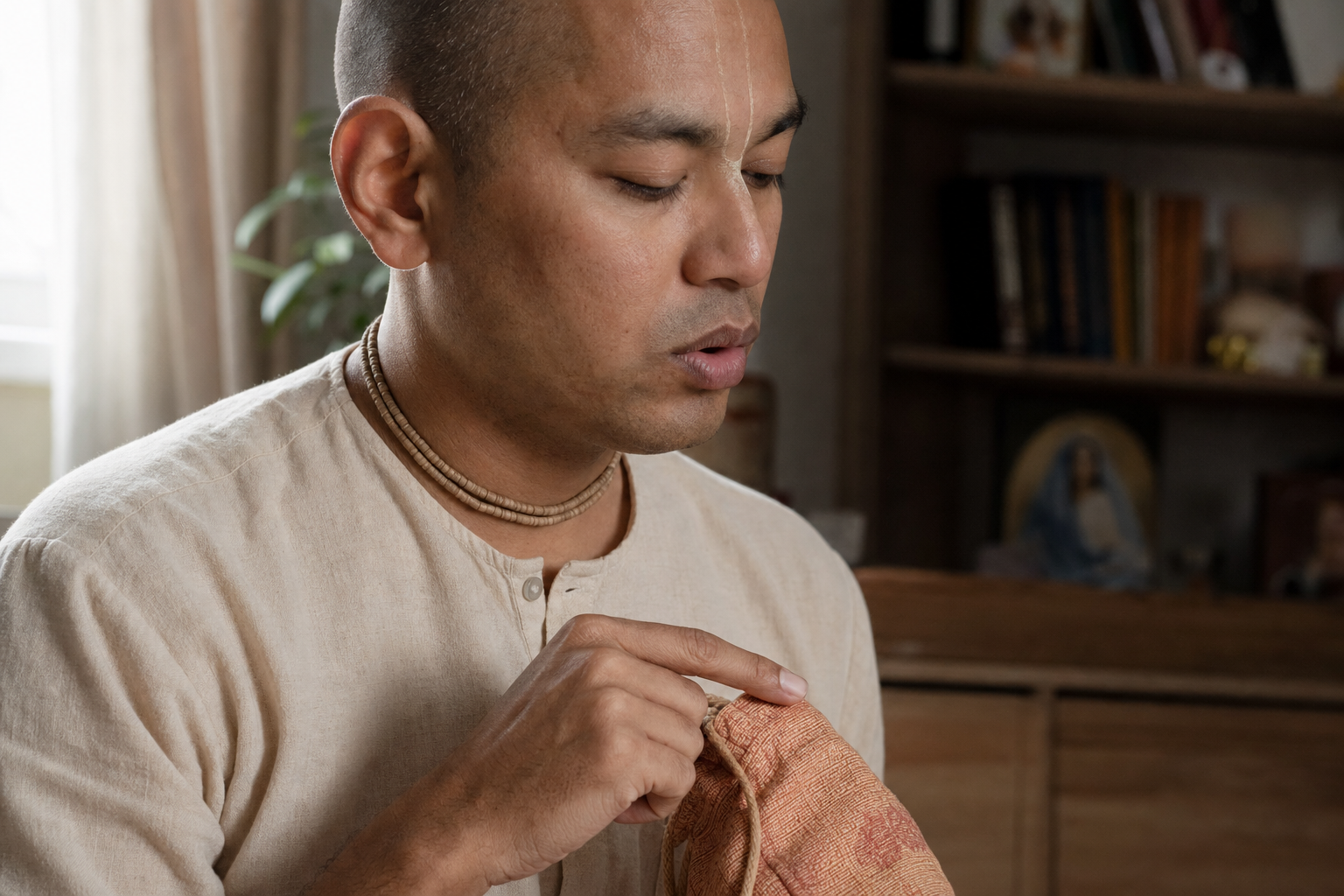
Completing the count carelessly and abandoning the count in search of a perfect meditation are opposite mistakes. The vow protects continuity; attentive hearing gives that continuity devotional direction. You need both.
At the beginning of a session, settle into a stable posture and let the breath become natural. Pronounce the complete maha-mantra clearly enough for your own ear to follow it. Move one bead for each repetition. The basic task is not to manufacture an elevated emotion but to hear the names you are speaking.
Your mind will wander. The useful moment is the moment you notice. Return to the words currently being chanted instead of spending the next several repetitions arguing with yourself about the distraction. That return is part of attentional training, not evidence that the round has been ruined.
Watch for three common distortions:
- Rushing to protect the total: When the session starts too late, pronunciation and hearing are often sacrificed to the clock. Repair the start time instead of normalizing hurried japa.
- Monitoring your spiritual mood: Continually asking whether the chanting feels deep replaces hearing with self-observation. Let quality mean faithful attention to the mantra, not a dramatic internal state.
- Combining japa with information intake: Messages, news, videos, and work tasks give the senses competing objects. Walking may sometimes be necessary, but scrolling or conducting business while chanting fractures the very attention the vow is meant to train.
Use the end of each round as a light checkpoint. Notice whether you could hear the mantra, whether the pace became hurried, and whether a recurring thought needs to be written down for later. Then continue. Lengthy self-analysis between rounds can become another form of avoidance.
Japa also needs nourishment outside the japa period. Kirtan renews the experience of the holy name as shared praise rather than private labor. Sastra study gives the mind substance to remember. Sadhu-sanga corrects the private narratives that make discouragement seem uniquely convincing.
Prasadam works through another doorway. Krishna consciousness does not require you to treat every sense as an enemy; it teaches you to redirect the senses through sanctified engagement. Honoring wholesome prasadam can support a simpler, steadier life while reminding you that pleasure itself may be brought into service. This same principle should shape your japa: attention is redirected toward Krishna, not crushed by hostility toward the mind.
Repair a broken rhythm with truth, not drama

A missed round or broken day requires a response, but shame rarely produces an intelligent one. Two reactions are especially unhelpful: hiding the lapse so that your devotional identity remains intact, or making an extreme compensatory promise that creates the next failure.
Do not assume that there is one universal formula for making up a formal vow. Resume at the earliest realistic opportunity, then ask your guru or authorized mentor how the lapse should be addressed. The instruction may depend on the commitment you made and the guidance of your lineage. Inventing private penances can look serious while avoiding the accountability that initiation actually establishes.
Use this repair sequence:
- State what happened without euphemism. Record how many rounds were completed and where the plan broke.
- Identify the immediate cause. Ran out of scheduled time is useful. Life became busy is not. Name the event or decision that displaced the practice.
- Correct the structure. Move the start earlier, remove the phone, prepare for travel, divide the rounds deliberately, or change the preceding evening.
- Resume without waiting for a symbolic fresh start. A new week, holy day, or burst of inspiration is unnecessary. The next protected session is the point of return.
- Report recurring difficulty. If the same obstacle appears again, bring the pattern to your mentor rather than presenting each lapse as an isolated accident.
Different obstacles call for different repairs. If you consistently run out of time, measure the actual duration and reserve the full window. If fatigue dominates, protect an earlier slot and examine the night before. If travel disrupts the ritual, pack the beads where they remain accessible and assign the rounds before the travel day begins. If devotional taste has weakened, preserve the count while adding supportive kirtan, study, and sadhu-sanga rather than waiting passively for inspiration.
A breach of one of the four regulative principles also deserves direct disclosure. Those principles protect the same clarity and integrity that japa requires. Concealment divides the outward practitioner from the inward life; honest guidance begins bringing them together again.
If you have not yet made the vow, do not use fear of future failure as a reason to remain indefinite. Establish a consistent daily practice, test it under ordinary conditions, and let a qualified mentor assess the pattern with you. Preparation is not hesitation when it is producing evidence of readiness.
Before tomorrow, write your one-sentence sankalpa, choose the exact start point, place your beads where you will sit, and tell one responsible person what you are practicing. The vow begins to transform you when Krishna’s names no longer receive whatever time survives the day, but the time you deliberately give them.