

You may already avoid plastic during puja, keep water out for birds in summer, or feel uneasy when food offered with devotion ends up in the bin. Yet a harder question remains: do these acts amount to an ecological way of life, or are they isolated gestures inside an otherwise extractive routine?
Dharmic ecology offers a firm test. A practice should reduce avoidable harm, restrain unnecessary consumption, restore a living system, or organize people to serve it. Reverence begins the relationship; disciplined choices make that relationship real.
Reverence must change your relationship with nature
In Hindu thought, Prakriti is not a decorative name for pleasant scenery. It is the dynamic matrix of embodied nature. Vedic and Sankhya frameworks describe the living world through the pancha-mahabhuta—earth, water, fire, air, and space—while sattva, rajas, and tamas describe qualities and tendencies within manifested life. The principle of rta places natural order and moral responsibility within the same field.
Calling nature mother therefore carries an obligation. A mother is not honoured by affectionate language while her soil is depleted, her waters are used as drains, and her gifts are routinely wasted. The maternal image asks you to receive with gratitude, live within limits, and return care to the systems that sustain you.
Modern ecology uses another helpful vocabulary. Nature supplies provisioning, regulating, cultural, and supporting services: food and medicines, climate and water regulation, spiritual and aesthetic nourishment, soil formation, nutrient cycles, and habitats that make other life possible. This language reveals how thoroughly human life depends on functioning ecosystems. Dharmic language adds the missing ethical question: what do we owe in return?
The Dharmic traditions should not be flattened into a single philosophy. Buddhist dependent co-arising is not another name for Sankhya metaphysics. Jain ahimsa and aparigraha arise from a distinct account of life, action, and bondage. Sikh seva and Sarbat da Bhala belong to a tradition centred on service, remembrance, equality, and the welfare of all. Yet these teachings confront the same ecological blind spot from different directions: the belief that we can take benefits while remaining separate from the harm imposed on other beings and shared conditions.
Before a purchase, meal, journey, festival plan, or building decision, ask:
- Is this meeting a genuine need, supporting a sacred purpose, or merely repeating a habit?
- Which beings, soils, waters, and communities bear its hidden cost?
- Can the need be met with less material, less energy, or something already available?
- Can an item be borrowed, repaired, refilled, shared, or reused instead of replaced?
- What reciprocal act would benefit the same living system from which we receive?
This turns gratitude from a feeling into a method of decision.
Audit your daily life through the five elements

An environmental checklist can become so broad that nothing changes. The pancha-mahabhuta provide a more legible frame. Walk through a place you can actually influence—a home, shrine, community kitchen, farm, school, or office—and sort what you observe under the elemental headings below.
Use this as an ethical map for attention, not as a replacement for ecological science. The purpose is to notice flows that routine has made invisible.
| Element | What to notice | A practical response |
|---|---|---|
| Earth | Food, soil, packaging, decorations, construction materials, plant choices, and discarded matter | Prevent food waste, compost suitable organic material, protect soil, favour appropriate native plants, and support farms that build soil and biodiversity |
| Water | Drinking, cooking, cleaning, ritual use, rainfall, runoff, storage, and contaminated discharge | Repair avoidable losses, prevent contamination, harvest rain where suitable, and support waterway or watershed restoration |
| Fire | Energy used for cooking, lighting, heating, cooling, transport, and ceremonies | Remove avoidable demand, maintain equipment, and redesign repeated routines so they require less energy |
| Air | Smoke, dust, ventilation, traffic emissions, tree cover, and the effect of heat on shared spaces | Avoid burning waste, reduce preventable pollution, and protect appropriate trees and canopy |
| Space | Permeable ground, habitats, corridors, shade, quiet, and room shared with other forms of life | Retain permeable surfaces, protect habitat connections, and reserve space for living systems rather than covering every available patch |
Record flows rather than good intentions. For each heading, note what enters the place, how it is used, what leaves, and where it goes. In a kitchen, for example, distinguish ingredients purchased, food served, preventable leftovers, unavoidable scraps, and packaging. That makes the failure point visible. A generous meal and a disciplined kitchen are entirely compatible.
Ayurveda applies similar attentiveness at the scale of the body. Ritucharya and dinacharya align habits with seasonal and daily conditions, including heat, cold, dryness, and humidity. Agni, ojas, and prana give this adaptation an embodied vocabulary. For ecological practice, the relevant lesson is not self-treatment. It is to work with conditions: prefer seasonal menus where feasible, schedule demanding outdoor activity sensibly, collect rain when it arrives, and choose crops or plants suited to their place. Personal health decisions still require appropriate individual guidance.
End the audit by choosing a flow that is repeated, materially significant, and within your authority. Do not make tree planting the centrepiece if nobody can protect and maintain the saplings. If you control the kitchen but not the grounds, reducing food waste may be the more honest beginning.
Put ahimsa and aparigraha before green consumption

Many environmental efforts begin with substitution: buy a different cup, bag, decoration, or packaged product. Some substitutions are worthwhile, but buying a greener object is still an act of acquisition. Ahimsa asks first whether harm can be avoided. Aparigraha asks whether the object is needed at all.
A useful order of action is:
- Avoid: remove an unnecessary purchase, journey, disposable item, or source of pollution.
- Reduce: meet the same purpose with fewer materials and less energy.
- Keep in use: maintain, repair, refill, share, and reuse what already exists.
- Return: compost suitable organic matter, retain rain, and return fertility rather than exporting every residue as waste.
- Restore: rebuild soil, nurture native trees, improve habitat, or help repair a waterway.
- Serve together: use seva to make the practice communal and durable.
No material choice is impact-free. An object may look benign at the point of use while carrying costs in production, transport, cleaning, maintenance, or disposal. Jain anekantavada is valuable here. Its many-sided approach to truth does not excuse indecision; it warns you against treating a partial view as the whole.
When comparing options, examine the entire practical life of the choice. Ask who makes it, what resources it consumes, how often it will be used, who maintains it, and what happens when it can no longer serve its purpose. A reusable festival decoration that remains in service is more faithful to aparigraha than a newly purchased object marketed as sustainable but discarded after the celebration.
Yajna also offers an important moral pattern: receiving and offering belong to one cycle. This does not reduce a sacred rite to an environmental metaphor. It does show why consumption without reciprocity is spiritually incomplete. A contemporary offering may involve surrendering convenience, prestige, excess decoration, or the desire to display abundance through waste.
For a festival or public observance, settle the material plan before ordering begins. Choose decorations that can remain in use, remove avoidable plastic, decide how flowers and food will be handled, provide an appropriate collection system, and assign the cleanup. A cleanup announced after the event is already too late; disposal choices were built into the purchasing decisions.
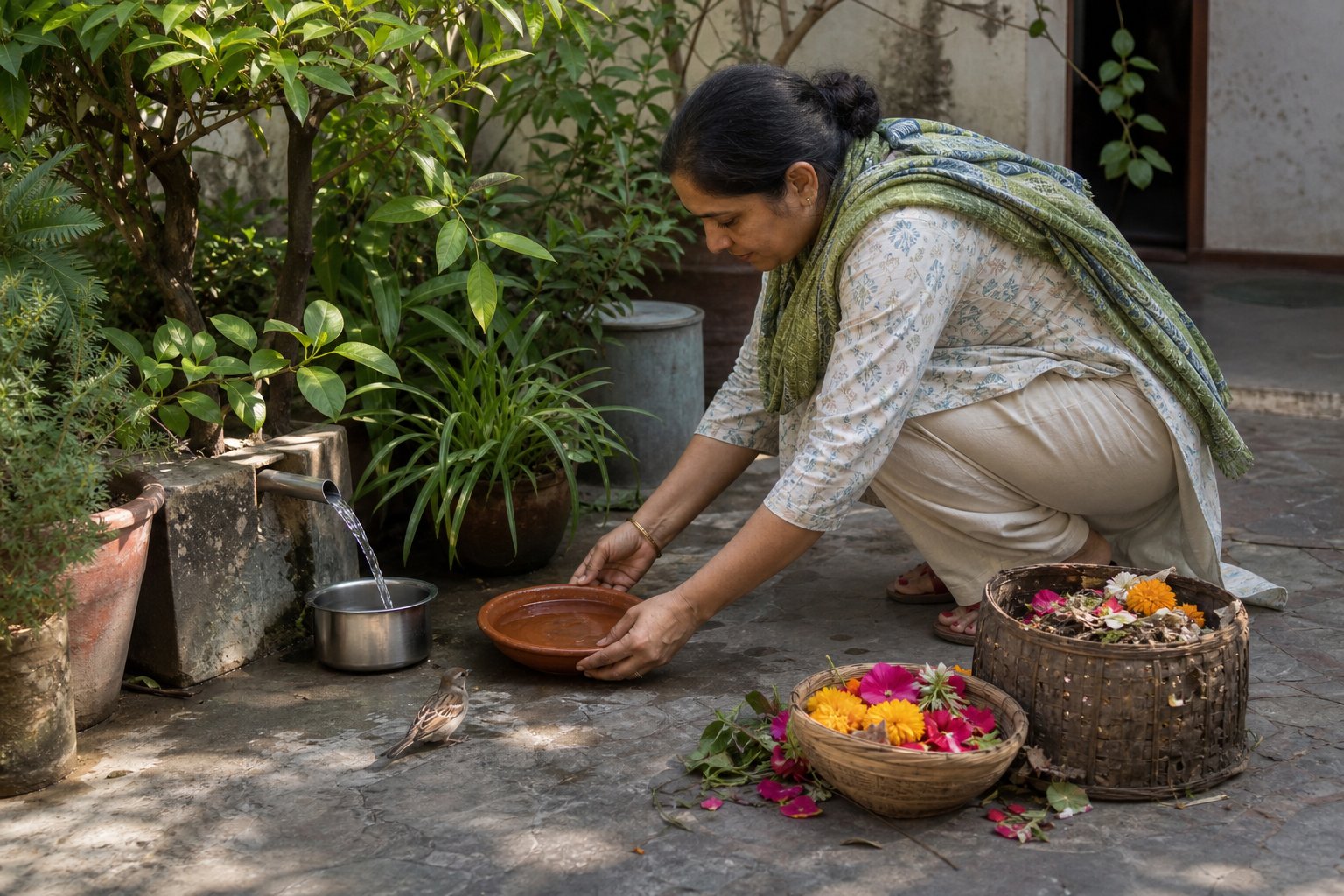
Small household customs still matter. Offering food to birds, keeping water available during summer, and composting kitchen scraps train attention toward beings outside the household. Their value lies in consistency and care. They should not become symbolic payments that excuse preventable waste elsewhere.
Use this test whenever an activity is presented as eco-friendly:
- Does it prevent extraction or merely require another purchase?
- Will the material remain useful through repeated cycles?
- Has someone accepted responsibility for maintenance?
- Can the ecological result be observed rather than assumed?
- Does the convenience for participants transfer a burden to animals, neighbours, sanitation workers, or a waterway?
Make seva part of the institution, not an occasional event
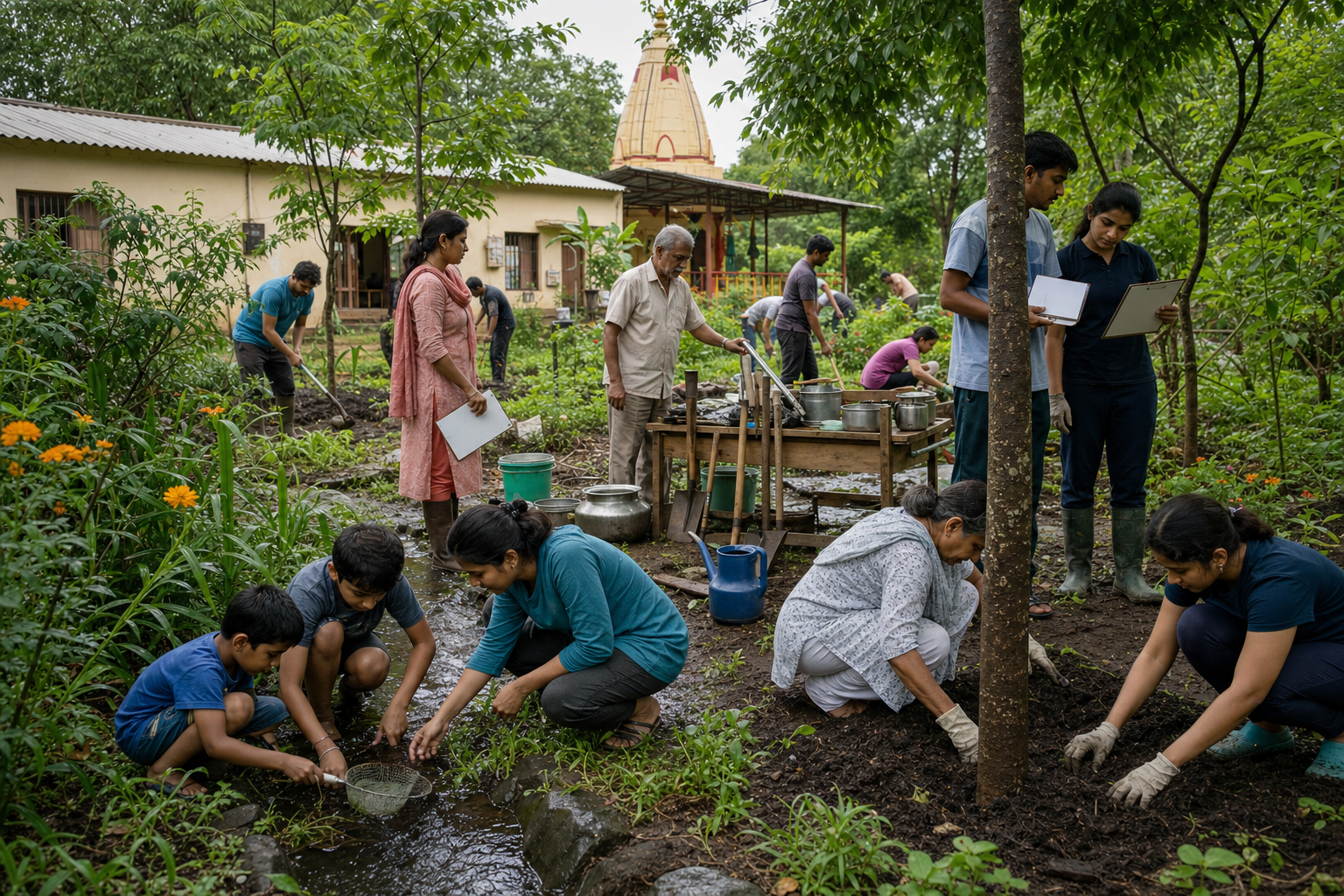
Personal virtue matters, but a household cannot create a biodiversity corridor, establish a watershed plan, or enact a right-to-repair framework. Institutions determine what becomes normal. Temples, gurdwaras, schools, farms, associations, and municipalities can turn care from a private preference into a shared practice.
Temples, gurdwaras, and community kitchens
Food service is an immediate place to begin because its flows are visible and repeated. Seasonal menus, responsible local sourcing where feasible, careful procurement, durable serving systems, and well-managed leftovers can join hospitality with restraint. A zero-waste aspiration is credible only when the institution understands where each material actually goes.
- Map the materials entering through cooking, offerings, worship, cleaning, and public events.
- Track food purchased, portions served, edible food left over, and unavoidable scraps.
- Use durable servingware only when washing, storage, and maintenance can support it reliably.
- Create clear streams for edible surplus, compostable matter, recoverable materials, and residual waste.
- Give a named role or committee responsibility for the system after the launch ceremony has passed.
- Report what changed in procurement and disposal, not merely how many volunteers attended a cleanup.
Seva becomes ecological when it improves the underlying flow. Collecting litter is worthwhile; preventing the recurring litter stream is better. Planting trees is worthwhile; selecting appropriate species, protecting the planting site, and maintaining living trees is the actual commitment.
Schools, farms, and public authorities
A school can pair the pancha-mahabhuta with field observation. Students can trace where rain travels across the grounds, map shade, examine soil, document nearby species, and follow food waste from meal to final destination. Scientific observation and reverence then reinforce each other without forcing spiritual language to substitute for evidence.
Farmers and food buyers can focus on soil-building, water conservation, seed diversity, and biodiversity-friendly production. A buyer who asks only about price misses the ecological relationship. Ask how soil is maintained, how water is managed, how crop diversity is protected, and whether purchasing terms reward or undermine those practices.
Municipal action belongs at the scale of the system. Tree canopies, permeable ground, and blue-green infrastructure help cities work with water and heat rather than simply forcing both elsewhere. Biodiversity corridors respond to the movement of species across boundaries. Watershed planning follows water across administrative lines. Repair, reuse, and refill systems keep useful material circulating instead of treating disposal as the default.
Anekantavada offers a sound process for these decisions. Residents, farmers, sanitation workers, ecologists, administrators, and religious institutions see different parts of the same problem. Their perspectives will not automatically agree, but excluding any affected viewpoint makes an avoidable blind spot more likely.
Every institutional pledge needs a defined material flow, a baseline, a custodian, a maintenance routine, and a review point. If a committee cannot say who will maintain a rainwater system, composting area, or planting site, it is not ready to announce the project. Quiet preparation is part of seva.
Key takeaways
- Sacred language becomes ecological practice only when it changes how you obtain, use, maintain, and return material things.
- Hindu, Buddhist, Jain, and Sikh teachings remain philosophically distinct, but each can discipline the illusion that human welfare is separate from the living world.
- Use earth, water, fire, air, and space as headings for an audit of the places you can influence.
- Apply ahimsa and aparigraha before buying a greener substitute: avoid harm, reduce demand, and keep existing things in use.
- Let yajna shape reciprocity, anekantavada improve decisions, and seva make good practices durable.
- Judge a project by maintained outcomes—less waste, healthier soil, retained water, surviving habitat, or lower material demand—not by the ceremony that launches it.
Begin where you already have authority. In the next regular cycle of your home, kitchen, temple committee, langar, school, farm, or workplace, write down the five elemental headings. Identify the most avoidable recurring flow. Choose the response that requires the least extraction, assign its maintenance, and observe what actually changes.
If the practice works, make it the default. If it fails, examine the neglected viewpoint or missing responsibility and revise it. That is how care for Mother Nature moves beyond sentiment: a vow becomes a habit, a habit becomes a shared norm, and the shared norm begins to repair the relationship.