
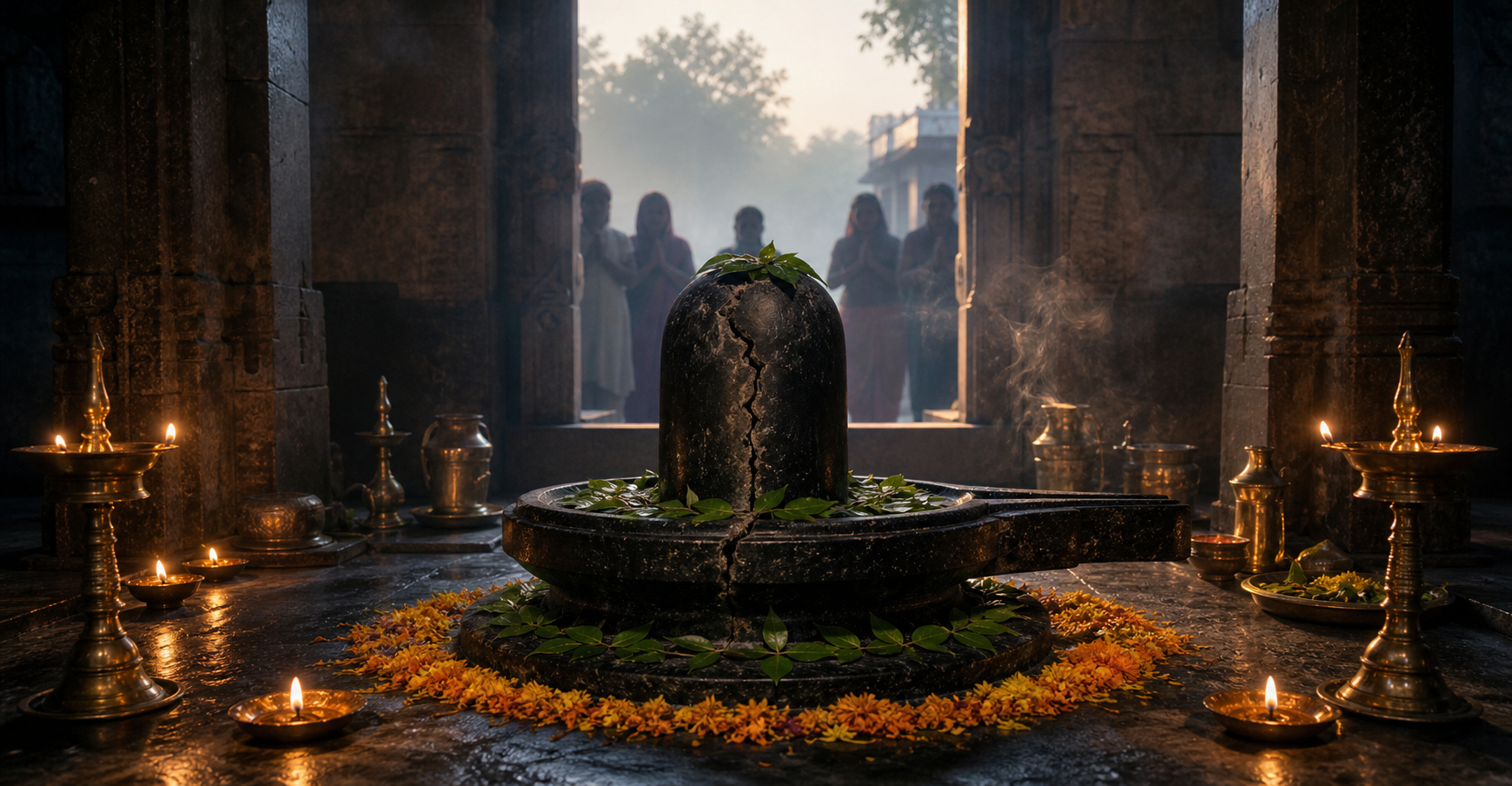
If you have been told that a broken Shivling must never be worshipped, Kaleshwar Mahadev at Kada Dham can look like a contradiction. It isn’t. The temple makes sense once you distinguish a general rule for consecrated forms from the authority of an old sacred place whose worship never ceased.
That distinction matters before you visit the temple, discuss its history, or cite it as an example of Hindu ritual practice. Kaleshwar Mahadev is neither permission to disregard damage to any Shivling nor an embarrassment that has to be explained away. It is a living tradition sustained by local memory, priestly practice, daily worship and careful treatment of the surviving form.
Key takeaways
- Shaiva ritual norms generally regard a broken consecrated linga as deficient, ordinarily calling for repair or respectful replacement followed by renewed consecration.
- Kaleshwar Mahadev belongs to a continuously worshipped local tradition, so its status cannot be decided by examining the fracture alone.
- Local sacred memory connects the Shivling with Yudhishthira and the Mahabharata period, while the precise historical cause of the damage remains unverified.
- During darshan, follow the temple’s own maryada: handle offerings gently, respect protective coverings and do not treat the fracture as a curiosity to be touched or tested.
- Preserving the Shivling means protecting both the material object and the community’s unbroken ritual relationship with Mahadev.
Why a broken Shivling can remain the centre of worship
The apparent conflict begins with a real ritual principle. Shaiva Agamas and temple manuals are generally exacting about the condition of a consecrated form. A bhagna-linga, or broken linga, is normally considered ritually deficient in a formal installation. Repair or respectful replacement, followed by punar-pratishtha, is therefore the usual response.
This rule is not a judgement that Shiva has somehow become damaged. It safeguards the integrity of worship and prevents negligence toward a form that has been ritually established. Material care matters precisely because the Shivling is not being handled as ordinary stone.
Yet dharmic practice also reasons through desha-kala-patra: place, time and circumstance. At Kada Dham, the decisive circumstance is continuity. The fractured Shivling remains the focus of daily worship and an established local maryada. Priestly practice, communal memory and repeated acts of devotion did not disappear when the material form was damaged.
This does not abolish the Agamic rule. It shows how a general norm and a particular sacred inheritance can be held together. Formal standards identify the defect; the living tradition determines how worship proceeds at this site, including any protective or compensatory rites considered necessary by its custodians.
If a Shivling in your home or a temple under your care breaks, do not use Kaleshwar Mahadev as automatic permission to continue exactly as before. Ask a qualified priest familiar with that installation and its sampradaya. The circumstances of a newly damaged household linga are not identical to those of an old tirtha sustained by generations of worship.
The theology of the linga helps explain why continuity is possible. A Shivling is an aniconic sign of Shiva, not a portrait whose identity depends on every visible feature remaining intact. It evokes the cosmic axis and the reality that exceeds name and form. The fracture belongs to the material surface; it does not divide Shiva. Kaleshwar’s worshippers can therefore take the damage seriously without treating Mahadev as spiritually diminished.
Separate sacred memory from claims about material history
Kada Dham stands in Kaushambi, an ancient region associated with the Vatsa mahajanapada and shaped by several dharmic currents. Its local sthala-purana connects the Shivling with Dharmaraja Yudhishthira. During the Pandavas’ agyatavasa, Yudhishthira is remembered as having established the linga, worshipped Shiva and consecrated it with water from the Ganga.
That account tells you how the community understands the place. Yudhishthira represents righteous resolve, while Ganga-jal joins purity, consecration and Shaiva abhisheka. A sacred history can guide pilgrimage and ritual identity even when it cannot be dated through an inscription.
The damage requires more careful wording. Local oral histories sometimes associate it with turbulence during the Mughal period, but firm epigraphic or archival confirmation of the exact episode is limited. It is therefore reasonable to describe the inherited account as an oral tradition. It is not reasonable to turn an uncertain attribution into a documented date, named attack or verified sequence of events.
When you explain Kaleshwar Mahadev to someone else, keep three kinds of claim distinct:
- Present, observable tradition: a fractured Shivling at Kada Dham remains under regular worship.
- Sacred local memory: the sthala-purana associates its establishment with Yudhishthira, the Pandavas’ period of concealment and Ganga-jal.
- Historically unresolved attribution: oral accounts sometimes place the damage amid later conflict, including the Mughal period, without firm evidence for the precise event.
This distinction protects both faith and credibility. You need not belittle inherited memory because an archive is incomplete. You also need not overstate the evidence to defend Hindu continuity. The strongest historical fact here is the survival of worship after disruption, whoever caused the fracture and whenever it occurred.
How to approach darshan without harming the Shivling
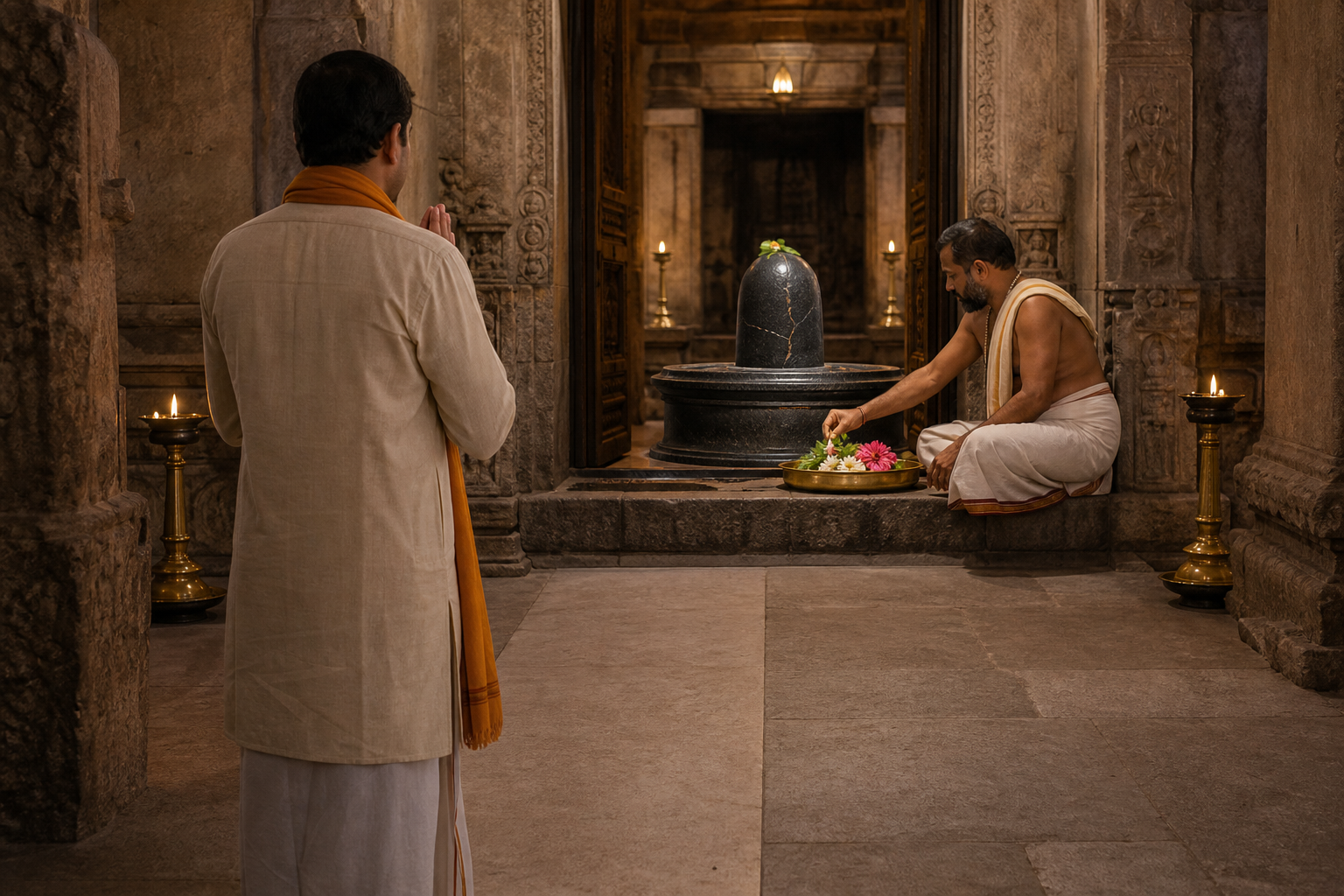
Kaleshwar Mahadev is a place of worship before it is an object of historical interest. The right pilgrim posture begins with that ordering. Go for darshan, listen to the priests and let the temple’s own practice determine what you may offer or touch.
- Observe before acting. Do not assume that a familiar practice from another Shiva temple applies in exactly the same way here. Follow local instructions concerning entry, offerings, abhisheka and physical contact.
- Offer liquids gently. Worship may include jalabhisheka with Ganga-jal and offerings of panchamrita, but a fractured surface requires mindful handling. Pour only as directed; do not press, rub or probe the damaged area.
- Respect any protective covering. A kavacha may be used to reduce stress on a vulnerable linga. Never lift or reposition it to obtain a clearer view.
- Use offerings as worship, not decoration. Bilva-patra, the mantra Om Namah Shivaya and arati direct attention toward Mahadev. They are not reasons to crowd the sanctum or manipulate the linga for a photograph.
- Keep circumambulation quiet and touch restrained. The local character of the shrine is contemplative. A soft pradakshina and a simple kshama-prarthana, asking forgiveness for any inadvertent fault, are more appropriate than inspecting the fracture as a spectacle.
Confirm current timings and offering rules locally before travelling, because these are practical details that can change. If the priest asks you not to perform a personal abhisheka, accepting that instruction is itself part of your seva. Devotion does not require access to every ritual action.
The fracture can sharpen the quality of darshan when you stop trying to look past it. Mantra, water, bilva and the light of arati do not pretend that the damage is absent. They place it within a relationship that history did not manage to end.
What is protected when the old form is retained
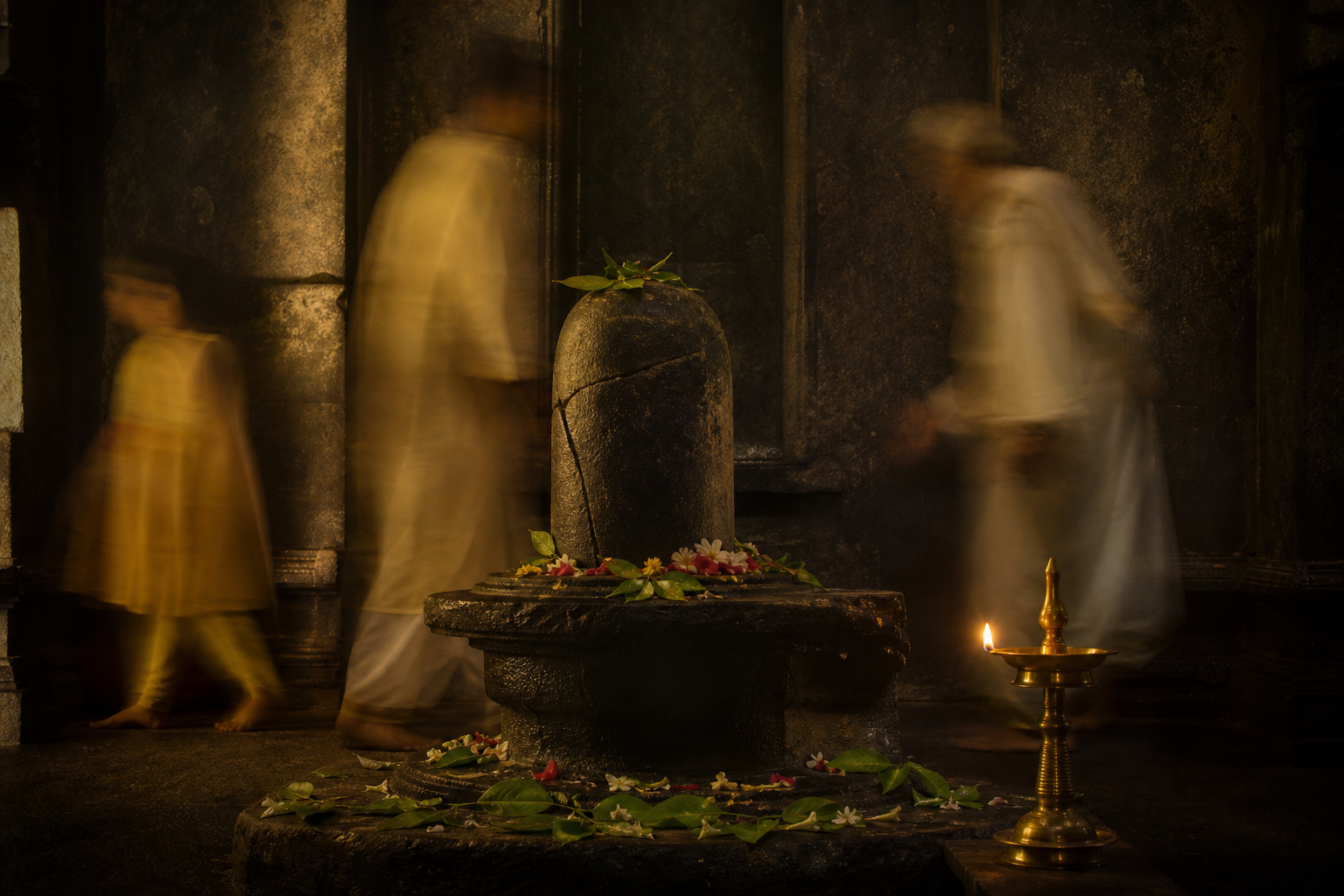
The choice between retaining and replacing a damaged sacred form is not merely a technical decision. Replacement may satisfy a formal rule while severing a community’s encounter with the form through which generations have known the deity. Retention without structural care, however, can allow avoidable deterioration. Kaleshwar Mahadev requires both ritual intelligence and material responsibility.
Good stewardship begins with documentation of the Shivling’s condition, gentle maintenance and safeguards agreed upon by priests and the local community. Protective measures should stabilise the form without casually altering it. Clear instructions for abhisheka and touch allow pilgrims to participate without placing additional strain on a vulnerable surface. When specialised conservation is necessary, it should serve the temple’s ritual life rather than treating the sacred object as an isolated museum specimen.
This balance also carries a wider civilisational lesson. The linga communicates divine presence without portraiture. Buddhist stupas, Jain reflection on formless realisation and Sikh remembrance of Ik Onkar each approach transcendence through their own distinct theology. They should not be collapsed into one doctrine, yet they share an intuition familiar across the dharmic world: ultimate reality is not exhausted by a visible form.
That does not make form disposable. A stupa, murti, linga or sacred text can be materially vulnerable while remaining the centre of a community’s disciplined attention. The proper response is neither idolatry of the material nor indifference to it. It is reverent care.
When you visit or speak about Kaleshwar Mahadev, begin with two questions: what rule protects the consecrated form, and what relationship has kept this particular form sacred? Follow the local maryada, make darshan gently and repeat only the history that the evidence can bear. That is how a devotee helps preserve both Hindu memory and the physical inheritance entrusted to the temple.